Key takeaways
- Table of Contents 7 sections 10 min read 1 Quick Verdict 2 Side by Side 3 Where Nonstick Cake Pan Wins 4 Where Silicone Baking Pan Wins 5 Cost Over 5 Years 6 Which One for Your Home 6.1 Small…
What's inside
Choosing between a nonstick cake pan and a silicone baking pan is less about which material is universally “better” and more about how you bake, store cookware, and clean up afterward. A nonstick metal pan is usually the more familiar choice: it has rigid sides, transfers heat quickly, and makes it easier to produce evenly browned cakes with defined edges. Silicone is flexible, lightweight, and naturally resistant to sticking, but it often needs support from a sheet pan and may produce softer, paler sides.
The real decision for your home is whether you value structure and browning or easy release and compact storage. Your oven size, cabinet space, baking frequency, cleanup habits, and the kinds of desserts you make all matter. The comparison below breaks down the practical differences so you can choose confidently in 2026.
As an Amazon Associate we earn from qualifying purchases at no extra cost to you. Product prices and availability are accurate as of the date shown and are subject to change.



Quick Verdict
Choose a nonstick cake pan if you want reliable browning, firm cake edges, and a pan that can go directly from the cabinet to the oven without additional support. It is the better all-purpose option for layer cakes, cheesecakes, quick breads, and recipes where shape matters.
Choose a silicone baking pan if effortless release, lightweight handling, and space-saving storage are your priorities. Silicone is especially convenient for brownies, muffins, delicate cakes, and occasional bakers who dislike scrubbing stuck-on batter.
For most households, a quality 8- or 9-inch nonstick metal cake pan is the safest first purchase. Silicone makes an excellent second pan or a better primary choice when storage is limited and easy release matters more than crisp edges.
Side by Side
| Category | Nonstick Cake Pan | Silicone Baking Pan |
|---|---|---|
| Comfort | Rigid sides are easy to grip and fill; heavier models feel stable. | Very light, but flexible walls can be awkward when full. |
| Durability | Carbon steel or aluminized steel can last for years with gentle care. | Resists rust, but can tear, crease, or degrade if overheated or cut. |
| Price range | About $8–$30 for a single home-use pan; larger sets may cost $20–$45. | About $8–$20 for a single pan; sets commonly range from $15–$40. |
| Maintenance | Usually hand-washing preserves the coating; parchment can reduce cleanup. | Often dishwasher safe, though grease may cling to the flexible surface. |
| Space needed | Requires a fixed shelf or drawer space; a 9-inch pan is commonly about 9–10 inches wide. | Can nest, fold, or lie flat, making it useful in small kitchens. |
| Heat response | Metal heats relatively quickly and supports browning and crisp edges. | Silicone insulates more, so baking may feel gentler and edges less browned. |
| Look | Usually understated gray, black, or metallic finishes with a traditional appearance. | Available in bright colors and modern shapes, but may look less substantial. |
| Resale | Recognizable brands and lightly used metal bakeware are generally easier to pass on. | Has less secondhand appeal unless the set is complete and visibly clean. |
| Best for | Layer cakes, pound cake, cornbread, roasting-style baking, and defined edges. | Brownies, molded desserts, delicate bakes, and kitchens with limited storage. |
Where Nonstick Cake Pan Wins
Better browning and structure: Metal conducts heat more efficiently than silicone. That helps cakes develop more color around the sides and bottom, while the rigid walls keep the batter in a consistent shape. If you like golden edges on brownies or a firm crust on a sponge cake, nonstick metal has the advantage.
Easier handling: A filled metal pan can usually be lifted with one hand using a standard oven mitt. The sides do not bow outward, and the pan is less likely to wobble as you move it from the counter to the oven. This matters when working with thin batters or recipes filled close to the rim.
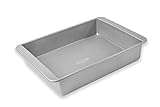
More precise results: A nonstick cake pan typically gives you predictable dimensions, such as an 8-inch or 9-inch round. That consistency is valuable when stacking layers, dividing a recipe, or matching a pan size listed in a recipe. The Farberware Nonstick Bakeware 9-Inch Round Cake Pan, Gray, represents the familiar format many home bakers already use.
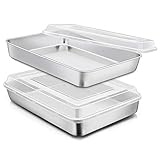
Useful options at modest prices: You do not need to spend a lot for a practical metal pan. The tutikuki 8-inch Round Cake Pan set includes three pans and parchment paper for $19.94, which can be useful if you bake multiple layers or want extra pans for batch preparation. Parchment is still worthwhile even with a nonstick coating because it reduces release risk and helps protect the surface.
There are limits. Nonstick coatings can scratch when exposed to metal utensils, abrasive scrubbers, or careless stacking. Many manufacturers recommend hand-washing and avoiding temperatures above the stated limit, often around 450°F, although the exact rating varies. Always check the pan’s instructions rather than assuming every coating has the same tolerance.
Where Silicone Baking Pan Wins
Effortless release: Flexible silicone can make it easy to peel a pan away from a cooled cake or brownie. This is particularly helpful for sticky recipes and molded desserts with corners or decorative details. A light coating of oil may still be useful for low-fat batters, but silicone generally reduces the need for heavy greasing.
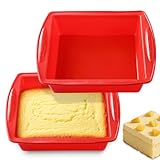
Easy storage: Silicone pans are a practical solution when every cabinet shelf is already full. They can nest inside one another or rest flat in a drawer. A square pan such as the KCKHFA Silicone Square Brownie Pan 2 Pack, priced at $9.99, provides two 8-by-8-inch baking surfaces without requiring the same rigid storage space as two metal pans.
Comfortable for occasional baking: Silicone is lightweight and will not rust. It is also quieter than metal when placed on a countertop and less likely to chip cabinet shelves. These qualities appeal to renters, students, and households that bake only a few times a month.
Flexible sets: A silicone set can cover several jobs with one purchase. The To Encounter Silicone Baking Pans Set includes four pieces and is listed at $35.99; its metal-reinforced frames and grips address one of silicone’s biggest weaknesses: instability while carrying a full pan. A reinforced frame is a useful feature, not just a cosmetic detail.
Silicone still benefits from support. Place a flexible pan on a sturdy baking sheet before filling it, especially for liquid batter. The extra sheet makes the pan easier to carry and keeps the base level. Silicone can also hold onto oily residue, so a thorough wash may be necessary even when the pan is technically dishwasher safe.
Cost Over 5 Years
Initial price is only part of the calculation. A basic nonstick cake pan may cost $8–$15, while a better-finished or heavier pan may run $15–$30. If it lasts five years, that works out to roughly $1.60–$6 per year. Add parchment at perhaps $4–$8 per year for regular use, and the practical annual cost may be about $6–$14, depending on how often you line the pan.
A silicone pan may cost $8–$20 individually or approximately $15–$40 in a set. Over five years, that is about $1.60–$8 per year before considering replacements. Silicone does not require parchment for every bake, which can lower ongoing supply costs. However, replacement becomes more likely if the pan is cut, exposed to excessive heat, stored against sharp objects, or repeatedly folded in the same place.
For frequent bakers, metal often provides the better long-term value because it handles repeated use and produces more consistent results. For occasional bakers, silicone can be the economical choice because one flexible pan may replace several specialty shapes and takes up very little space.
Which One for Your Home
Small apartment
Choose silicone if cabinet space is your biggest constraint. An 8-inch square pan or a compact set can nest with other cookware, and its low weight is convenient in a small kitchen. Keep a rimmed metal sheet pan available for support. If you bake layer cakes often, reserve space for one 8- or 9-inch metal round pan instead.
Family with kids or pets
Nonstick metal is usually easier to carry securely because it stays rigid when full. A 9-inch pan also handles familiar family desserts and can move from the oven to a cooling rack without flexing. Store it out of reach, since scratched coatings are not worth keeping. Silicone is still useful for easy-release brownies, but transport it on a sheet pan.
Rental
Silicone is a strong choice for renters who want inexpensive, lightweight cookware that is less likely to rust or damage surfaces. A $9.99 two-pack can provide useful capacity without a major commitment. If you are unsure about storage or expect to move soon, nesting silicone pieces can be easier to pack than several rigid pans.
Long-term home
Build a basic metal collection first: one 9-inch round pan, one 8-inch square pan, and a rimmed sheet pan. Add silicone for specific needs such as sticky brownies, delicate cakes, or space-saving overflow capacity. This combination gives you strong browning and structure when you want it, plus easy release when it saves time.
FAQ
Do silicone cake pans bake faster than nonstick metal pans?
Usually not. Silicone is a poorer heat conductor than metal, so it may produce slower browning and softer edges. Follow the recipe’s temperature and timing first, then check for doneness with a toothpick or the recipe’s visual cues. Do not automatically raise the oven temperature to compensate.
Do I need to grease a silicone baking pan?
Often, a light coating is enough, but it depends on the recipe and the pan’s shape. Low-fat cakes and detailed molds may release more easily with a small amount of oil or baking spray. Avoid using a knife to loosen the edges, since sharp tools can damage silicone.
Can a nonstick cake pan go in the dishwasher?
Some can, but hand-washing is usually gentler and may help preserve the coating. Use warm water, mild dish soap, and a soft sponge. Check the manufacturer’s care instructions, particularly if the pan has a reinforced rim, textured coating, or removable parts.
Which pan is better for beginners?
A nonstick metal pan is the better all-purpose starting point for most beginners because it is stable, predictable, and compatible with a wide range of recipes. Choose silicone first if your top priorities are compact storage and easy release, and pair it with a sturdy sheet pan for support.