Key takeaways
- Most likely to crack: ceramic and stoneware, especially after cold-water rinsing while hot or when knocked against a sink.
- Most likely to develop surface changes: unglazed stoneware and seasoned cast iron. Darkening and minor staining are usually cosmetic.
- Most likely to rust: bare cast iron if it is stored damp or left with flour paste in the corners.
- Most likely to retain odors: silicone, particularly after baking strongly flavored foods or using fragranced dish soap.
- Most common consumable: parchment paper or reusable bread slings. They reduce sticking and make loading safer, although parchment may darken during high-temperature baking.
The best bread cloches for most home bakers are a lidded ceramic or stoneware baker for easy handling, a cast-iron combo cooker for maximum heat retention, and a silicone cloche for small kitchens that prioritize light weight and simple storage.
Quick picks by baking situation
| Situation | Best choice | Why it fits | Main compromise |
|---|---|---|---|
| First covered bread baker | Ceramic cloche | Even heating, forgiving handling, attractive enough to leave on the counter | Heavier and more breakable than silicone |
| Maximum oven spring and frequent baking | Cast-iron combo cooker | Excellent heat retention and a deep base that supports tall dough | Usually 10–15 lb and requires drying and seasoning care |
| Limited cabinet space | Silicone cloche | Light, flexible, and often foldable or nestable | Does not store or radiate heat like a thick ceramic or iron baker |
| Decorative countertop-to-oven use | Stoneware cloche | Good presentation and steady, moderate heat retention | Can be bulky, and thermal-shock rules matter |
| Large country loaf | Large ceramic baker or cast iron | Interior length of about 12–14 in gives dough room to expand | Needs a wide oven rack and more storage space |
What a bread cloche actually changes
A cloche covers wet dough during the first part of baking. Steam released by the dough stays around the loaf instead of escaping immediately. That delays crust setting, allowing the dough to expand, while the moist surface supports a thin, glossy crust. After the lid is removed, dry oven heat finishes browning and crisping the exterior.

Flavehc Bread Oven Cast Iron Bread Dutch Oven with Cloche Lid for Bread Baking Darkcyan Enameled Cast Iron Bread Oven with Dome Lid for Sourdough, 9.8 Inches
Included for 'Best Bread Cloches for Crisp Crust and High-Rise Loaves' because the listing specifies 9.8 Inches, details this guide uses to compare options.
View on Amazon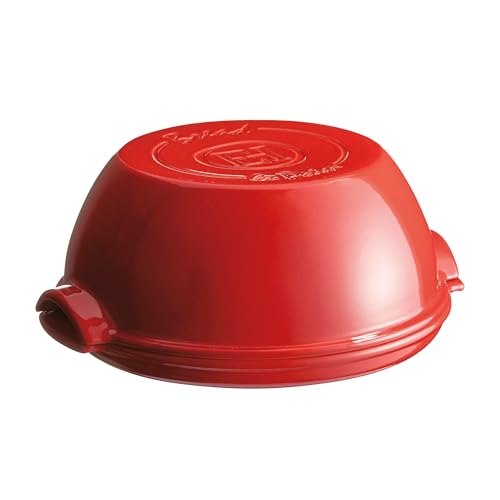
Emile Henry Modern Bread Cloche | Burgundy
Included for 'Best Bread Cloches for Crisp Crust and High-Rise Loaves' because the listing specifies Burgundy, details this guide uses to compare options.
View on Amazon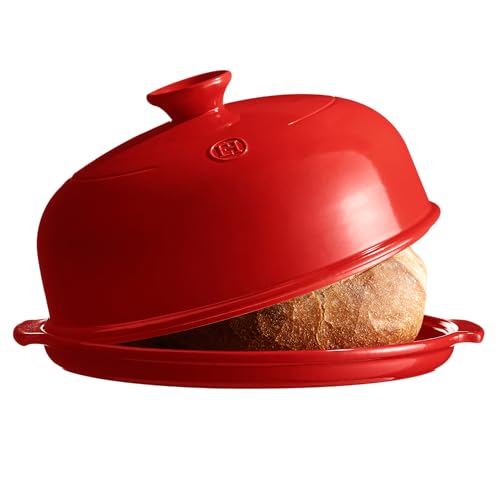
Emile Henry Ceramic Bread Cloche 13.2" x 11.2" x 7", Burgundy
Included for 'Best Bread Cloches for Crisp Crust and High-Rise Loaves' because the listing specifies Burgundy, details this guide uses to compare options.
View on Amazon
HAWOK Baking Pre-Seasoned Cast Iron Bread cloche Pan Bake sourdough bread dome cover, grill steaks Dia.7.9-inch 0.65-Quart best for gift……
Included for 'Best Bread Cloches for Crisp Crust and High-Rise Loaves' because the listing specifies grill steaks Dia.7.9-inch 0.65-Quart best for gift……, details this guide uses to compare options.
View on AmazonThe lid is only part of the result. A preheated base supplies the initial burst of heat, and the interior dimensions determine whether the dough can rise without pressing into the lid. A very hot, narrow baker may outperform a larger but poorly preheated one, while an oversized cloche can produce a flatter, paler loaf because the steam is less concentrated.
Material comparison: ceramic, cast iron, stoneware, and silicone
Ceramic
Ceramic cloches are the balanced choice. They heat more gradually than iron, which makes them less intimidating for beginners, but a properly preheated ceramic base still delivers useful oven spring. Many have smooth glazed interiors that release baked bread easily and wipe clean without seasoning.
Typical interior dimensions are about 10–12 inches long, 8–10 inches wide, and 4–5 inches high. A medium ceramic baker usually weighs roughly 6–10 lb. That is manageable to lift with oven mitts, but it is still substantial enough to occupy a full shelf.
The vulnerability is thermal shock. Do not move a cold ceramic cloche directly into a very hot oven unless its instructions specifically allow that method, and do not place a hot base on a wet or cold surface. Hairline cracks often begin with temperature changes rather than ordinary baking.
Cast iron
Cast iron wins the head-to-head heat-retention contest. It absorbs a large amount of heat during preheating and releases it steadily when cool dough is added. A deep cast-iron skillet paired with an inverted skillet or a purpose-built combo cooker is especially useful for high-hydration dough and tall boules.
Expect a typical 10–12-inch cast-iron setup to weigh about 8–15 lb, depending on the lid and wall thickness. The interior height is often around 4–5 inches, with larger models offering more clearance. That depth is valuable because a loaf that rises dramatically can otherwise touch the lid and weld itself to the surface.
Cast iron is durable but not maintenance-free. Dry it immediately after washing, wipe it with a very thin layer of cooking oil when needed, and avoid leaving acidic dough residue in it for long periods. Enameled cast iron eliminates seasoning work, but chips, greater weight, and thermal-shock precautions remain concerns.
Stoneware
Stoneware sits between ceramic and cast iron in everyday behavior. Its porous body can absorb and release heat steadily, while the thick walls help stabilize oven temperature around the loaf. Some stoneware bread bakers are unglazed inside; others have a glazed cooking surface.
Unglazed stoneware can develop darker areas and absorb oils over time. That is normal, but it also means you should avoid harsh detergents that may linger in the pores. Glazed stoneware is easier to clean but can be more slippery when turning out a loaf. Either type needs careful handling around sudden temperature changes.
Stoneware cloches commonly weigh 5–9 lb and have interior lengths of roughly 10–13 inches. They suit bakers who want a traditional-looking vessel and do not mind allowing it to cool fully before washing and storing.
Silicone
Silicone cloches are the space-saving option, but they work differently. Silicone itself is a poor heat conductor compared with iron, ceramic, or stoneware, so it does not provide the same strongly heated baking chamber. Its main advantage is retaining steam around dough without adding much weight.
A silicone cover generally weighs less than 2 lb and can fit in a drawer or inside a mixing bowl. Heat ratings commonly fall around 450–500°F, but the exact limit depends on the product. Silicone should sit on a rigid baking sheet or preheated tray if the base is flexible; otherwise, transferring wet dough can distort the loaf.
Expect a softer, sometimes less dramatically browned bottom crust than with a heavy preheated base. For small kitchens or occasional bakers, that trade-off may be worthwhile. For a thick, crackling bâtard every weekend, ceramic or cast iron is usually the better investment.
Specifications that matter more than the material label
| Specification | Useful target for one loaf | Why it matters |
|---|---|---|
| Interior length | 10–12 in for a boule; 12–14 in for a bâtard | Prevents side contact and gives the loaf room to expand |
| Interior width | 8–10 in | Supports a round loaf without excessive spreading |
| Interior height | 4–5 in minimum | Allows oven spring beneath the lid |
| Base weight | 4–8 lb for ceramic or stoneware | Balances heat storage with practical lifting |
| Covered capacity | At least 2.5–3 qt for a 750–1,000 g dough | Reduces the chance of dough touching the lid |
| Oven clearance | At least 2 in above the lid | Makes loading safer and promotes even circulation |
Measure the usable interior, not the outside dimensions. Decorative handles, thick walls, and sloped sides can remove more baking room than expected. As a practical sizing calculation, a 900 g dough may expand to a loaf about 10–11 inches across and 5–6 inches high, depending on hydration and shaping. A cloche with only 4 inches of interior height is therefore better suited to a compact boule than a tall, loosely shaped loaf.
Cleaning, durability, and storage realities
- Most likely to crack: ceramic and stoneware, especially after cold-water rinsing while hot or when knocked against a sink.
- Most likely to develop surface changes: unglazed stoneware and seasoned cast iron. Darkening and minor staining are usually cosmetic.
- Most likely to rust: bare cast iron if it is stored damp or left with flour paste in the corners.
- Most likely to retain odors: silicone, particularly after baking strongly flavored foods or using fragranced dish soap.
- Most common consumable: parchment paper or reusable bread slings. They reduce sticking and make loading safer, although parchment may darken during high-temperature baking.
For any material, let the baker cool before cleaning. Brush out loose flour first, then use warm water and a nonabrasive sponge. Avoid soaking cast iron and avoid metal tools on glazed ceramic or stoneware. Never use a cloche with a visible structural crack; steam and heat can worsen it during the next bake.
Storage is part of the purchase decision. A cast-iron combo cooker can double as a skillet, but its weight makes high shelves unsuitable. A ceramic cloche should have padding or a dedicated shelf so the lid cannot slide into the base. Stoneware often needs a similar footprint. Silicone is easiest to store, though repeated sharp folding can eventually leave permanent creases or damage thinner sections.
How to use a cloche for a crisp crust
- Check the dough size against the interior. Leave space for expansion on every side, especially above the highest point.
- Preheat according to the manufacturer’s instructions. Heavy ceramic, stoneware, and cast iron commonly need 30–45 minutes, while some ceramic vessels are designed for a cold-oven start.
- Load with a sling or parchment. This limits handling time and reduces the chance of deflating the dough.
- Bake covered for roughly 20–30 minutes. The exact time depends on loaf size and temperature; the goal is expansion before significant browning.
- Remove the lid and finish uncovered. Continue until the crust reaches the color you want. If the bottom is becoming too dark, move the baker to a higher rack or place it on a second sheet.
- Cool fully on a rack. Cutting too soon releases interior steam and can make a properly baked loaf seem gummy.
Bottom line
Choose a ceramic cloche if you want the best all-purpose balance of heat, cleaning, and appearance. Choose cast iron if oven spring, durability, and frequent baking matter more than weight and maintenance. Choose stoneware for steady, traditional baking with a decorative finish, and choose silicone when storage and low lifting weight are the deciding factors. The best bread cloches are not necessarily the thickest or most expensive; they are the ones whose interior shape matches your loaf, whose weight you can handle safely, and whose care requirements you will actually follow.