Key takeaways
- Table of Contents 7 sections 10 min read 1 Quick Verdict 2 Side by Side 3 Where Heavy Metal Roasting Pan Wins 4 Where Glass Baking Dish Wins 5 Cost Over 5 Years 6 Which One for Your Home 6.1…
What's inside
Choosing between a heavy metal roasting pan and a glass baking dish is less about which material is universally better and more about how you cook, store food, and use your kitchen. A large metal roaster is built for high-volume meals: turkey, prime rib, vegetables for a crowd, and recipes that benefit from a rack and strong heat circulation. A glass dish is more versatile for everyday cooking, especially casseroles, baked pasta, brownies, leftovers, and refrigerator-to-oven meal prep.
The real decision is whether you want one durable, specialized pan or several compact pieces that can move from baking to serving to food storage. In 2026, both categories are affordable, but they solve different problems. Metal wins on capacity and roasting performance; glass wins on visibility, storage, and daily convenience.
As an Amazon Associate we earn from qualifying purchases at no extra cost to you. Product prices and availability are accurate as of the date shown and are subject to change.



Quick Verdict
Choose a heavy metal roasting pan if you regularly cook large cuts of meat, host holiday meals, or want a rigid pan with a rack. Stainless steel models are especially useful when you need a pan that can handle stovetop gravy-making, depending on the manufacturer’s compatibility instructions.
Choose a glass baking dish if you mostly cook casseroles, baked desserts, lasagna, enchiladas, roasted vegetables, and smaller family meals. Glass also makes sense when matching lids allow you to refrigerate or transport leftovers without transferring them to another container.
For many homes, the best answer is not either-or. A practical kitchen may use an 8-by-8-inch or 9-by-13-inch glass dish for weekly meals and add a 16-inch metal roasting pan only when large-batch cooking justifies it.
Side by Side
| Factor | Heavy Metal Roasting Pan | Glass Baking Dish |
|---|---|---|
| Comfort | Strong handles and rigid walls, but a full pan can be heavy and awkward | Easy to monitor through the sides; filled dishes can still be heavy |
| Durability | Resists chips and can last for many years; may dent or discolor | Does not rust, but can chip, crack, or break from thermal shock |
| Price range | About $40-$100 for a large stainless steel pan with a rack | About $20-$45 for a set or individual everyday dishes |
| Maintenance | Usually dishwasher-safe; baked-on drippings may require soaking | Usually dishwasher-safe; clear surfaces show residue and grease |
| Space needed | A 16-inch pan needs substantial cabinet or oven storage | Stacks efficiently, especially with lids; common sizes fit regular cabinets |
| Look | Professional stainless steel appearance, often suitable for serving | Clear, casual, and easy to coordinate with storage containers |
| Resale | Recognizable stainless steel brands can retain usefulness and value | Generally low resale value, particularly for individual used pieces |
| Best for | Turkey, roast beef, whole chickens, large vegetables, and pan sauces | Casseroles, desserts, baked pasta, smaller roasts, and leftovers |
| Heat response | Typically heats and cools more quickly than thick glass | Heats more gradually and retains heat well after removal |
Where Heavy Metal Roasting Pan Wins
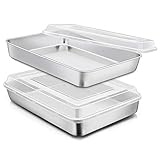
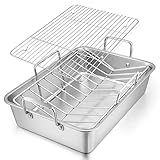
A heavy metal roasting pan is the better tool when volume, structure, and versatility under high heat matter. A 16-inch model can accommodate a large turkey or roast with room for vegetables around it. The included rack lifts meat above the drippings, encouraging air circulation and making it easier to collect juices for gravy. A V-shaped rack can hold a whole turkey or elongated roast securely, while a flat rack is useful for poultry, vegetables, or smaller cuts.
Metal also handles aggressive kitchen work well. You can usually scrape browned bits from a stainless steel surface with a suitable utensil, and many stainless steel pans are safe for dishwasher cleaning. Some are induction-compatible, which lets you move the roasting pan to a compatible cooktop for reducing drippings. Always check the manufacturer’s instructions before using a roasting pan on a burner, since construction, base design, and handle materials vary.
Capacity is the biggest advantage. A deep pan measuring approximately 16 by 11.5 inches is large enough for holiday cooking without requiring several smaller baking dishes. It can also be useful for batch-roasting potatoes, carrots, and other vegetables when a sheet pan is too shallow.
Current prices show the range clearly. The Cuisinart 16-Inch Roasting Pan with rack is listed at $79.95, while the E-far 16-by-11.5-inch stainless steel roaster with V-shaped and flat racks is listed at $43.69. Those prices are higher than a basic glass dish, but the rack, deeper walls, and larger capacity explain much of the difference.
The drawbacks are weight and storage. A large pan filled with liquid and a 15-pound turkey can be difficult to lift safely, especially from a low oven. Metal can also develop stains, rainbow discoloration, or stuck-on grease. These are usually cosmetic or cleaning concerns rather than reasons to discard a sound pan.
Where Glass Baking Dish Wins
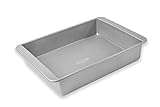
Glass is more useful for the meals many households make every week. A 9-by-13-inch dish is well suited to lasagna, enchiladas, baked macaroni and cheese, cobblers, brownies, and casseroles. Smaller 8-by-8-inch or 9-by-9-inch dishes work for side dishes and two- to four-person portions.
The transparent sides are genuinely convenient. You can check browning, bubbling, and layering without lifting a lid or opening the oven repeatedly. Glass also presents food attractively at the table, then can move to the refrigerator after cooling. When a set includes BPA-free lids, leftovers may require no extra storage container.
That storage advantage is reflected in products such as the Amazon Basics six-piece borosilicate glass baking dish set with lids, listed at $24.29, and the M MCIRCO eight-piece deep glass baking dish set with lids, listed at $35.99. A set can provide multiple sizes for less than the cost of a premium roasting pan, although lids generally are for storage and transport rather than oven use.
Glass is not automatically safer for every recipe. Sudden temperature changes can cause thermal shock, so do not move a hot glass dish directly onto a cold, wet, or stone surface, and do not pour cold liquid into a very hot dish. Follow the product’s temperature limits. Borosilicate glass may be rated for very high oven temperatures, but the complete set, including lids, handles, and any decoration, may have different restrictions.
Glass also tends to be less convenient for pan sauces. It is not a stovetop pan, and its thicker walls can respond more slowly to temperature changes. It is a strong baking and storage material, but not a substitute for a roasting pan with a rack when you are preparing a large roast.
Cost Over 5 Years
Purchase price alone favors glass, but five-year value depends on use. Suppose a household buys a $25-$36 glass set and uses it twice per week. At roughly 104 uses per year, that is more than 500 uses in five years, before accounting for any breakage. Even replacing one broken dish, the cost can remain under about 15 cents per use.
A $44-$80 metal roasting pan used four times per year for holidays and large gatherings would see approximately 20 uses over five years. That works out to about $2.20-$4 per use before considering its service life. However, if the pan replaces disposable foil roasters, rented cookware, or several smaller dishes during each event, its practical value improves. A well-maintained stainless steel roaster can remain useful beyond five years, lowering the long-term cost further.
The most economical choice is therefore based on frequency. Glass delivers better value for frequent everyday baking. Metal delivers better value for cooks who host, roast large foods, or need one substantial pan that performs a job smaller dishes cannot handle.
Which One for Your Home
Small apartment
Start with glass. Cabinets and ovens in small apartments often cannot spare room for a large 16-inch roaster, and everyday meals are more likely to be sized for one to four people. A stackable glass set with lids provides baking, serving, and storage in a compact footprint. Add a metal roasting pan later if you host Thanksgiving or regularly buy whole poultry.
Family with kids or pets
Glass is convenient for batch cooking and leftovers, but it requires careful handling. Keep hot dishes away from children and pets, and let them cool on a stable, dry surface. A metal roasting pan may be the more forgiving choice for large holiday meals because it is less likely to shatter if bumped, though its heavy contents still create a lifting hazard. Families that cook both weeknight casseroles and large roasts will benefit from owning one of each.
Rental
Choose glass if your rental has limited storage or a smaller oven. A $24-$36 lidded set can cover many recipes without a major investment. If you need metal, prioritize dishwasher-safe construction, sturdy handles, and dimensions that fit your oven; measure the rack width before buying a 16-inch pan.
Long-term home
A long-term homeowner who entertains should invest in the metal roaster first, particularly if the kitchen has deep drawers or a pantry for oversized cookware. For regular family cooking, add a 9-by-13-inch glass dish and one smaller square dish. This combination covers holiday roasting, casseroles, desserts, meal prep, and leftover storage without forcing one material to do every job.
FAQ
Can I use a glass baking dish for roasting meat?
Yes, for appropriately sized cuts and within the dish’s temperature instructions. Glass works well for chicken pieces, meatloaf, smaller roasts, and baked recipes. It does not provide the same capacity, rack support, or stovetop flexibility as a large metal roasting pan.
Does a metal roasting pan make food cook faster?
Not necessarily in every recipe. Metal generally responds to oven heat more quickly, while glass may retain heat longer after removal. Cooking time depends on the food, pan depth, oven temperature, and whether the recipe was written for metal or glass. Use visual and internal-temperature cues rather than changing time automatically.
Can glass go from the refrigerator to a hot oven?
Only if the manufacturer specifically allows that use. Even heat-resistant glass can crack from sudden temperature changes. Let refrigerated food and the dish warm gradually when required, avoid placing hot glass on cold or wet surfaces, and follow the product’s care instructions.
What size roasting pan should I buy?
For general holiday use, a pan around 16 inches long and 11 to 12 inches wide is a practical large size, provided it fits your oven. Look for enough depth to contain juices without crowding the food, strong handles, and a rack that matches the meals you cook. Measure your oven interior and storage space before purchasing.