Key takeaways
- Buying by quarts alone: Capacity does not tell you the interior diameter or lid height. Always check both.
- Choosing a pot that is too small: If the dough touches the sides before baking, the loaf may develop an uneven shape and stick to the pot.
- Going excessively large: A 7- or 8-quart pot will bake a small boule, but the extra empty space can make handling awkward and may reduce how efficiently steam surrounds the dough.
- Ignoring the lid: A flat lid can work, but a domed lid provides more vertical clearance for oven spring. The lid must also seal reasonably well.
- Forgetting preheating weight: A very heavy pot is harder to lower dough into safely. Use heat-resistant gloves and a sling if lifting a wet, fragile boule feels difficult.
- Using the wrong shape: Oval Dutch ovens suit bâtards, while round Dutch ovens are generally better for boules. A wide oval pot may leave excess space around a round loaf.
What's inside
The Short Answer
For most sourdough bread boules, a 5- to 6-quart round Dutch oven is the best choice. A 5-quart pot works especially well for boules made with about 500 grams of flour, while a 6-quart Dutch oven gives larger loaves more room to expand and is easier to use with parchment, a sling, or a proofing basket.
Choose a Dutch oven with an interior diameter of approximately 9 to 10 inches (23 to 25.5 cm) and at least 4.5 inches (11.5 cm) of interior height. The pot should be large enough for the dough to rise without touching the sides or lid, but not so oversized that steam escapes around a small loaf. A close-fitting lid is more important than a large capacity because trapped steam helps sourdough develop a thin, crisp crust.
As an Amazon Associate we earn from qualifying purchases at no extra cost to you. Product prices and availability are accurate as of the date shown and are subject to change.



For a standard boule, look for a round, heavy-lidded Dutch oven rated for temperatures of at least 450°F (232°C), with many cast-iron models suitable for 500°F (260°C) or higher. In 2026, common bread-baking options range from about $30 to $50, depending on whether the pot is bare cast iron, enameled, or sold with accessories such as a sling and proofing basket.
Standard Sizes
The listed capacity is only part of the sizing picture. Two 5-quart pots can have noticeably different interior widths and heights, so check the manufacturer’s interior measurements whenever possible. The measurements below are typical usable dimensions for round Dutch ovens, not guaranteed specifications for every model.
| Dutch oven size | Typical interior diameter | Typical interior height | Best boule size | Approximate weight |
|---|---|---|---|---|
| 3 to 3.5 quarts | 8 to 8.5 in (20 to 21.5 cm) | 3.5 to 4 in (9 to 10 cm) | Small boules using 300 to 400 g flour | 8 to 12 lb (3.6 to 5.4 kg) |
| 4 to 4.5 quarts | 8.5 to 9 in (21.5 to 23 cm) | 4 to 4.5 in (10 to 11.5 cm) | Small to medium boules using 400 to 500 g flour | 10 to 15 lb (4.5 to 6.8 kg) |
| 5 quarts | 9 to 9.5 in (23 to 24 cm) | 4.5 to 5 in (11.5 to 12.7 cm) | Most standard boules using 450 to 600 g flour | 12 to 18 lb (5.4 to 8.2 kg) |
| 6 quarts | 9.5 to 10.5 in (24 to 26.5 cm) | 4.5 to 5.5 in (11.5 to 14 cm) | Large boules using 600 to 800 g flour | 14 to 22 lb (6.4 to 10 kg) |
| 7 to 8 quarts | 10.5 to 12 in (26.5 to 30.5 cm) | 5 to 6 in (12.7 to 15.2 cm) | Very large boules or two smaller loaves | 16 to 28 lb (7.3 to 12.7 kg) |
A 5-quart Dutch oven is the safest all-purpose recommendation. It accommodates the dough, a sheet of parchment, and modest sideways expansion without feeling excessively heavy. A 6-quart model is preferable if your dough weighs more than 1,000 grams after mixing, your boule has a wide footprint, or you want extra room to lower the dough without touching the hot sides.
Capacity does not directly equal loaf capacity. A tall 5-quart pot may hold the same volume as a wide 5-quart pot, but the wide version generally gives a boule better lateral room. For a classic round loaf, prioritize a round base at least 9 inches (23 cm) across rather than choosing solely by the quart number.
How to Measure Your Space
- Measure the shaped dough. After proofing, gently measure the boule’s approximate width. A 500-gram-flour recipe commonly produces dough about 7 to 8 inches (18 to 20 cm) wide, though hydration and shaping affect the result.
- Add expansion room. Choose an interior diameter at least 1 to 2 inches (2.5 to 5 cm) wider than the unbaked boule. This leaves room for oven spring and prevents the dough from baking against the sidewall.
- Check interior height. Measure from the pot’s base to the lowest point of the lid. Allow at least 1.5 inches (4 cm) above the dough for upward expansion. A domed lid provides additional headroom.
- Include your lifting method. Parchment usually adds little space, but a silicone sling may raise the dough slightly. If you use a proofing basket, measure the basket’s outer diameter and confirm it can sit inside the pot without catching on the rim.
- Measure the oven opening. Check the oven rack width, depth, and height between the rack and the heating element. A 6-quart cast-iron pot can measure roughly 12 to 14 inches (30.5 to 35.5 cm) across including handles and weigh more than 18 pounds (8.2 kg) with the lid.
- Account for handles and lid clearance. Side handles can make a compact oven feel crowded. Confirm that the lid can be lifted safely without hitting the oven roof, especially when using a tall pot or a domed lid.
By Room or Use Case
For a standard home oven
A 5-quart round Dutch oven is the most balanced option for everyday sourdough. It fits many standard oven racks, works with common 9-inch proofing baskets, and is manageable when preheated. Look for a base around 9 to 9.5 inches (23 to 24 cm) wide and a total exterior width under approximately 13 inches (33 cm), including handles.
For small kitchens or apartment ovens
Choose a 4- to 5-quart pot with compact handles and a low-profile lid. A 4-quart Dutch oven can handle a boule made with approximately 400 to 500 grams of flour while reducing storage demands. Confirm the pot’s weight before buying: a bare cast-iron model may weigh 10 to 15 pounds (4.5 to 6.8 kg), while an enameled pot can be similarly heavy.
For large boules
Use a 6-quart Dutch oven for dough made with 600 to 800 grams of flour or for boules that spread beyond 8 inches (20 cm) during proofing. Its wider cooking surface helps prevent a large loaf from pressing against the side. The tradeoff is extra weight, longer preheating, and more storage space.
For beginners buying a bread-baking set
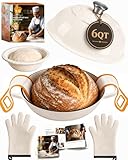
A 5-quart cast-iron bread pot with a domed lid is a practical starting point. Some low-cost models include a lame, parchment accessories, or a proofing basket. The example products in this category range from about $30 to $48: a basic 5-quart pot may cost around $29.99, while a 5- or 6-quart set with a basket, sling, and gloves may cost approximately $42.99 to $47.99.
For easy cleanup
An enameled cast-iron Dutch oven is convenient if you bake frequently and want a nonreactive interior that does not require seasoning. A 6-quart enameled pot is often a good compromise for bread because it provides ample room and can also be used for soups, braises, and roasting. Avoid assuming that a cream or colored finish makes the pot lighter; enameled cast iron is still dense and may weigh 12 to 20 pounds (5.4 to 9.1 kg).
Common Sizing Mistakes
- Buying by quarts alone: Capacity does not tell you the interior diameter or lid height. Always check both.
- Choosing a pot that is too small: If the dough touches the sides before baking, the loaf may develop an uneven shape and stick to the pot.
- Going excessively large: A 7- or 8-quart pot will bake a small boule, but the extra empty space can make handling awkward and may reduce how efficiently steam surrounds the dough.
- Ignoring the lid: A flat lid can work, but a domed lid provides more vertical clearance for oven spring. The lid must also seal reasonably well.
- Forgetting preheating weight: A very heavy pot is harder to lower dough into safely. Use heat-resistant gloves and a sling if lifting a wet, fragile boule feels difficult.
- Using the wrong shape: Oval Dutch ovens suit bâtards, while round Dutch ovens are generally better for boules. A wide oval pot may leave excess space around a round loaf.
FAQ
Is a 5-quart Dutch oven big enough for sourdough?
Yes. A 5-quart Dutch oven is large enough for most home-baked sourdough boules made with 450 to 600 grams of flour. Choose one with an interior diameter of roughly 9 to 9.5 inches (23 to 24 cm) and at least 4.5 inches (11.5 cm) of height.
Is a 6-quart Dutch oven too big for one loaf?
No. A 6-quart pot is suitable for one large boule or a standard loaf when you want extra room for oven spring and easier handling. It may be unnecessarily large for a small 300-gram-flour loaf, but it remains versatile for other cooking tasks.
Can I bake sourdough in a 3-quart Dutch oven?
Yes, but limit it to small boules made with approximately 300 to 400 grams of flour. Check the interior width carefully; some 3-quart pots are too narrow for a round proofing basket or a boule wider than 7 inches (18 cm).
Does a Dutch oven need to be cast iron for sourdough?
No. Cast iron retains heat exceptionally well, but a heavy stainless-steel, ceramic, or enameled pot may also work if it has an oven-safe lid and is rated for at least 450°F (232°C). For the most reliable all-purpose choice, select a 5- or 6-quart round Dutch oven with a tight-fitting lid.