Key takeaways
- Shopping by outside length only: A 21-inch pan may have a much smaller interior after accounting for thick walls and handles.
- Ignoring turkey shape: A broad, 20-pound turkey can need more width than a taller, narrower bird of the same weight.
- Forgetting the rack: A rack can reduce usable interior height and raise the turkey several inches.
- Buying a pan that is too deep: Extra depth does not automatically mean better roasting. It can make the turkey harder to lift and limit browning.
- Overloading with vegetables: Food packed tightly around the bird can block airflow and make drippings harder to monitor.
- Trusting capacity labels blindly: A “25-pound” label is helpful, but it does not guarantee that every 25-pound turkey will fit comfortably.
- Underestimating total weight: Include the pan, turkey, rack, liquid, and vegetables when judging whether the handles and your oven rack can support the load.
What's inside
Choosing the right pan is the difference between a turkey that roasts evenly and a holiday meal that turns into an oven-cleaning project. If you are asking what size roasting pan for twenty pound turkey, the safest answer is a heavy-duty pan measuring about 16 to 18 inches long, 12 to 14 inches wide, and at least 3 inches deep. Look for a pan rated for at least 25 pounds so the bird, rack, vegetables, and drippings have room without touching the oven walls.
The Short Answer
For a 20-pound turkey, choose a roasting pan with an interior cooking area of approximately 16 by 12 inches or larger. An exterior size around 18 by 13 inches is common once handles and rims are included. A rectangular pan is generally more space-efficient than an oval roaster, especially in a standard 30-inch range.
As an Amazon Associate we earn from qualifying purchases at no extra cost to you. Product prices and availability are accurate as of the date shown and are subject to change.


A pan should be deep enough to catch juices but not so deep that hot air cannot circulate around the turkey. A depth of 3 to 4 inches works well for most whole birds. Add a low roasting rack when possible; it lifts the turkey above the drippings and helps heat move underneath it.
For a 20-pound bird, avoid pans marketed only for 12- to 16-pound turkeys. Their listed capacity may not account for the turkey’s actual footprint, the rack, or the clearance needed to remove the pan safely. A 25-pound-rated pan offers useful extra space without becoming unnecessarily oversized.
Standard Sizes
The measurements below are practical buying ranges rather than universal industry standards. Always compare the pan’s interior dimensions with your turkey and oven cavity. Exterior measurements can be several inches larger because of handles, rolled rims, lids, and sidewalls.
| Pan size category | Approximate interior dimensions | Approximate exterior dimensions | Typical capacity | Best use |
|---|---|---|---|---|
| Medium | 14 x 10 x 3 in (35.6 x 25.4 x 7.6 cm) |
16 x 11.5 x 3.5 in (40.6 x 29.2 x 8.9 cm) |
12–16 lb | Chicken, small turkey, roasts |
| Large | 16 x 12 x 3.5 in (40.6 x 30.5 x 8.9 cm) |
18 x 13 x 4 in (45.7 x 33.0 x 10.2 cm) |
18–25 lb | Most 20-lb turkeys |
| Extra large | 18 x 13 x 4 in (45.7 x 33.0 x 10.2 cm) |
21 x 15 x 5 in (53.3 x 38.1 x 12.7 cm) |
25–30 lb | Large birds, vegetables, catering |
| Oval roaster | 17–18 x 12–13 x 4 in (43.2–45.7 x 30.5–33.0 x 10.2 cm) |
19–21 x 14–15 x 5 in (48.3–53.3 x 35.6–38.1 x 12.7 cm) |
18–25 lb | Covered roasting and compact storage |
The large category is the best starting point for a 20-pound turkey. A 17.3-inch nonstick pan with a rack and a 25-pound rating, for example, may fit well if its interior width is sufficient. Some 21-inch models offer a 25-pound capacity and extra room for vegetables, but their handles and lid can make them too large for a compact oven.
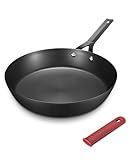
Material also affects handling. Carbon steel and stainless steel pans are durable but can be heavy. A large steel pan may weigh roughly 5 to 10 pounds before food is added; a turkey, stuffing, and liquid can bring the total load well above 25 pounds. Choose wide, firmly attached handles and confirm that they remain cool enough to grip with oven mitts. Nonstick pans are easier to clean, but metal utensils can damage the coating.
How to Measure Your Space
- Measure the oven rack width. Measure between the side walls, not just the outside of the oven. Subtract at least 1 inch from the total width so heat can circulate and the pan can slide in without scraping.
- Measure front-to-back depth. Check from the inside of the closed oven door to the back wall. Account for the thickness of the door and leave several inches near the front for handles.
- Measure usable height. With the rack installed at the correct level, measure from the rack surface to the top heating element or oven ceiling. Include the turkey’s height, the rack, and any lid. A covered roaster may need 10 to 12 inches of vertical clearance.
- Check the rack position. A 20-pound turkey often needs a lower or middle-lower rack so its breast and lid do not sit too close to the top element. Remove an unused rack if it blocks the pan.
- Measure the pan including handles. Product listings may show only the cooking bowl or base. Look for overall length and width, including handles, side lips, and lid knobs.
- Plan for lifting space. A pan that technically fits may still be unsafe if the handles are flush against the oven walls. You need enough room to grip both sides while wearing thick oven mitts.
- Test the empty pan. Slide it into the cold oven before cooking day. This confirms that the rack is level and that the door closes without pressing against the pan.
By Room or Use Case
Standard kitchen oven
For a conventional 30-inch range, a rectangular pan about 18 by 13 inches overall is usually the most practical choice. Prioritize a 25-pound rating, a sturdy rack, and a 3- to 4-inch interior depth. A pan in this category commonly costs about $45 to $70, depending on the material, coating, lid, and included accessories.
Compact apartment or older oven
Measure carefully before buying a large roaster. An 18-inch pan may fit lengthwise but fail because of wide handles or a bulky lid. Choose a streamlined pan with removable or narrow handles and confirm the exterior width. An oval 18-inch roaster can work, but its curved shape may leave less room for side dishes. Expect roughly $40 to $65 for a basic covered model.
Convection oven
Convection cooking benefits from open space around the pan, so do not fill the oven with the largest possible roaster. A 16- by 12-inch interior is generally sufficient for a 20-pound bird if the turkey is not crowded by vegetables or a tall lid. Use the temperature and rack position recommended by your oven manufacturer, since convection settings vary.
Holiday cooking for a crowd
If you want potatoes, onions, carrots, or other vegetables in the same pan, step up to an extra-large model with an interior around 18 by 13 inches. A 21-inch roaster with a V-rack, baster, and lid may cost approximately $75 to $100. Confirm that the loaded weight is manageable; a full pan can be difficult for one person to remove safely.
Storage and occasional use
If you roast only once or twice a year, a nestable pan with a removable rack is easier to store. A flat lid can double as a serving or storage cover, while a tall domed lid takes more cabinet space. Avoid choosing a smaller pan solely for storage if it will force the turkey against the sides.
Common Sizing Mistakes
- Shopping by outside length only: A 21-inch pan may have a much smaller interior after accounting for thick walls and handles.
- Ignoring turkey shape: A broad, 20-pound turkey can need more width than a taller, narrower bird of the same weight.
- Forgetting the rack: A rack can reduce usable interior height and raise the turkey several inches.
- Buying a pan that is too deep: Extra depth does not automatically mean better roasting. It can make the turkey harder to lift and limit browning.
- Overloading with vegetables: Food packed tightly around the bird can block airflow and make drippings harder to monitor.
- Trusting capacity labels blindly: A “25-pound” label is helpful, but it does not guarantee that every 25-pound turkey will fit comfortably.
- Underestimating total weight: Include the pan, turkey, rack, liquid, and vegetables when judging whether the handles and your oven rack can support the load.
FAQ
Can a 20-pound turkey fit in a 16-inch roasting pan?
It can, but only if 16 inches refers to the usable interior length and the pan is wide and deep enough. Check the turkey’s actual length and width after thawing. For less risk, choose a pan with an interior around 16 by 12 inches and a capacity of at least 25 pounds.
Is a 25-pound roasting pan too large for a 20-pound turkey?
No. A 25-pound rating provides useful clearance for the bird, rack, and drippings. The important factor is the pan’s physical dimensions, not just its capacity label. Avoid a very large pan if it leaves less than about 1 inch of side clearance inside the oven.
Should I use a lid when roasting a turkey?
A lid can help retain moisture, but it also requires substantial vertical clearance and may reduce browning. Many cooks roast uncovered and use foil loosely over the breast if it browns too quickly. If you prefer a lid, measure the pan with the lid installed, including its knob.
What is the best roasting pan size for a 20-pound turkey in 2026?
The most versatile choice is a sturdy rectangular pan with an interior of about 16 by 12 inches, an exterior no larger than roughly 18 by 13 inches, and a 25-pound-or-greater rating. Choose a 3- to 4-inch depth, a stable rack, and handles that leave room for safe lifting.