Key takeaways
- Assuming “full size” means full oven size. A full sheet pan is a commercial 26-by-18-inch pan, not a larger version that automatically fits a home range.
- Measuring only the flat cooking surface. Rims and handles add to the outside dimensions. Compare the manufacturer’s maximum exterior size with your rack measurements.
- Ignoring pan depth. A 1-inch rim is standard for sheet pans, but some roasting or jelly-roll pans are deeper. Depth affects oven clearance, storage, and usable capacity.
- Overcrowding the pan. A pan can physically fit in the oven while still being too small for the recipe. Crowded vegetables steam instead of browning, and crowded cookies can spread together.
- Buying a lid without checking compatibility. A cover designed for an 18-by-13-inch half pan may not fit another brand with an unusually wide rim or rolled edge.
- Confusing cookie sheets with sheet pans. Flat cookie sheets may be easier to slide into an oven but cannot contain juices or loose ingredients as securely as a rimmed pan.
What's inside
The Short Answer
When comparing full sheet pan dimensions vs half sheet pan dimensions, the standard full pan measures about 26 by 18 inches (66 by 46 cm), while the standard half pan measures about 18 by 13 inches (46 by 33 cm). A full sheet pan has roughly twice the surface area of a half sheet pan, but it will not fit in most residential ovens.
For everyday home baking, roasting, meal prep, and countertop storage, the half sheet pan is usually the practical choice. Its 18-by-13-inch footprint fits most standard ovens with room for airflow around the edges. Full sheet pans are primarily designed for commercial ovens, restaurant production, catering, and large quantities of food.
As an Amazon Associate we earn from qualifying purchases at no extra cost to you. Product prices and availability are accurate as of the date shown and are subject to change.


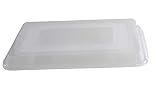

Keep in mind that manufacturers may list the outside rim dimensions, while the usable cooking surface is smaller. Rims, rolled edges, handles, and sloped sides can reduce the flat interior by approximately 1 to 2 inches in each direction. Always measure your oven rack and storage area before buying.
Standard Sizes
| Pan type | Typical dimensions in inches | Approximate dimensions in centimeters | Approximate surface area | Best use |
|---|---|---|---|---|
| Full sheet pan | 26 x 18 x 1 inch | 66 x 46 x 2.5 cm | 468 square inches | Commercial ovens, catering, large batches |
| Two-thirds sheet pan | 21 x 15 x 1 inch | 53 x 38 x 2.5 cm | 315 square inches | Commercial kitchens and larger roasting jobs |
| Half sheet pan | 18 x 13 x 1 inch | 46 x 33 x 2.5 cm | 234 square inches | Home ovens, cookies, vegetables, roasting |
| Quarter sheet pan | 13 x 9 x 1 inch | 33 x 23 x 2.5 cm | 117 square inches | Small portions, toaster ovens, side dishes |
| Eighth sheet pan | 9 x 6.5 x 1 inch | 23 x 17 x 2.5 cm | 58.5 square inches | Single servings and compact ovens |
Although a half sheet pan is half the length of a full commercial pan, the naming refers to area rather than a simple linear measurement. The 18-by-13-inch half pan has approximately 50 percent of the full pan’s surface area. Two half pans can replace one full pan for many recipes, and they are easier to lift, rotate, wash, and store.
Most sheet pans have a rim between 0.75 and 1 inch high. Rimmed pans are more versatile than flat cookie sheets because they contain cooking oil, juices, and small ingredients. Aluminum is lightweight and heats efficiently; stainless steel is durable and less reactive with acidic foods but may brown food differently. Heavy-gauge pans commonly weigh about 1.5 to 3 pounds for a half size, depending on the metal, rim, and construction.
Current half-pan prices typically range from about $8 to $20 for a basic single pan, $20 to $40 for a two-pan set, and $30 to $100 or more for heavy-duty commercial multipacks. For example, a two-pack of aluminum half pans may cost around $32.99, while a 12-pack can approach $99.99. Clear fitted covers generally add about $9 to $15 per lid. Prices vary by material, gauge, finish, and whether lids are included.
How to Measure Your Space
- Measure the oven rack, not only the oven opening. Remove the rack if possible and measure its usable width from side to side and its depth from front to back. A pan must fit on the rack itself.
- Account for clearance. Leave at least 1 inch of open space around the pan when possible. This allows hot air to circulate and gives you room to grip the rim without scraping the oven walls.
- Check the oven door. Slide the rack out partway and confirm that a pan’s front rim will not collide with the door or gasket. Some compact ovens have a deep opening but a short rack.
- Measure between the side rails. Oven racks rest on rails or molded supports that may reduce the available width by several inches. The interior wall-to-wall measurement is not always the usable measurement.
- Consider handles and sloped edges. A pan labeled 18 by 13 inches may have flared sides or exterior handles that make its maximum footprint slightly larger than its flat base.
- Measure storage vertically and horizontally. Include the height of the rim and any lid. A covered half sheet pan may need 2 to 3 inches of vertical clearance, while nested pans need enough room to separate them easily.
- Confirm countertop-appliance limits. Toaster ovens, air-fryer ovens, and compact ranges often accept quarter pans or smaller custom pans rather than a standard half sheet.
By Room or Use Case
Home kitchen
A half sheet pan is the best all-purpose size for most kitchens. It fits standard residential ovens and works for cookies, roasted vegetables, chicken thighs, bacon, focaccia, and sheet-pan dinners. A half pan also provides enough space to spread food into one layer without requiring a commercial oven.
Small kitchen or apartment
Choose a quarter sheet pan if cabinet space, oven width, or sink capacity is limited. Its 13-by-9-inch footprint is close to a rectangular baking dish and is easier to maneuver in a narrow oven. Two quarter pans can provide more flexibility than one half pan when cooking foods with different timing or temperatures.
Large family and meal prep
Two half sheet pans are usually more useful than one full pan. You can roast protein on one pan and vegetables on another, or prepare separate batches without overcrowding. For meal prep, use pans with a 1-inch rim to contain marinades and oil, and allow enough room between ingredients for browning.
Baking and cookies
The half sheet is the common home-baking standard. It typically holds one batch of drop cookies, depending on the recipe and spacing requirements. Light-colored aluminum pans are popular for even browning, while dark nonstick finishes can brown the bottoms faster. Parchment or a silicone baking mat should be sized to the flat interior rather than the outside dimensions.
Roasting and holiday cooking
A half pan handles vegetables, potatoes, poultry pieces, and smaller roasts. A full sheet pan offers more room but is difficult to lift when filled with heavy food and hot liquid. For large gatherings, several half pans are safer and easier to rotate than a single overloaded full pan.
Commercial kitchen or catering space
A full sheet pan makes sense only when the oven, racks, carts, and storage shelves are built for it. Commercial convection ovens often accept full pans, but residential ovens generally do not. Full pans are efficient for high-volume production, yet their large footprint can make handling and washing awkward outside a professional setting.
Common Sizing Mistakes
- Assuming “full size” means full oven size. A full sheet pan is a commercial 26-by-18-inch pan, not a larger version that automatically fits a home range.
- Measuring only the flat cooking surface. Rims and handles add to the outside dimensions. Compare the manufacturer’s maximum exterior size with your rack measurements.
- Ignoring pan depth. A 1-inch rim is standard for sheet pans, but some roasting or jelly-roll pans are deeper. Depth affects oven clearance, storage, and usable capacity.
- Overcrowding the pan. A pan can physically fit in the oven while still being too small for the recipe. Crowded vegetables steam instead of browning, and crowded cookies can spread together.
- Buying a lid without checking compatibility. A cover designed for an 18-by-13-inch half pan may not fit another brand with an unusually wide rim or rolled edge.
- Confusing cookie sheets with sheet pans. Flat cookie sheets may be easier to slide into an oven but cannot contain juices or loose ingredients as securely as a rimmed pan.
FAQ
Will a full sheet pan fit in a standard home oven?
Usually not. A standard full sheet pan is about 26 by 18 inches, which is wider and deeper than most residential oven racks. Measure the rack carefully, but expect a home oven to accommodate a half sheet pan instead.
Is a half sheet pan the same as a 9-by-13-inch baking dish?
No. A half sheet pan is approximately 18 by 13 inches on the outside, with a broad, shallow cooking surface. A 9-by-13-inch baking dish is narrower and much deeper. The two sizes are not interchangeable for capacity, airflow, or baking time.
How many half sheet pans equal one full sheet pan?
Two standard half sheet pans provide approximately the same total surface area as one full sheet pan. However, their combined exterior footprint is not identical because each pan has its own rim and requires separate rack space.
What sheet pan size should I buy first?
Start with one or two rimmed half sheet pans measuring about 18 by 13 inches. They cover the widest range of home uses, fit most standard ovens, and are available in aluminum, stainless steel, nonstick, and commercial-weight options. Add quarter pans if you regularly cook small portions or use a compact oven.