Key takeaways
- Table of Contents 7 sections 9 min read 1 Quick Verdict 2 Side by Side 3 Where Stainless Steel Wins 4 Where Tri Ply Copper Core Saucepan Wins 5 Cost Over 5 Years 6 Which One for Your Home 6.1…
What's inside
Choosing between a stainless steel saucepan and a tri-ply copper core saucepan is less about finding a universally “better” pan and more about deciding how much control, durability, and convenience your kitchen actually needs. Both can handle sauces, grains, vegetables, reheating, and everyday stovetop cooking. The difference is how quickly they respond to heat, how evenly they distribute it, what they cost, and how much attention they demand.
For many homes, a standard stainless steel saucepan with an aluminum core delivers the best value. A tri-ply copper core saucepan is a more specialized upgrade for cooks who regularly make delicate sauces, custards, caramel, reductions, or other foods where small temperature changes matter. This guide compares the two in practical terms, including ownership costs and kitchen space, so you can choose confidently in 2026.
As an Amazon Associate we earn from qualifying purchases at no extra cost to you. Product prices and availability are accurate as of the date shown and are subject to change.


Quick Verdict
Choose stainless steel if you want a durable, versatile saucepan at a reasonable price and do not mind adjusting the burner or using a little cooking technique. A good stainless pan with an aluminum or encapsulated base works on gas, electric, ceramic, and induction cooktops, depending on its construction.
Choose a tri-ply copper core saucepan if precise heat control is your top priority. Copper heats and cools faster than aluminum, which can make delicate cooking more predictable. The tradeoff is a much higher purchase price, a heavier pan, and more care if you want to preserve its polished appearance.
In practical terms, stainless steel is the sensible default for most households. Tri-ply copper core earns its premium when you cook often, value responsiveness, and intend to keep the pan for many years.
Side by Side
| Factor | Stainless Steel Saucepan | Tri-Ply Copper Core Saucepan |
|---|---|---|
| Heat response | Good, especially with an aluminum core; slower to change temperature | Very fast response and precise control |
| Heat distribution | Even when built with an aluminum core or thick base | Highly even across the bottom and sidewalls |
| Comfort | Usually lighter, often about 2.5–4 pounds for a 2–3-quart pan | Often about 3.5–5 pounds for a similar size |
| Durability | Excellent; resists rust, stains, and daily wear | Excellent stainless exterior, but the copper layer adds cost rather than making it indestructible |
| Typical price range | About $25–$180, depending on construction and brand | About $150–$350 for a quality 2–3-quart saucepan |
| Maintenance | Low; dishwasher-safe models are widely available | Usually hand-washing is preferred; polishing is optional |
| Space needed | Common sizes are 1–3 quarts, with roughly 6–8-inch diameters | Similar footprint, but thicker walls and heavier construction can make storage less convenient |
| Look | Bright, practical, and easy to coordinate with other cookware | Professional appearance, sometimes with a visible copper band or polished finish |
| Resale value | Moderate, unless it is a recognized premium brand | Potentially stronger for well-known brands kept in good condition |
| Best for | Everyday cooking, families, rentals, and value-focused kitchens | Frequent cooks, sauce work, precision cooking, and long-term ownership |
Where Stainless Steel Wins
Stainless steel wins on practicality. It tolerates metal utensils, high heat, acidic ingredients, and the occasional cooking mistake better than many specialty materials. Stainless does not react with tomatoes, wine, citrus, or vinegar, so it is a reliable choice for marinara, lemon curd, soup, and pan sauces.
The best value usually comes from a stainless saucepan with a thick aluminum core or a fully clad aluminum layer. Aluminum spreads heat efficiently while stainless steel provides the cooking surface. A lower-cost pan may use an aluminum disk only on the bottom, which can still work well but may leave the sidewalls less responsive.
Stainless steel also offers broad cooktop compatibility. Many models work on gas, electric, ceramic, and induction, although you should check for a magnetic stainless base before buying for induction. A set such as the Cuisinart Chef’s Classic 11-Piece Stainless Steel Pots and Pans Set is an example of the kind of multi-piece purchase that can make sense when you need several sizes at once; its listed price is $172.43.
Maintenance is straightforward. Food that sticks can usually be loosened with warm water and a short simmer. Baking soda helps with discoloration, while a dedicated product such as the $4.99 Weiman Stainless Steel Cleaner & Polisher wipes can help maintain the exterior finish. Cleaning products are optional, not a requirement for safe cooking.
The main weakness is heat management. Stainless steel itself is not a particularly efficient heat conductor. If the pan has a thin base, it can create hot spots, and food may scorch before you notice. Even with a quality aluminum core, you may need to lower the burner sooner than expected. On a typical household electric burner rated around 1,200–1,800 watts, gradual preheating and moderate settings are usually more useful than simply turning the heat to maximum.
Where Tri Ply Copper Core Saucepan Wins
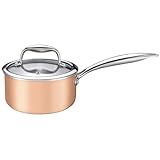
A tri-ply copper core saucepan generally sandwiches a copper layer between stainless steel layers. The copper carries heat rapidly, while the stainless interior gives you a durable, nonreactive cooking surface. Because copper responds quickly when the burner is adjusted, it is especially useful for foods that can split, scorch, curdle, or over-reduce.
This responsiveness is most noticeable with béchamel, pastry cream, hollandaise, caramel, risotto, and small-batch reductions. It does not eliminate the need to stir or monitor the food, but it gives you more control when moving from a boil to a gentle simmer. On gas, the difference can feel immediate; on electric or induction, the pan still responds well, though the cooktop itself may change temperature more slowly.
Tri-ply construction also tends to heat the sidewalls more evenly than a basic bottom-disc pan. That matters when a sauce reduces up the sides or when you are cooking a small quantity in a relatively tall vessel. A 2-quart saucepan typically measures about 6–7 inches across and 4–5 inches deep, making it useful for sauces without taking much space on the range.
The drawback is cost. The All-Clad Copper Core Stainless 3 Qt Saucepan with Lid is listed at $214.99, illustrating the premium for a recognized copper-core design. A product such as the KC-Emier 1-Quart Saucepan, listed at $39.99, occupies a very different budget category; when shopping, verify whether “copper” describes a genuine copper core, a decorative exterior, or another construction detail.
Copper-core pans are also heavier and more expensive to replace. Hand-washing is generally preferable, especially if the manufacturer wants the finish protected. Water spots and fingerprints are cosmetic rather than functional problems, but polished cookware may need occasional buffing if appearance matters to you.
Cost Over 5 Years
Purchase price is only part of the calculation. A basic but well-built stainless saucepan may cost $35–$90, while a premium fully clad model may run $100–$180. Over five years, that works out to roughly $7–$36 per year before considering replacement. If the pan lasts longer—which is common for quality stainless steel—the annual cost drops further.
A tri-ply copper core saucepan usually costs about $150–$350, with many 2–3-quart models landing near $200–$250. At a $215 purchase price, the five-year ownership cost is about $43 per year. Add perhaps $5–$15 over that period for optional polish or specialty cleaning supplies, but routine care does not need to be expensive.
The value equation changes if a cheaper pan warps, develops a loose handle, or has an uneven base and must be replaced. Still, the price premium for copper is rarely justified by durability alone. You are paying primarily for heat response and construction quality. If you rarely make delicate sauces, the savings from stainless steel are likely better spent elsewhere in the kitchen.
Which One for Your Home
Small apartment
Choose a 1.5–2-quart stainless steel saucepan with a lid. It can handle oatmeal, rice, vegetables, sauces, and reheating without consuming valuable storage space. A pan around 6–7 inches in diameter fits most compact burners and leaves room for another pot. Copper core is worthwhile only if you cook precision sauces frequently and have enough cabinet space for its extra weight.
Family with kids or pets
Stainless steel is usually the better match. It is less stressful when dinner is interrupted, tolerates frequent use, and is often dishwasher safe. Look for a securely riveted handle, a helper grip on larger sizes, and a lid that fits tightly. A 2.5–3-quart saucepan offers useful capacity without becoming unwieldy.
Rental kitchen
Pick stainless steel, particularly if you do not know whether the property has gas, ceramic, electric, or induction cooking. Confirm compatibility before buying, and avoid paying for a finish you may not have time to maintain. A durable midrange pan offers flexibility if you move or your next kitchen has a different cooktop.
Long-term home
Either option can work, but this is where tri-ply copper core makes the most sense. If you cook several times a week and appreciate precise control, a 2–3-quart copper-core saucepan can become a frequently used heirloom-quality piece. If your cooking is more general-purpose, invest in a premium stainless model instead and use the savings for a larger stockpot, skillet, or baking equipment.
FAQ
Is a tri-ply copper core saucepan better than stainless steel?
It is better for fast heat response and delicate temperature control, but not automatically better for every task. Stainless steel is usually more affordable, easier to replace, and fully capable of everyday saucepan cooking.
Can a stainless steel saucepan work on induction?
Yes, if it has a magnetic stainless base or magnetic exterior. Test the bottom with a refrigerator magnet, or check the manufacturer’s compatibility statement. Stainless steel alone does not guarantee induction performance.
Does copper core cookware require polishing?
No. Polishing affects appearance, not cooking performance. Hand-washing and drying promptly are usually enough. Follow the manufacturer’s instructions, particularly if the pan has an exposed copper band or decorative exterior.
What size saucepan should most people buy?
A 2-quart saucepan is the most versatile starting point for sauces, grains, vegetables, and reheating. Choose 1 quart for small portions and limited storage, or 3 quarts for family-size sauces and larger batches. A diameter of about 6–8 inches fits most standard burners.