Key takeaways
- “Induction ready” without a magnetic base description: Look for a clear compatibility statement and a flat magnetic exterior base.
- Unspecified ply arrangement: “Three-layer technology” is vague unless the product explains which metals are used and where.
- A very low price paired with premium claims: Inspect the warranty, base thickness, lid, and return policy before trusting words such as “professional.”
- A rocking base: This can create uneven contact and inconsistent induction heating.
- Loose or sharply finished handles: Rivets should be secure, welds should be smooth, and edges should not dig into your hand.
- No capacity or base measurements: A listed quart size does not tell you whether the pan will fit your induction zone or storage space.
- Unclear oven limits: If the lid or handle rating is missing, treat the entire set as unsuitable for high-heat oven use.
What's inside
Buying an induction-ready saucepan is less straightforward than choosing any stainless steel pot. Shoppers often see “tri-ply” on a label and assume every three-layer pan heats evenly. Others buy a magnetic-looking saucepan with a thin base, overlook handle comfort, or choose a 4-quart pot for tasks better suited to a 2-quart model. Those mistakes can lead to slow heating, scorched sauces, awkward storage, and a pan that does not sit properly on the cooktop.
This stainless steel saucepan ply layer guide for induction focuses on the specifications that make a measurable difference: capacity, magnetic compatibility, the location and thickness of the conductive layers, handling, and total value. The goal is not to buy the most expensive pan, but to match the saucepan to the food you cook and the way your induction range delivers heat.
As an Amazon Associate we earn from qualifying purchases at no extra cost to you. Product prices and availability are accurate as of the date shown and are subject to change.



Decide These 3 Things First
- Choose your working capacity. A 1.5- to 2-quart saucepan is useful for oatmeal, grains, reheating soup, melting butter, and sauces for two to four people. A 3- to 4-quart pan is better for pasta sauce, rice, vegetables, and family-sized batches.
- Decide between a fully clad body and a disc-bottom design. Fully clad cookware layers metal from the base through the sidewalls. A disc-bottom saucepan usually has a thicker bonded plate only under the base. Both can work on induction, but they distribute heat differently.
- Set a realistic budget before comparing features. Basic induction-compatible stainless steel saucepans commonly cost $25 to $50, dependable midrange tri-ply models about $50 to $100, and premium versions $100 to $220 or more. Price alone does not prove better cooking performance.
Size and Shape
Capacity labels are useful, but the cooking diameter and wall height matter just as much. A 2-quart saucepan typically has an interior diameter near 6 to 7 inches and a height of roughly 4 to 5 inches. It is compact, heats quickly, and is easy to control for small portions. A 3-quart pan generally measures about 7 to 8 inches across and 5 to 6 inches tall. Four-quart models can reach 8 to 9 inches in diameter and may weigh 5 to 7 pounds once filled.
For induction, choose a base that covers at least 70 percent of the burner’s active cooking area. A tiny 1.5-quart pan on a large 11-inch zone may heat less efficiently, while a wide 4-quart pan can overhang a small 6-inch zone. Check the manufacturer’s stated base diameter rather than relying on the rim diameter.
A straight-sided pan offers more usable surface area and makes whisking easier. A gently flared rim is better for pouring. A 2-quart saucepan with a helper handle can be convenient, but the extra handle adds storage demands and is rarely necessary unless the pan is unusually heavy.
Material and Induction Compatibility
Ordinary stainless steel is not always magnetic. Induction requires a ferromagnetic cooking surface, usually magnetic stainless steel or a separate magnetic stainless steel disc bonded to the base. Look for explicit wording such as “induction compatible” or an induction symbol. A magnet test can provide a quick check: a strong magnet should cling firmly to the exterior base, not merely stick weakly to one small spot.
Most quality saucepans use stainless steel for the cooking surface because it resists rust, does not react readily with tomatoes or wine, and tolerates metal utensils better than nonstick coatings. Aluminum is often placed between stainless layers because it spreads heat efficiently. Copper spreads heat even faster but usually raises the price substantially.
Stainless-steel grades such as 18/10 or 18/8 describe the approximate chromium and nickel content. They can be useful indicators of corrosion resistance, but grade alone does not tell you how evenly a pan heats. A well-designed 18/10 saucepan with poor construction can perform worse than a carefully made pan with less prominently advertised steel specifications.
Construction: What “Ply” Really Means
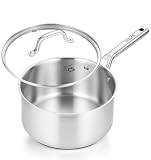
“Tri-ply” means three bonded layers, but the arrangement varies. The most useful configuration for a saucepan is typically stainless steel on the interior, an aluminum heat-spreading core, and magnetic stainless steel on the exterior. In fully clad cookware, those layers continue up the sidewalls. This helps reduce hot spots when a sauce is simmering or when ingredients sit above the center of the induction zone.
A disc-bottom saucepan can be a sensible budget choice. It may use a stainless-steel body with a thick aluminum or aluminum-and-steel plate attached underneath. The disc concentrates heat across the base, but the sidewalls are less responsive and may cook differently from the center. For boiling, steaming, and reheating, that may be perfectly adequate. For custards, caramel, béchamel, and delicate reductions, full cladding is generally the safer design.
Do not assume that more plies automatically mean better performance. Four- and five-ply cookware can be excellent, but the useful questions are whether the layers are bonded evenly, whether the base is flat, and whether the pan responds predictably to temperature changes. A practical construction target is a flat base about 3 to 5 millimeters thick, although brands do not always publish this measurement.
Comfort, Performance, and Cooktop Fit
A saucepan should feel balanced when empty and remain manageable when filled. For a 2-quart model, an empty weight around 2.5 to 4 pounds is common. A 3- to 4-quart pan may weigh 4 to 7 pounds before food is added. Heavier construction can improve stability, but excessive weight makes draining, pouring, and one-handed stirring tiring.
Look for a long handle that stays clear of the burner and has a secure riveted or welded attachment. A useful handle length is approximately 7 to 10 inches on a small saucepan. Stay-cool claims should be interpreted cautiously: handles can become hot in an oven, when placed over a large burner, or when exposed to rising steam. A helper handle is worthwhile on a 4-quart model.
Check the temperature rating if you plan to finish dishes in the oven. Many stainless steel saucepans are oven-safe to 400°F or 500°F, but the lid, handle material, and knob may have lower limits. Glass lids often make it easier to monitor simmering, while stainless lids tolerate higher heat and rougher use. A tight-fitting lid reduces evaporation, but a small amount of venting can help prevent boilovers.
Induction power varies by cooktop. A small saucepan may draw roughly 1,200 to 1,800 watts on a moderate zone, while a larger zone can deliver about 1,800 to 2,400 watts or more. Use medium power for simmering rather than leaving the control at maximum; induction changes temperature quickly and can scorch thick sauces before you notice vigorous bubbling.
Price Tiers
In the budget tier, about $25 to $50, expect stainless steel with a disc base or a lighter tri-ply body. Examples in this category include the Tramontina Signature Tri-Ply Clad 2-quart saucepan at a listed price of $47.99, the KOCH SYSTEME CS 4-quart saucepan at $38.95, the Idymere 1.5- and 2.5-quart set at $29.99, and the EWFEN 3-quart model at $23.99. Retail pricing changes, so compare construction and included lids rather than treating these figures as permanent benchmarks.
Midrange saucepans, usually $50 to $100, tend to offer more consistent finishing, better-fitting lids, thicker handles, and clearer warranty support. Premium cookware commonly costs $100 to $220 or more per saucepan. It may provide heavier fully clad construction, refined pouring rims, longer warranties, and more consistent quality control. If you mostly boil water and reheat food, the premium difference may not pay off. If you make delicate sauces several times a week, better heat distribution can justify it.
Warranty and Long-Term Ownership
Read the warranty before assuming it covers everything. A useful warranty covers manufacturing defects for at least five years; some brands offer limited lifetime coverage. It generally will not cover discoloration, overheating, dents, scratched surfaces, misuse, or normal wear. Confirm whether the lid and handle are included.
Also check care instructions. Dishwasher-safe stainless steel is convenient, but repeated cycles can cause water spotting or rainbow discoloration. A pan that is easy to hand-wash may retain its appearance longer. Avoid thermal shock: do not place a very hot saucepan into cold water, as rapid temperature changes can contribute to warping.
Delivery, Packaging, and Assembly
There is no assembly for a normal saucepan, but delivery details still matter. Confirm that the listed price includes the lid and any helper handle. A small pan with lid may ship in a box roughly 10 by 10 by 7 inches; a 4-quart model may need packaging closer to 13 by 11 by 8 inches. Those dimensions are useful if you have limited storage or are ordering multiple pieces.
Inspect the base, rim, lid, and handle as soon as the package arrives. The pan should sit flat without rocking on a smooth surface. A slightly flexible lid is not automatically defective, but a visibly warped base or loose handle is a reason to request a replacement. Delivery estimates of two to seven business days are common, though availability and seller policies vary.
Spec Checklist
| Spec | Budget | Mid | Premium |
|---|---|---|---|
| Typical price | $25–$50 | $50–$100 | $100–$220+ |
| Useful capacity | 1.5–4 qt | 2–4 qt | 1.5–4 qt |
| Layer design | Disc base or light tri-ply | Fully clad tri-ply | Four- or five-ply, often fully clad |
| Base diameter | 5.5–8 in. | 6–8.5 in. | 6–9 in. |
| Empty weight | 2–6 lb | 3–7 lb | 3.5–8 lb |
| Oven rating target | 350–400°F | 400–500°F | 450–600°F, including compatible lid |
| Warranty target | 1–5 years | 5 years or limited lifetime | Limited lifetime |
Red Flags
- “Induction ready” without a magnetic base description: Look for a clear compatibility statement and a flat magnetic exterior base.
- Unspecified ply arrangement: “Three-layer technology” is vague unless the product explains which metals are used and where.
- A very low price paired with premium claims: Inspect the warranty, base thickness, lid, and return policy before trusting words such as “professional.”
- A rocking base: This can create uneven contact and inconsistent induction heating.
- Loose or sharply finished handles: Rivets should be secure, welds should be smooth, and edges should not dig into your hand.
- No capacity or base measurements: A listed quart size does not tell you whether the pan will fit your induction zone or storage space.
- Unclear oven limits: If the lid or handle rating is missing, treat the entire set as unsuitable for high-heat oven use.
FAQ
Is tri-ply stainless steel good for induction?
Yes, provided the outer layer or attached base is magnetic. Fully clad tri-ply is especially versatile because the aluminum core spreads heat through the base and sidewalls. Always verify induction compatibility instead of relying on the word “tri-ply.”
Is a disc-bottom saucepan better than a fully clad saucepan?
Neither is universally better. A disc-bottom pan can offer strong base heating at a lower price and works well for boiling and reheating. Fully clad construction is usually preferable for sauces and other foods that need even sidewall heating.
What saucepan size is best for an induction cooktop?
A 2-quart saucepan is the most flexible choice for one to four servings. Choose 3 to 4 quarts for family meals or batch cooking, but match the base diameter to the active induction zone. A pan that is too small or too large for the zone may heat less efficiently.
Can stainless steel saucepans go in the dishwasher?
Many can, but check the manufacturer’s instructions. Dishwasher detergent may leave spots or dull the finish, and repeated cycles can affect some handles or lids. Hand-washing with warm water and a nonabrasive sponge is usually the gentlest option.