Key takeaways
- Base thickness: A substantial, flat base helps prevent hot spots on a stovetop. Avoid a visibly convex or unstable bottom.
- Lid fit: The lid should sit evenly with minimal wobble. Self-basting ridges or interior dimples can help return condensation to the food.
- Rim design: An enameled rim should be smooth and free of exposed chips. A bare-iron rim should be cleanly finished and easy to season.
- Handle attachment: Integrated cast handles are typically more secure than thin add-on hardware, but every handle becomes hot and requires protection.
What's inside
Choosing a Dutch oven by capacity alone is an easy mistake. A “5-quart” pot can feel dramatically different from another 5-quart model if its walls are thicker, its base is heavier, or its lid fits poorly. Shoppers also tend to assume that the heaviest pot is automatically the best, overlook the difference between bare and enameled cast iron, and compare prices without checking what is included.
Wall thickness matters because it affects heat retention, preheating speed, weight, durability, and how evenly the pot responds when you change the burner setting. However, it is only one part of the buying decision. The best Dutch oven for baking bread, stovetop braising, camping, or everyday soup may have a different build.
As an Amazon Associate we earn from qualifying purchases at no extra cost to you. Product prices and availability are accurate as of the date shown and are subject to change.



Use the following guide to compare construction details instead of relying on marketing language. The goal is not to find the thickest walls available, but to choose a balanced pot for your cooking style, lifting ability, storage space, and budget.
Decide These 3 Things First
- Where will you cook? Indoor stovetop and oven use favors an enameled or smooth bare cast-iron pot with a manageable weight. Campfire cooking requires a lid designed to hold coals and, often, a bail handle.
- What will you cook most? Soups and stews benefit from capacity and heat retention. Bread benefits from a close-fitting lid and an interior diameter that allows the dough to expand. Searing favors a broad base and a dark, durable cooking surface.
- How much weight can you comfortably handle? A 5- to 6-quart Dutch oven may weigh 10 to 15 pounds empty, while an 8-quart camp oven can weigh approximately 18 to 25 pounds before food is added. Thick walls are useful, but only if you can safely lift the pot.
Size and Usable Capacity
For two to three people, a 3- to 4-quart Dutch oven is usually sufficient for small braises, rice, and soup. A 5- to 6-quart model is the most versatile household size: it can hold a four-person stew, a medium roast, or a standard loaf of sourdough. For six or more servings, batch cooking, or large poultry, consider 7 to 8 quarts.
Pay attention to diameter and height, not just quart capacity. A pot around 10 to 11 inches wide gives you room to brown several pieces of meat without crowding. A very tall, narrow design may hold the advertised volume but make searing and stirring less convenient. Check the exterior dimensions against your oven, especially if the pot has wide handles. Allow at least 1 inch of clearance on each side and enough space above the lid for safe removal.
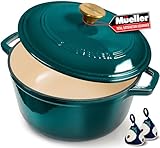
Examples in this category illustrate the spread: a 5.5-quart Overmont model and a 5-quart Vivicreate model suit everyday cooking, while a 6-quart Mueller offers more room for family meals. The 8-quart Lodge camp oven is better suited to large batches and outdoor cooking, but its empty weight is a more important consideration than its extra capacity.
Material: Bare Cast Iron or Enameled Cast Iron
Bare cast iron is the traditional choice for campfire cooking and high-heat searing. It develops a seasoning layer that improves release and protects the metal, but it must be dried promptly and lightly oiled. Acidic foods such as tomatoes, wine, and vinegar can be cooked in well-seasoned bare iron, though long simmering may affect flavor and seasoning.
Enameled cast iron has a glass-like coating that does not require seasoning and is more convenient for acidic recipes. It is a strong choice for indoor braises, soups, and bread baking. The coating can chip if the pot is dropped, struck with metal utensils, or heated aggressively while empty. Unless the manufacturer specifically says otherwise, avoid using an enameled pot directly over an open campfire.
Material also changes how you interpret wall thickness. Bare camp ovens often use a rugged, relatively thick casting to withstand outdoor handling. Enameled cookware may use a somewhat more refined shape and a lighter finish, but the enamel itself is not a substitute for structural thickness. Look for the actual cast-iron body weight and construction details rather than assuming a glossy coating means premium performance.
Construction and Wall Thickness
When deciding how to choose the right Dutch oven wall thickness, look for a balanced casting rather than the maximum measurement. Many household cast-iron Dutch ovens have body walls in the approximate 3 to 5 millimeter range, while heavy-duty camp ovens may be around 4 to 6 millimeters or more. These are useful comparison ranges, not universal standards; brands measure different areas and may not publish the number at all.
Thicker walls generally retain heat longer and resist warping or rough handling. They also take longer to preheat and add weight. Thinner walls can respond more quickly to burner changes and make the pot easier to lift, but they may provide less thermal buffering. For slow braises and steady oven cooking, a well-cast body with even walls is usually more useful than an ultrathin, lightweight design.
Check four construction details:
- Base thickness: A substantial, flat base helps prevent hot spots on a stovetop. Avoid a visibly convex or unstable bottom.
- Lid fit: The lid should sit evenly with minimal wobble. Self-basting ridges or interior dimples can help return condensation to the food.
- Rim design: An enameled rim should be smooth and free of exposed chips. A bare-iron rim should be cleanly finished and easy to season.
- Handle attachment: Integrated cast handles are typically more secure than thin add-on hardware, but every handle becomes hot and requires protection.
If wall thickness is not listed, use weight as a secondary clue, not proof. Two pots with the same capacity can differ by several pounds because of wall thickness, lid design, handles, and casting geometry.
Comfort, Heat Performance, and Compatibility
A Dutch oven should heat steadily without making everyday handling unreasonable. For indoor use, confirm that the pot is safe for your oven temperature and cooktop. Most cast-iron models tolerate high oven temperatures, but enamel knobs, lid handles, and manufacturer instructions may impose lower limits, such as 400°F to 500°F.
For induction, the base must be flat and magnetically responsive. Cast iron normally works, but a rough underside can scratch glass cooktops. Lift rather than slide the pot. On a gas or electric burner, a 10- to 11-inch base offers practical stability for a 5- to 6-quart vessel.
Comfort includes the lid handle, side handles, and balance. A full 6-quart pot can weigh 20 pounds or more once food is inside. Wide side handles are easier to grip with oven mitts, while a small knob may be difficult to grasp safely. For camp cooking, a bail handle and a flanged lid that holds charcoal are more important than a polished enamel finish.
Price Tiers and What You Actually Get
Budget Dutch ovens generally cost about $25 to $60. At this level, expect basic cast iron, less refined enamel, limited finish consistency, and little detail about wall measurements. The approximately $23.74 Vivicreate and $39.99 Overmont examples fit the value end of the category, depending on current retailer pricing.
Midrange models usually fall around $60 to $130. They often offer more consistent enamel, better lid fit, smoother handles, and clearer temperature guidance. A 6-quart enameled model such as the approximately $52.97 Mueller sits near the lower edge of this band.
Premium Dutch ovens commonly cost $130 to $400 or more. You are paying for tighter manufacturing tolerances, finish quality, long-term support, and sometimes a stronger warranty—not necessarily dramatically thicker walls. A bare 8-quart camp oven, such as the approximately $89.95 Lodge example, can offer excellent outdoor utility without reaching premium enameled pricing.
Warranty and Long-Term Support
Read the warranty before treating it as a quality signal. Coverage may include casting defects but exclude chips caused by impact, thermal shock, misuse, or normal surface wear. A useful warranty states the coverage period, remedy, and process for submitting photographs or proof of purchase.
Also check whether replacement lids, knobs, bail handles, and manufacturer-approved care products are available. A replaceable knob can extend the life of an otherwise sound pot. For enameled cookware, customer support matters because small finish problems may be easier to resolve early than after months of use.
Delivery, Packaging, and Assembly
Dutch ovens require no assembly, but delivery condition matters because cast iron is heavy and enamel can chip in transit. Look for packaging that immobilizes the pot and protects the lid separately. Inspect the rim, interior, lid, handles, and underside immediately after delivery.
Before ordering, confirm the delivered weight, box dimensions if storage is tight, return window, and whether shipping charges apply to a heavy item. A $40 pot can become less economical if return shipping is expensive. Never use a pot with a structural crack, a sharp enamel chip in the cooking area, or a lid that rocks badly; photograph the problem and contact the seller.
Spec Checklist
| Spec | Budget | Mid | Premium |
|---|---|---|---|
| Typical price | $25-$60 | $60-$130 | $130-$400+ |
| Useful capacity | 4-6 qt | 5-7 qt | 5-8 qt |
| Approximate wall range | 3-5 mm, if evenly cast | 3-6 mm | 4-6 mm or carefully specified construction |
| Empty weight | 8-16 lb | 10-18 lb | 12-25 lb |
| Useful interior diameter | 9-10.5 in | 10-11.5 in | 10.5-12 in |
| Best use | Basic stews and occasional baking | Frequent family cooking | Specialized, high-use, or heirloom cooking |
Red Flags
- The listing gives a quart capacity but no weight, dimensions, material, or temperature rating.
- “Heavy duty” appears without a wall, base, or construction specification.
- The lid visibly rocks, leaves large gaps, or has a loose knob.
- Enamel has pinholes, sharp chips, bubbling, or an uneven rim.
- The underside is rough enough to scratch a glass cooktop.
- A very light pot claims the capacity of a full-size cast-iron Dutch oven without explaining the construction.
- The warranty excludes nearly every realistic defect or provides no clear return process.
FAQ
Is a thicker Dutch oven wall always better?
No. Thicker walls improve heat retention and durability but increase preheating time and lifting weight. For most indoor cooks, even 3- to 5-millimeter walls and a solid base provide a practical balance. Choose heavier construction for long braises or rough camp use, not simply because the number is larger.
What wall thickness is best for sourdough bread?
Even heat retention matters more than a specific wall measurement. A 4- to 6-quart Dutch oven with a close-fitting lid, a 9- to 11-inch interior diameter, and a temperature rating of at least 450°F is a versatile choice. Confirm the lid knob rating before baking at high heat.
Should I buy a 5-quart or 6-quart Dutch oven?
Choose 5 quarts for two to four servings and easier handling. Choose 6 quarts if you regularly cook for four people, make large batches, or bake round loaves. The extra quart usually adds only modest exterior size but can add several pounds, so compare listed weights.
Can I use an enameled Dutch oven over a campfire?
Usually not unless the manufacturer specifically approves it. Direct flames, hot coals, and sudden temperature changes can damage enamel. For campfires, select bare cast iron with a flanged coal-ready lid, legs if needed, and a sturdy bail handle.