Key takeaways
- More cooking flexibility: A separate sauté pan gives you a dedicated vessel for simmering, braising, reducing sauces, and cooking foods that would spill from a shallow skillet.
- Less crowding: Two pans let you cook a main dish and a side at the same time. This matters when preparing meals for four or more people.
- Better control for liquid-heavy recipes: Straight sides make it easier to add stock, wine, cream, or tomato sauce without sloshing.
- Less splatter: Taller sides provide a modest barrier when frying bacon, searing meat, or reducing a sauce.
- Useful capacity: A 3- to 5-quart sauté pan can replace a small Dutch oven for many weeknight recipes, while heating faster and usually weighing less.
- Dedicated cookware can improve workflow: You can keep a skillet free for high-heat browning while the sauté pan handles the sauce or finishing step.
What's inside
The Short Answer
No—unless you regularly cook foods that need a wide, flat cooking surface plus tall, straight sides. For most home cooks, one roomy skillet can handle browning, frying, sautéing, reheating, and even shallow braising. A separate sauté pan becomes worthwhile when you cook larger batches, make pan sauces often, or want more capacity without using a stockpot.
The distinction is useful but not absolute. A skillet usually has sloped sides, which makes it easy to toss vegetables and slide food onto a plate. A sauté pan has straight, taller sides and often comes with a lid. Those sides hold more liquid and reduce splatter, but they also make the pan heavier and less nimble.
As an Amazon Associate we earn from qualifying purchases at no extra cost to you. Product prices and availability are accurate as of the date shown and are subject to change.

What You Actually Get
A 10- to 12-inch skillet is the most versatile choice for a typical kitchen. The sloped sides expose more food to the pan’s heat and make turning eggs, flipping pancakes, and stirring vegetables straightforward. A 12-inch model generally offers enough room for four servings, though crowded food will brown less effectively.
A sauté pan is typically measured by diameter as well, but its usable volume is greater because the sides are vertical. A 10- or 12-inch sauté pan may hold roughly 3 to 5 quarts, depending on its depth. That makes it better for dishes such as chicken thighs in sauce, a full batch of risotto, braised greens, or pasta finished with several cups of liquid.
The trade-off is handling. A large sauté pan can weigh several pounds before food is added, especially if it has a thick aluminum or stainless-steel base. A helper handle is valuable for lifting it safely from the stove. A lid is also more useful on a sauté pan than on a traditional skillet because the pan is designed for covered cooking.
There is substantial overlap between the two categories. Some deep skillets have 4- to 5-quart capacities, lids, and helper handles, effectively serving as sauté pans. For example, the 12-inch SENSARTE nonstick deep frying pan is listed as a 5-quart pan with a lid and helper handle, at about $39.99. It may be a practical one-pan solution if you want sauté-pan capacity without buying a second piece.
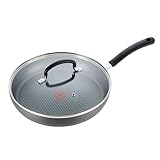
By contrast, a conventional 12-inch skillet such as the T-Fal Ultimate Hard Anodized nonstick model is listed at about $54.99 and includes a lid. Its 400°F oven rating and dishwasher-safe construction add convenience, although the lid is listed as safe to 350°F. Always check the manufacturer’s instructions before putting any nonstick pan or lid in the oven or under a broiler.
Pros
- More cooking flexibility: A separate sauté pan gives you a dedicated vessel for simmering, braising, reducing sauces, and cooking foods that would spill from a shallow skillet.
- Less crowding: Two pans let you cook a main dish and a side at the same time. This matters when preparing meals for four or more people.
- Better control for liquid-heavy recipes: Straight sides make it easier to add stock, wine, cream, or tomato sauce without sloshing.
- Less splatter: Taller sides provide a modest barrier when frying bacon, searing meat, or reducing a sauce.
- Useful capacity: A 3- to 5-quart sauté pan can replace a small Dutch oven for many weeknight recipes, while heating faster and usually weighing less.
- Dedicated cookware can improve workflow: You can keep a skillet free for high-heat browning while the sauté pan handles the sauce or finishing step.
Cons
- It takes up cabinet space: A sauté pan with a lid can require roughly 12 to 14 inches of storage width, plus clearance for the handle.
- There is considerable overlap: A deep 12-inch skillet with a lid may perform nearly every task you had in mind for a sauté pan.
- It can be heavier and less maneuverable: Straight sides and greater depth make tossing food more difficult, especially when the pan is full.
- It may cost more than expected: A dependable sauté pan commonly ranges from about $50 to $180, depending on its material, coating, lid, and construction.
- Nonstick surfaces have limitations: They are convenient for eggs and delicate foods, but many are not designed for extremely high heat, metal utensils, or aggressive broiler use.
- Cleaning two pans is not always faster: If you usually cook one-pan meals for one or two people, the extra cookware may simply add another item to wash.
Who Should Buy It
Buy a separate sauté pan if you regularly cook for three or more people or make recipes that combine searing and simmering. It is especially useful for chicken piccata, pork chops with pan gravy, curries, risotto, shakshuka, braised vegetables, and pasta sauces that need room to reduce.
It is also a good choice for cooks who meal-prep. A 4- or 5-quart pan can accommodate a larger batch of vegetables, grains, or protein without the ingredients piling several layers deep. Look for a 10- to 12-inch diameter, at least 2.5 to 3 inches of side height, a secure lid, and a helper handle. If you have an induction cooktop, confirm that the base is induction-compatible rather than assuming every stainless-steel-looking pan will work.
A deep nonstick skillet may be the smarter purchase if you want just one piece. The SENSARTE option, listed at $39.99, combines a 12-inch diameter, 5-quart capacity, lid, and helper handle. That configuration covers many sauté-pan jobs while remaining suitable for everyday frying.
Who Should Skip It
Skip the separate pan if you mostly cook for one or two people, prepare quick breakfasts, or favor recipes that use little liquid. In those cases, a good 10- or 12-inch skillet is likely enough. It will usually be easier to lift, store, preheat, and clean.
You can also skip it if your kitchen already has a 5- to 6-quart Dutch oven or a wide braiser. Those pieces offer the capacity and tall sides associated with a sauté pan, although they may be slower to heat and heavier to handle.
Finally, do not buy a sauté pan merely because a recipe calls for one. Recipe terminology is inconsistent. A large, deep skillet often works perfectly well unless the instructions require a precise volume or a tightly fitting lid.
Cheaper Alternatives
| Option | Cost | Trade-off |
|---|---|---|
| Use your existing 10- or 12-inch skillet | $0 | Most affordable choice, but limited capacity and more splatter for liquid-heavy recipes. |
| 12-inch deep nonstick skillet with lid | $35-$70 | Often performs like a sauté pan, though its sloped sides may hold slightly less liquid. |
| 12-inch stainless-steel skillet with lid | $50-$130 | Durable and generally better for high heat, but food can stick without proper preheating and oil. |
| 3.5- to 5-quart Dutch oven | $45-$250 | Excellent for braising and simmering, but heavier and slower to heat than a sauté pan. |
| Large electric skillet | $35-$100 | Provides broad cooking space and temperature control, but requires counter space and an outlet. |
FAQ
Can a skillet replace a sauté pan?
Yes, in most kitchens. Use a 12-inch skillet for sautéing, searing, frying, and smaller braises. The main limitations are capacity, splatter, and the amount of liquid it can hold safely. A deep skillet with a lid closes most of the gap.
Is a sauté pan better than a frying pan?
Neither is universally better. A sauté pan is better for saucy, crowded, or covered recipes. A frying pan is better for quick tossing, flipping, crisping, and foods that benefit from more exposed surface area. Choose based on what you cook most often.
What size sauté pan should I buy?
For most homes, a 10- or 12-inch pan holding about 3 to 5 quarts is the practical range. Choose 10 inches for one to three servings and easier handling; choose 12 inches for family meals or batch cooking. Avoid filling any pan to the rim, particularly when simmering.
Should my sauté pan be nonstick or stainless steel?
Nonstick is easiest for eggs, fish, delicate vegetables, and low- to medium-heat cooking. Stainless steel is more versatile for browning and pan sauces and is typically better suited to higher temperatures. In 2026, a deep nonstick skillet may offer the best value if you want one multipurpose pan, while stainless steel makes more sense for cooks who prioritize durability and searing.