Key takeaways
- Place the sharpener on a stable surface and hold it firmly by the base.
- Start with the coarse slot if the knife is truly dull, drawing the blade heel-to-tip through with light, even pressure 3-5 times.
- Move to the fine slot to refine and polish the edge, another 3-5 pulls.
- Let the slots set the angle for you; that consistency is the whole advantage of a pull-through like the Professional 4-in-1 with tungsten and ceramic stages.
What's inside
A dull knife is both frustrating and dangerous; it slips off food instead of biting in, and the extra force you apply is exactly what causes cuts. The reassuring truth is that most home cooks never need a professional to keep their knives sharp. With an inexpensive sharpener and five minutes, you can restore a keen edge on the same knives that feel hopeless today.
This guide explains the difference between honing and sharpening, walks through using pull-through and manual sharpeners, and covers how to maintain the edge once you’ve got it. You don’t need whetstone mastery to cut cleanly again, just the right tool and a little consistency.
As an Amazon Associate we earn from qualifying purchases at no extra cost to you.



⚡ Save on Your Next PC — Amazon Prime
Prime members get fast free shipping on the systems above, plus early access to Prime Day & Black Friday PC deals. New members get a 30-day free trial.
Watch: How to Sharpen Your Kitchen Knives at Home — Video Review
Honing vs. Sharpening: Know the Difference
These get confused constantly. Honing realigns an edge that’s rolled over slightly from use; it doesn’t remove metal and should be done often. Sharpening actually grinds a new edge and removes metal, needed only occasionally. Many tools like the Longzon 5-in-1 and 4-in-1 sharpeners include separate coarse (sharpen) and fine (hone/polish) stages so you can do both in one device.
Using a Pull-Through Sharpener
- Place the sharpener on a stable surface and hold it firmly by the base.
- Start with the coarse slot if the knife is truly dull, drawing the blade heel-to-tip through with light, even pressure 3-5 times.
- Move to the fine slot to refine and polish the edge, another 3-5 pulls.
- Let the slots set the angle for you; that consistency is the whole advantage of a pull-through like the Professional 4-in-1 with tungsten and ceramic stages.
Manual and Multi-Stage Sharpeners
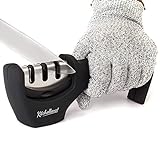
Multi-stage tools such as the Longzon 5-in-1 (which includes a cut-resistant glove) walk a blade from coarse repair to fine polish and often add a slot for serrated knives or scissors. The SHARPAL 191H handles both knives and scissors in one compact unit. These are the sweet spot for home use: more control than a single-slot gadget, far easier than a whetstone.
Maintaining the Edge
Once sharp, a knife stays that way longer with good habits. Cut on wood or plastic boards, never glass or stone, which dull an edge in a single meal. Hone lightly before each use, hand-wash rather than dishwasher (detergent and jostling damage edges), and store knives in a block or on a magnetic strip so blades don’t knock together in a drawer.
Tips
- Use light pressure; forcing the blade grinds away too much metal and shortens the knife’s life.
- Always pull heel-to-tip in one smooth motion, keeping the same speed through the stroke.
- Test sharpness on a sheet of paper; a sharp edge slices cleanly, a dull one tears.
- Wear a cut-resistant glove, like the one bundled with the Longzon, while you learn.
Frequently Asked Questions
How often should I sharpen my kitchen knives?
Sharpen (remove metal) only every few months for a home cook, or when honing no longer restores the edge. Hone lightly before each use to keep the edge aligned between sharpenings.
Are pull-through sharpeners bad for knives?
Quality multi-stage pull-throughs with tungsten and ceramic slots work well and set a consistent angle. Cheap single-slot models can remove too much metal, so choose one with separate coarse and fine stages and use light pressure.
Can I sharpen serrated knives at home?
Some multi-stage sharpeners include a dedicated serrated slot. Otherwise serrated blades need a tapered rod to sharpen each groove; a standard flat slot won’t do them justice.
Do I need a whetstone?
Not for everyday sharpness. A good pull-through or multi-stage sharpener is faster and more forgiving. Whetstones give the finest edge but require practice to hold the angle correctly.
Conclusion
Keeping knives sharp at home is a simple, repeatable routine: hone often to realign the edge, sharpen occasionally with a multi-stage tool to rebuild it, and protect the edge with proper boards and storage. An inexpensive sharpener plus five minutes turns a drawer of dull, dangerous blades into knives that glide through tomatoes and onions. Master that and you’ll never dread prep, or fear the slip of a dull edge, again.