Key takeaways
- Buying by rim diameter alone: A pan labeled 10 inches may have only an 8-inch cooking surface. Check the base and interior measurements when available.
- Using an 8-inch pan for four fried eggs: The eggs may overlap, making it difficult to flip or remove them separately.
- Choosing 12 inches for every breakfast: A large skillet can take longer to preheat, weigh more, and spread a small amount of egg too thinly.
- Confusing a divided egg pan with a regular skillet: Four cups are convenient for individual portions, but they do not provide the open surface needed for a large omelet or sautéed vegetables.
- Ignoring handle clearance: A pan may fit the burner but not the cabinet, oven, or adjacent burners once the handle is included.
- Assuming a lid is universal: A lid made for a 10-inch pan will not necessarily fit a different brand with a thicker rim or unusual shape.
What's inside
Choosing the right skillet for four large eggs is mostly a matter of balancing cooking space, maneuverability, and how much room you want between the eggs. A pan that is too small makes the eggs crowd together, while an oversized skillet can leave thin egg whites spread across a broad, hot surface.
The Short Answer
The best skillet size for cooking four large eggs is usually a 10-inch skillet. It provides enough room for four fried eggs without forcing the whites into one another, yet it is compact enough to heat evenly and handle comfortably. A 10-inch pan also works well for scrambled eggs, omelets, breakfast sandwiches, and small pancakes.
As an Amazon Associate we earn from qualifying purchases at no extra cost to you. Product prices and availability are accurate as of the date shown and are subject to change.



Choose an 8-inch skillet if you are making scrambled eggs or a single folded omelet. It can technically hold four eggs, but four fried eggs will usually be crowded. Move up to a 12-inch skillet if you want four eggs with generous spacing, plan to add bacon or vegetables, or regularly cook breakfast for more than four people.
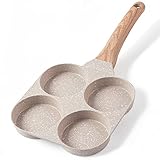
For eggs cooked in separate molded sections, a four-cup egg pan is another option. These pans are often priced at approximately $14 to $22, including examples such as the HUPECHAM 4-Cup Egg Pan, HUPECHAM Egg Pan With Lid, and CAROTE 4-Cup Nonstick Granite Egg Pan. A divided pan is convenient for uniform fried eggs, but it is less versatile than a standard 10-inch skillet.
Standard Sizes
Skillet measurements refer to the diameter across the top rim, not the flat cooking surface. Because sloped sides reduce the usable area, a labeled 10-inch skillet may have a cooking surface closer to 8 to 9 inches wide.
| Skillet size | Diameter | Approximate flat cooking surface | Typical depth | Best use for eggs |
|---|---|---|---|---|
| 8 inches | 8 in (20.3 cm) | 6.5–7 in (16.5–17.8 cm) | 1.5–2 in (3.8–5.1 cm) | One to two fried eggs, scrambled eggs, or one omelet |
| 9 inches | 9 in (22.9 cm) | 7.5–8 in (19.1–20.3 cm) | 1.5–2 in (3.8–5.1 cm) | Two to three eggs, or four scrambled eggs |
| 10 inches | 10 in (25.4 cm) | 8.5–9 in (21.6–22.9 cm) | 1.75–2.25 in (4.4–5.7 cm) | Four fried eggs, scrambled eggs, and medium omelets |
| 12 inches | 12 in (30.5 cm) | 10.5–11 in (26.7–27.9 cm) | 2–2.5 in (5.1–6.4 cm) | Four eggs with additions, larger omelets, or family portions |
For four large fried eggs, allow roughly 2.5 to 3 inches (6.4 to 7.6 cm) of space per egg, depending on how much the whites spread. That makes a 10-inch skillet the most practical everyday choice. A pan with gently sloped sides may provide more usable space than a straight-sided pan with the same advertised diameter.
Weight is also worth checking. An 8-inch nonstick skillet commonly weighs about 1.5 to 2.5 pounds (0.7 to 1.1 kg), a 10-inch skillet about 2 to 4 pounds (0.9 to 1.8 kg), and a 12-inch stainless steel or cast-iron skillet may weigh 3 to 7 pounds (1.4 to 3.2 kg). For everyday eggs, a lighter 10-inch pan is easier to lift, tilt, and clean.
How to Measure Your Space
- Measure the cooktop burner. A 10-inch skillet is usually a good match for a medium burner, but compare the flat base diameter with the burner ring. A base that extends far beyond the heating area may cook less evenly.
- Check the flat base, not just the rim. Turn the pan over and measure the section that actually touches the cooktop. Some 12-inch pans have a base closer to 9 or 10 inches.
- Measure cabinet and drawer clearance. Include the handle. A 10-inch skillet with a long handle may require 17 to 20 inches (43 to 51 cm) of total storage length.
- Check sink width. The pan should fit comfortably in the sink for washing. A 12-inch skillet can be awkward in a compact sink, especially with a fixed handle.
- Measure the lid separately. If you want covered eggs, confirm that the lid diameter matches the skillet and that its knob does not prevent stacking.
- Confirm cooktop compatibility. For induction, the pan must have a magnetic base and a reasonably flat bottom. Gas and electric coil cooktops are generally less restrictive, but the base should still sit level.
By Room or Use Case
Everyday fried eggs
A 10-inch nonstick skillet is the best all-around size for four large eggs. The eggs can be cracked into separate areas, and a flexible spatula can slide under each one without breaking the neighboring yolks. Use low to medium heat; a typical stovetop burner setting in the approximate 1,200- to 1,800-watt range is usually sufficient, though actual heat depends on the cooktop and pan material.
Scrambled eggs
Four large eggs occupy less space once beaten, so an 8- or 9-inch skillet can work well. Choose a 10-inch pan if you add cheese, vegetables, ham, or potatoes. The extra room helps you stir without pushing food over the sides.
Omelets and egg sandwiches
A 10-inch skillet gives a four-egg omelet enough surface area to cook into a manageable layer. For a two-egg omelet, an 8-inch pan usually produces a thicker, easier-to-fold result. If you make round egg patties for sandwiches, a four-cup egg pan keeps each portion consistent, but check the cup diameter before buying. Many divided pans are designed for small eggs or compact sandwich portions rather than oversized restaurant-style eggs.
Cooking with vegetables or meat
Use a 12-inch skillet when four eggs are only one part of the meal. Sautéed peppers, onions, mushrooms, sausage, or potatoes need room to brown. A crowded 10-inch pan can steam vegetables instead of browning them, and the eggs may spread into the ingredients.
Induction and smaller kitchens
For a compact kitchen, a 10-inch induction-compatible nonstick pan is usually the best compromise. Look for a base that is at least 7 to 8 inches (17.8 to 20.3 cm) wide, a comfortable handle, and a total weight under about 4 pounds. Prices for basic nonstick four-cup egg pans and small breakfast skillets commonly fall between $14 and $22; heavier stainless steel, ceramic, or cast-iron models may cost more.
Common Sizing Mistakes
- Buying by rim diameter alone: A pan labeled 10 inches may have only an 8-inch cooking surface. Check the base and interior measurements when available.
- Using an 8-inch pan for four fried eggs: The eggs may overlap, making it difficult to flip or remove them separately.
- Choosing 12 inches for every breakfast: A large skillet can take longer to preheat, weigh more, and spread a small amount of egg too thinly.
- Confusing a divided egg pan with a regular skillet: Four cups are convenient for individual portions, but they do not provide the open surface needed for a large omelet or sautéed vegetables.
- Ignoring handle clearance: A pan may fit the burner but not the cabinet, oven, or adjacent burners once the handle is included.
- Assuming a lid is universal: A lid made for a 10-inch pan will not necessarily fit a different brand with a thicker rim or unusual shape.
FAQ
Can a 10-inch skillet hold four large eggs?
Yes. A 10-inch skillet is the recommended size for four large fried eggs. It provides enough room for the whites to spread while keeping the eggs close enough to cook evenly. For scrambled eggs, it offers even more capacity.
Is an 8-inch skillet too small for four eggs?
It is usually too small for four separate fried eggs, particularly if you want intact yolks. An 8-inch skillet is better for one or two fried eggs, a small omelet, or four eggs scrambled together.
Should I buy a 10-inch or 12-inch skillet?
Choose 10 inches for four eggs and everyday breakfast cooking. Choose 12 inches if you frequently add vegetables, meat, or potatoes, cook for more than four people, or want substantial spacing between the eggs.
Are four-cup egg pans better than standard skillets?
Four-cup pans are useful when you want four uniform eggs cooked separately at the same time. A standard 10-inch skillet is more versatile for omelets, scrambled eggs, sautéing, and other meals. For most kitchens, the standard skillet is the better primary pan, while a divided egg pan is a specialized option.