Investing in a top-tier cutlery collection transforms your entire cooking experience, turning tedious prep work into an effortless, precise routine. Navigating the high-end market can feel overwhelming, especially with countless steel types, forging methods, and handle designs competing for your attention.
To find options that truly elevate your kitchen workflow, you must look past flashy marketing and evaluate the fundamental engineering of the blade. This guide breaks down the core elements that separate mediocre cutlery from exceptional investments, ensuring you make a confident, informed choice.
As an Amazon Associate we earn from qualifying purchases at no extra cost to you.

Understanding Steel Types and Rockwell Hardness
The backbone of any quality knife is its steel composition. High-carbon stainless steel has become the gold standard for luxury kitchen cutlery because it combines the edge-retention properties of traditional carbon steel with the rust-resistance of stainless varieties. When browsing specifications, you will often encounter the Rockwell Hardness scale, abbreviated as HRC. Premium kitchen knives typically register between 58 and 62 on this scale. Blades on the lower end are tougher and easier to sharpen, while those on the higher end hold a razor-sharp edge significantly longer but can be more brittle. Finding the right balance depends entirely on your willingness to maintain the edge with proper honing and sharpening stones.
Forged Versus Stamped Construction
Manufacturing methods dictate both the durability and the price of your investment. Forged blades are crafted from a single solid bar of heated steel, pounded into shape by heavy machinery or master artisans. This process creates a thicker bolster, a heavier weight distribution, and an inherent sturdiness that many traditional home cooks prefer. Stamped blades, on the other hand, are laser-cut from a large sheet of rolled steel and subsequently ground and heat-treated. While stamped knives used to be considered inferior, modern manufacturing allows high-end stamped options to perform brilliantly, offering lighter weights and agile handling that reduces wrist fatigue during long prep sessions.
Blade Geometry and Cutting Angles
How a blade tapers toward the edge defines its cutting performance and suitability for specific tasks. Western-style chef knives usually feature a wider 20-degree edge angle on each side, designed to withstand heavy-duty rocking motions and tougher ingredients like winter squash or small bones. Japanese-inspired profiles often utilize a steeper 12 to 15-degree angle, yielding a sharper, more delicate edge ideal for precision slicing, fine brunoise cuts, and paper-thin vegetable ribbons. Consider your daily cooking habits carefully: if you chop aggressively through dense produce, a robust Western geometry is safer. If you prioritize clean, frictionless slicing, a narrower Japanese angle is superior.
Evaluating Handle Ergonomics and Materials
A breathtaking blade is completely useless if the handle causes hand cramps or slips during use. Handle construction must offer a secure, comfortable grip, whether your hands are dry or slick with moisture from cooking. Premium brands utilize various materials, ranging from stabilized hardwoods and Pakkawood to modern composite micarta and sanitary stainless steel. Wood provides a warm, organic feel and molds comfortably to the hand over time, though it requires hand-washing and occasional mineral oil conditioning. Synthetics offer ultimate durability, dishwasher-safe convenience, and absolute resistance to moisture absorption and bacterial growth.
Avoiding the All-In-One Block Fallacy
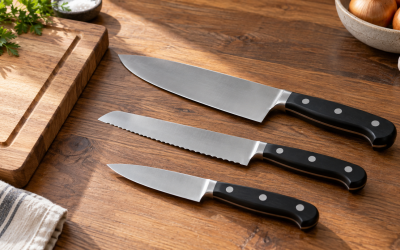
One of the most common pitfalls when shopping for high-end cutlery is purchasing massive twenty-piece blocks filled with specialty tools you will rarely use. Many manufacturers pad these sets with steak knives, utility shears, and redundant paring sizes to inflate the perceived value and price tag. Instead, look for curated sets consisting of three to five core pieces: a chef’s knife, a utility knife, a paring knife, and perhaps a bread knife or santoku. Building your collection around essential tools ensures that every single piece justifies its cost and receives regular rotation in your kitchen.
Weight Distribution and Balance Point
Balance is subjective, but it fundamentally dictates how natural a knife feels in your palm. The ideal balance point typically rests right at the bolster or the heel of the blade where it meets the handle, allowing you to execute a proper pinch grip securely and safely. Heavy heels provide natural downward momentum for chopping, while neutral balances offer swift agility for intricate cuts. Always check if the weight feels centered rather than pulling heavily toward the tip or the pommel, as poor balance strains hand muscles quickly during extended cooking sessions.
Knowing When to Upgrade
Determining when to spend more on professional-grade cutlery comes down to your frequency of use and culinary ambition. If you cook daily, process your own proteins, and find yourself constantly frustrated by factory edges that dull within a week, investing in a superior set yields immediate dividends. Higher price tags generally reflect superior heat treatment, meticulous hand-polishing, better edge retention, and ergonomic refinement that cheap alternative sets simply cannot replicate.
Related Guides
Building a comprehensive kitchen arsenal goes far beyond cutlery alone; explore our curated reviews on top-rated knife collections, durable hard anodized cookware, and professional copper sets to assemble your ultimate cooking environment. Note that our 2026 evaluations highlight gear designed to last a lifetime with proper care.
FAQ
Should I store my knives in a wooden block or on a magnetic strip?
Magnetic strips are generally superior because they prevent dulling that can occur when sliding blades in and out of tight wooden slots. They also allow the blades to air-dry thoroughly, significantly reducing moisture retention risks.
How often should I sharpen a premium chef knife?
High-end steel retains its edge exceptionally well, but you should hone the blade with a ceramic rod every few uses to realign microscopic burrs. Full sharpening with whetstones is usually only necessary one to three times a year depending on your frequency of use.
Can I put high-end kitchen knives in the dishwasher?
You should never place premium cutlery in a dishwasher, as harsh detergents, intense heat, and clattering against other utensils will ruin wooden handles and pit or chip the delicate blade edge. Always hand-wash and dry them immediately after use.
What is the difference between a santoku and a chef knife?
A chef knife features a curved belly designed for a rocking motion, while a santoku has a flatter edge meant for up-and-down chopping and often includes granton edges to prevent food sticking. Both serve similar versatile prep roles depending entirely on your preferred cutting style.