Our Top Picks
 Omega Juicer Premium Vegetable and Fruit Juice Extractor150-Watt6.5 x 14.5 x 15.5 inches13 poundsCheck on Amazon
 Hamilton Beach Centrifugal Juicer Machine With Big Mouth800W Motor11.46 x 7.8 x 14.41 inches7.8 poundsCheck on Amazon


The real decision when you buy a juicer is not which brand looks best on the counter. It is how you will actually juice: a fast centrifugal machine turns whole apples into a glass in seconds, but it is loud, it makes foam, and it wastes leafy greens. A slow masticating machine squeezes more juice from kale and celery, runs quietly, and keeps juice fresh longer, but it works slowly and costs more. Pick the wrong type and the machine ends up in a cabinet.
This guide is for daily juicers who want a glass before work, families who juice in big weekend batches, cooks who juice mostly greens, and anyone who only wants fresh orange juice. Every machine below was chosen from the name and the listed figures on its Amazon product page, so you can check each claim yourself before ordering.
Quick Picks
As an Amazon Associate we earn from qualifying purchases.
| Product | Best for | Key spec from title |
|---|---|---|
| Breville Juice Fountain Plus JE98XL | Fast whole-fruit batches | 850 watts, 3-inch chute |
| Omega NC900HDC | Leafy greens and wheatgrass | 80 RPM dual-stage, 15-year warranty |
| Hurom H-AA | Quiet mornings in small kitchens | 43 RPM, 150 watts |
| Ninja NeverClog JC151 | Pulp control on a modest budget | 150 watts, 24 oz juice jug |
| Hamilton Beach Big Mouth Pro | Big batches for little money | 800 watts, 3-inch chute |
How to Choose
Pick the juicer type first
Centrifugal juicers spin a flat disc at thousands of revolutions per minute and fling juice through a mesh screen. They are fast, they take whole apples through a wide chute, and they cost less than slow juicers. The trade is foam, noise, and weak results with leafy greens, which spin through before the disc can grip them. Slow masticating juicers crush produce with an auger at 40 to 80 revolutions per minute, so they squeeze more juice from greens and celery, run quietly, and make juice that keeps longer. Citrus presses only squeeze oranges, lemons, limes, and grapefruit, so buy one only if citrus is all you juice.
Match the chute to your prep time
A wide feed chute changes how much time you spend before the machine even starts. A 3-inch chute swallows a whole apple or a halved orange, so you wash and drop produce in without chopping. A narrow chute, like the 1.5 by 2 inch oval on a horizontal slow juicer, means cutting carrots into sticks and celery into short lengths first, which adds several minutes to every batch. If you juice before work, a wide chute is worth more than extra watts. If you juice slowly on weekends and care about yield from greens, a narrow chute is a fair trade for the extra juice.
Judge cleanup before you buy
Cleanup decides whether a juicer gets used twice a week or twice a year, so read the listed cleaning notes before you order. Centrifugal machines have a mesh basket that traps pulp in tiny holes, and dried pulp turns to cement if you leave it, so rinse the basket under running water right after juicing and use the brush that comes in the box. Slow juicers have fewer parts but more nooks around the auger and strainer, and some parts are hand wash only even when the jug is dishwasher safe. Count the parts in the listing and check which ones go in the dishwasher.
Check noise, size and warranty
A centrifugal juicer sounds like a small blender at full speed, which matters if you juice at 6 a.m. while others sleep. Slow juicers hum at conversation level, so they suit early mornings and shared walls. Measure your counter before ordering: a tall centrifugal machine can stand over 16 inches high and may not fit under wall cabinets, while a horizontal slow juicer is long and needs counter depth. Warranty length is a useful signal too. A 15-year warranty on the Omega shows the maker expects the machine to last, while a 1-year warranty on a budget pick means you should treat it as a starter machine.
The 5 Best Options
Breville Juice Fountain Plus JE98XL
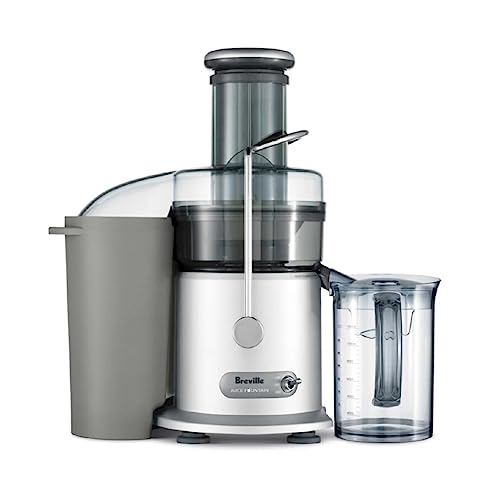
The Breville JE98XL is the classic first juicer for a household that wants juice fast and does not want to chop produce first. Its 850-watt motor drives a titanium-reinforced disc, and the 3-inch extra-wide chute takes whole apples and halved oranges, so a morning glass takes seconds rather than minutes. Two speeds cover soft fruit on low and hard carrots and beets on high. The 35.2 fl oz jug holds enough for two glasses, and the froth separator keeps foam out of the pour.
Specs
- 850-watt motor with two speeds, 6,500 RPM low and 12,000 RPM high
- 3-inch extra-wide feed chute for whole fruit
- 35.2 fl oz juice jug with froth separator
- 2.6 qt detachable pulp container
- Titanium-reinforced disc and stainless steel micro mesh filter basket
- 1-year limited warranty
Best for: Households that juice fruit and hard vegetables in fast morning batches.
Watch out for: It is loud, it makes foam, and leafy greens pass through with poor yield, so confirm the 16.42-inch height fits under your cabinets before ordering.
Omega NC900HDC
The Omega NC900HDC is a horizontal slow juicer built for people who juice greens, celery, and wheatgrass every day. Its single auger turns at 80 RPM and crushes produce in a dual-stage process, first crushing and then pressing it against the screen, which wrings out more juice and leaves drier pulp than a fast spinner. Five adjustable pressure settings let you tune the machine for soft fruit or tough greens. Beyond juice, the included nozzles and screens turn it into a pasta extruder, a sorbet maker, and a nut milk press.
Specs
- 150-watt motor with 80 RPM low-speed auger
- Exclusive dual-stage masticating extraction
- 5 adjustable pressure settings on the end cap
- 6 nozzles and 2 juicing screens included
- Ultem auger, 8 times stronger than standard plastic augers per the maker
- 15-year warranty on parts and performance
Best for: Daily green juice, wheatgrass, and cooks who want one machine that also makes pasta and sorbets.
Watch out for: The narrow 1.5 by 2 inch oval chute means cutting produce small first, and the horizontal body is long, so measure counter depth before ordering.
Hurom H-AA
The Hurom H-AA is the quietest pick here and the best fit for small kitchens and early mornings. Its 150-watt motor turns the auger at just 43 RPM, so it hums instead of roaring, and the slow squeeze keeps juice fresh for up to 72 hours when stored cold in a sealed jar. Fine and coarse strainers plus a pulp control lever let you choose smooth juice or a thicker pour. The vertical body has a small footprint, which matters when counter space is tight, and the 500 ml juice container suits one or two glasses at a time.
Specs
- 150-watt motor with 43 RPM slow squeeze technology
- Fine and coarse strainers with adjustable pulp control lever
- 500 ml juice container
- Vertical design, 7.1 by 16 by 7.1 inches
- 10.6 lb
- 10-year warranty on motor, 2-year warranty on parts
Best for: Quiet early-morning juicing in small kitchens, and anyone who stores juice for the next day.
Watch out for: The small crescent chute needs produce cut into pieces, and the 500 ml container means emptying it for big family batches.
Ninja NeverClog JC151
The Ninja NeverClog JC151 is the best value slow juicer for a household that wants pulp control without paying for a premium brand. Its 150-watt motor drives a compact auger, and the Total Pulp Control system offers two pulp functions, so you can pour smooth juice one day and a thicker glass the next. The 24 oz juice jug and 36 oz pulp container cover a family breakfast, and the parts are dishwasher safe, which makes cleanup the easiest of the slow juicers here. It is short and light enough to lift into a cabinet between uses.
Specs
- 150-watt slow masticating motor
- Total Pulp Control with 2 pulp functions
- 24 oz juice jug
- 36 oz pulp container
- Dishwasher-safe parts
- Charcoal finish
Best for: Families that want slow-juicer yield and pulp choice at a starter-machine cost.
Watch out for: It is a compact machine, so large batches need the pulp container emptied partway through, and very fibrous celery can slow the auger.
Hamilton Beach Big Mouth Pro
The Hamilton Beach Big Mouth Pro is the cheapest way to juice a lot of fruit quickly. Its 800-watt motor and 3-inch chute handle whole apples and carrots with almost no prep, and the 20-oz juice container doubles as a serving pitcher, so you pour straight from the machine to the table. The parts are dishwasher safe, and the stainless steel body wipes clean. It is the pick for a household that juices in big weekend batches and does not want to spend much to start.
Specs
- 800-watt motor, 1.1 horsepower
- 3-inch extra-large feed chute for whole fruits and vegetables
- 20-oz juice container doubles as a serving pitcher
- Dishwasher-safe parts
- Stainless steel body, BPA-free parts
Best for: Big weekend batches of fruit juice on a tight budget.
Watch out for: It is a centrifugal machine, so expect foam, noise, and weak yield from leafy greens, and check the 16-inch height against your cabinet clearance.
Which One Fits Your Situation
You juice every morning before work
Pick the Breville JE98XL or the Hamilton Beach Big Mouth Pro. Both take whole fruit through a 3-inch chute, so you wash, drop, and pour in under a minute with no chopping. The Breville is the stronger machine with a larger jug, while the Hamilton Beach costs less and still covers a fast glass. Rinse the mesh basket right away or dried pulp will slow tomorrow’s cleanup.
You juice mostly greens and celery
Pick the Omega NC900HDC. Its 80 RPM auger and dual-stage press squeeze far more juice from kale, spinach, and wheatgrass than any centrifugal machine, and the five pressure settings let you tune it for soft fruit or tough stems. Accept the narrow chute and cut produce small first. The Hurom H-AA is the quieter second choice if you juice greens in small amounts.
You juice for a family
Pick the Ninja NeverClog JC151 or the Breville JE98XL. The Ninja gives you pulp control and dishwasher-safe parts, which matters when four people drink every day, while the Breville fills its 35.2 fl oz jug fast for a breakfast table. Either way, plan on emptying the pulp container during a big batch, and store leftover juice in a sealed jar filled to the top.
You only drink orange juice
Skip the full-size juicers and buy a dedicated citrus press instead. A lever-arm citrus press squeezes oranges, lemons, limes, and grapefruit with far less cleanup than a centrifugal machine, and it costs less to store. None of the five picks above is a citrus-only machine, so check the listing of a citrus press for its cone size and pulp control before ordering.
Common Mistakes
- Buying a centrifugal juicer for daily leafy greens, then wondering why the pulp comes out wet and the yield is low.
- Leaving the mesh basket unwashed after juicing, so dried pulp hardens in the tiny holes and the next batch runs slowly.
- Feeding bananas or avocados into a juicer, which have almost no juice to give and clog the screen; blend those instead.
- Storing fresh juice in a half-empty open container, where air turns it brown and flat within hours.
- Ordering a juicer taller than the space under your wall cabinets, then leaving it on the counter because it will not fit away.
Frequently Asked Questions
Can a juicer replace a blender?
No, and the two machines do different jobs. A juicer separates juice from fiber and throws the pulp away, so you get a smooth, light drink. A blender keeps all the fiber and makes thick smoothies from bananas, berries, and yogurt. If you want both, keep both machines, because a juicer cannot blend and a blender cannot make clear juice.
How long does fresh juice keep?
Drink it within a day for the best taste, and keep it cold in a sealed jar filled to the top so air cannot reach it. Juice from a slow masticating machine keeps longer, up to 72 hours when stored cold and sealed, because the slow squeeze adds less air and heat. Juice from a centrifugal machine goes flat faster, so make only what you will drink that morning.
Why is my pulp wet?
Wet pulp usually means the produce went through too fast or the pressure setting was wrong for that ingredient. On a slow juicer, try a higher pressure setting and feed pieces slowly so the auger has time to press. On a centrifugal juicer, wet pulp is normal with soft fruit and leafy greens, which is why those ingredients belong in a slow machine instead.
Can I juice leafy greens in a centrifugal juicer?
You can, but the yield is poor and the pulp comes out damp, because light leaves spin through the mesh before the disc can grip them. Roll leaves into tight balls and mix them with hard fruit like apples to help push them through, or switch to a slow juicer. For a daily green juice habit, a masticating machine pays for itself in produce saved.
FAQ
Can a juicer replace a blender?
How long does fresh juice keep?
Why is my pulp wet?
Can I juice leafy greens in a centrifugal juicer?
More from Amazon
Programs that pair well with the guide above. Offers and eligibility are set by Amazon and may change.
Set up recurring deliveries of everyday items on eligible products. Terms and savings are set by Amazon.
Explore Subscribe & SaveCollect the home and kitchen items you want in one registry that guests can shop from.
Create a wedding registryFree shipping on eligible items, Prime Video and more. Eligible new members can start with a free trial.
Start a Prime free trialAudiobooks and podcasts to listen to on the go. Eligible new members can start with a free trial.
Try Audible freeAs an Amazon Associate we earn from qualifying purchases.