Our Top Picks
 Paderno World Cuisine 4-Blade Folding Vegetable Slicer /Folding 4-Blade9.38 x 5.63 x 5.63 inches2.98 poundsCheck on Amazon
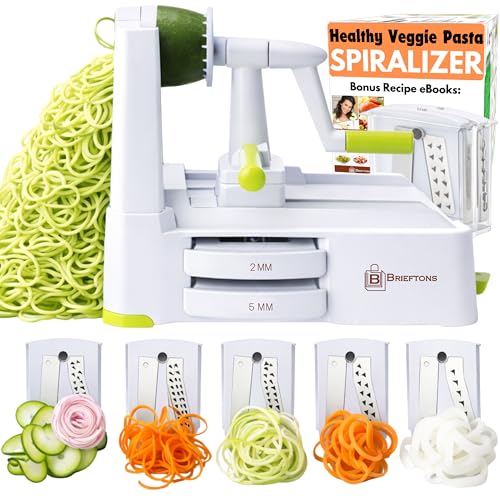 Brieftons 5-Blade Countertop Vegetable Spiralizer and Veggie Noodle5 Blades2.1 poundsCheck on Amazon
 OXO Good Grips 3-Blade Tabletop Spiralizer with StrongHoldOne Size6.25 x 9.75 x 8.25 inches1.5 poundsCheck on Amazon
 Spiralizer Ultimate 10 Strongest-and-Heaviest Duty Vegetable Slicer BestMedium13 x 20 x 27 inches1.81 poundsCheck on Amazon

A spiralizer earns its drawer space only if you actually use it, and the real choice is not which brand looks best in a photo. It is how often you will turn vegetables into noodles, which cuts you will cook most, and how much counter and cabinet space you can give a tool that does one job. A crank model that sits on the counter handles weekly batches and hard roots, while a handheld tool suits a single serving and a small kitchen.
This guide is for home cooks who want lighter noodle swaps, parents who want vegetables to look fun on the plate, and small-household cooks who need a tool that stores flat or fits in a drawer. We picked five spiralizers from the names and listed details on their Amazon product pages, and we compared blade counts, suction bases, and storage so you can match the tool to the way you cook.
Quick Picks
As an Amazon Associate we earn from qualifying purchases.
| Product | Best for | Key spec from title |
|---|---|---|
| Paderno 4-Blade Folding Spiralizer | Small kitchens and folding storage | 4 blades, folds flat |
| Brieftons 5-Blade Spiralizer | Most cut choices for family batches | 5 Japanese steel blades |
| OXO 3-Blade Tabletop Spiralizer | Everyday zucchini noodles | 3 blades, StrongHold suction |
| OXO Handheld Spiralizer | Single servings and tight drawers | Single blade, handheld |
| Spiralizer Ultimate 7-Blade | Hard roots and the most cuts | 7 blades, lifetime replacement |
How to Choose
Blade count and cut size
Blade count decides what lands on the plate. A three-blade model covers the basics: thin spaghetti strands, wider fettuccine, and flat ribbons for salads and garnishes. Five or seven blades add angel hair for delicate noodles, a curly fry cut for potatoes, and ridged pasta shapes that hold sauce better. Count the cuts you will actually cook each week, not the total on the box. If zucchini noodles are ninety percent of your use, three blades are enough. If you swap pasta for vegetables most nights and want variety, the extra blades earn their keep. Keep the blade caddy close so the spares do not vanish into a drawer.
Countertop crank or handheld
A countertop crank model clamps to the counter and turns a whole zucchini into noodles in under a minute, and it handles firm roots that would tire your wrist. It needs counter space while you work and cabinet space when you store it. A handheld spiralizer is a small cone you twist by hand, and it fits in a drawer beside the peelers. It suits one serving at a time and soft vegetables like zucchini and cucumber. For a big batch of sweet potato noodles, the crank wins on speed and comfort. For a quick lunch for one, the handheld wins on cleanup and storage.
Suction base and stability
A spiralizer only works when it stays put. Crank models grip the counter with a suction cup or a clamp, and that grip is what lets you push a firm sweet potato through the blade without the unit sliding. Test the base on your own counter before you judge it, because a wet, textured, or butcher-block surface holds less well than smooth stone or laminate. Wipe the counter dry, press the lever down firmly, and give the unit a tug before you start. A model that wobbles will give you uneven strands and a sore wrist, so treat a weak base as a deal breaker.
Cleaning and storage
Spiralizer blades are sharp, so cleaning matters as much as cutting. Look for blades and pushers that go in the dishwasher, and use the cleaning brush that comes in the box to clear strands from the teeth before they dry on. A blade caddy or a holder inside the unit keeps spare blades together and keeps fingers safe. Folding models collapse flat for a shelf, while fixed frames need a full cabinet slot. Measure your cabinet before you buy a large crank model, and keep the manual nearby for the first few uses so you learn which blade makes which cut.
The 5 Best Options
Paderno 4-Blade Folding Spiralizer
The Paderno is the classic countertop crank spiralizer, and it fits cooks who want a proven design that folds flat when the job is done. Its four blades cover the cuts most home cooks use every week: three julienne widths for spaghetti-style strands and a flat blade for ribbons. The folding body opens for work and collapses for a shelf, which matters in a kitchen where cabinet space is tight. The blades are stainless steel, the body is BPA-free plastic, and the whole unit goes in the dishwasher. It is a manual tool with no cord and no motor, so it works anywhere on the counter.
Specs
- 4 stainless steel blades: julienne blades in 3/32, 1/8, and 1/4 inch, plus a 1/8-inch flat ribbon blade
- Folding body with a blade holder for storage
- BPA-free ABS plastic construction
- Dishwasher safe
- Model A4982800
Best for: Cooks who want a folding crank spiralizer that stores flat.
Watch out for: Confirm the white 4-blade model on the listing, since an out-of-stock red listing of the same model was swapped for the white one in roundups.
Brieftons 5-Blade Spiralizer
The Brieftons is the middle-ground crank spiralizer, and it suits cooks who want more cut choices without jumping to a seven-blade frame. Its five Japanese stainless steel blades make angel hair, spaghetti, fettuccine, and ribbons, so one tool covers delicate noodles and wide garnish cuts. A strong suction cup holds the unit to the counter, and a blade caddy keeps the spare blades together between uses. The listing also includes four recipe eBooks for low-carb, vegan, paleo, and gluten-free meals. It is a manual crank model, so there is no motor to fail and no cord to store.
Specs
- 5 Japanese stainless steel blades for angel hair, spaghetti, fettuccine, and ribbon cuts
- Strong suction cup base
- Blade caddy included for spare blade storage
- 4 recipe eBooks included
- Model 712038187669
Best for: Family batches and cooks who want five cut choices in one crank unit.
Watch out for: No container is listed with this model, so strands land on the counter unless you set a bowl under the blade end.
OXO 3-Blade Tabletop Spiralizer
The OXO tabletop model is the simplest crank spiralizer in this guide, and it fits cooks who make zucchini noodles most nights and want a tool that is easy to set up. Its three blades make spaghetti, fettuccine, and ribbon cuts, which covers the three shapes most recipes call for. The StrongHold suction base grips smooth counters, and the blades store inside the unit so nothing loose rattles around a drawer. The parts go in the dishwasher, and the compact frame takes less cabinet space than the larger seven-blade units. It is a good first spiralizer for a cook who is still learning which cuts they like.
Specs
- 3 stainless steel blades for spaghetti, fettuccine, and ribbon cuts
- StrongHold suction base
- Blades store inside the unit
- Dishwasher safe
Best for: Everyday zucchini noodles and cooks buying their first spiralizer.
Watch out for: Only three cuts are included, so there is no angel-hair blade for very fine noodles; the suction base needs a smooth, dry counter to hold well.
OXO Handheld Spiralizer
The OXO handheld is the smallest tool here, and it fits cooks who spiralize one serving at a time and have no room for a crank frame. It is a single-blade cone you hold in one hand and twist, and it turns a zucchini or cucumber into noodles in seconds. There is nothing to clamp, nothing to fold, and nothing to plug in, so cleanup is a rinse and the tool slips into a drawer. The single blade makes one cut width, which keeps the choice simple but limits variety. It is the right pick for a quick lunch, a garnish, or a small household that skips full batches.
Specs
- Single-blade handheld design
- Model 11151300
- Compact size for drawer storage
- No cord, no motor, no assembly
Best for: Single servings, small kitchens, and quick garnishes.
Watch out for: One blade means one cut width, and large batches of firm vegetables will tire your wrist; use a crank model for family-size portions.
Spiralizer Ultimate 7-Blade
The Spiralizer Ultimate 7 is the heaviest-duty crank model in this guide, and it fits cooks who spiralize hard roots every week and want the widest set of cuts. Its seven blades make 2mm noodles, 3mm spaghetti strands, 5mm fettuccine, 5.5mm curly fries, wide ribbons, and two ridged pasta shapes, so one frame covers nearly every noodle swap. The blades are 420 high-carbon cutlery-grade stainless steel, and the ultra-reinforced ABS frame is built to take firm sweet potatoes and turnips without flexing. The listing includes four recipe eBooks and a lifetime replacement policy, which is rare at this level.
Specs
- 7 blades in 420 high-carbon cutlery-grade stainless steel
- Cuts include 2mm noodles, 3mm spaghetti, 5mm fettuccine, 5.5mm curly fries, wide ribbons, and ridged pasta
- Ultra-reinforced ABS frame
- 4 recipe eBooks included
- Lifetime replacement policy
- Dishwasher safe
Best for: Hard roots, heavy weekly use, and cooks who want the most cut choices.
Watch out for: The frame is bulky and does not fold, so it needs a full cabinet slot; the dimension field on some listing summaries looks wrong, so confirm the real footprint before ordering.
Which One Fits Your Situation
Weekly zucchini noodles for one or two
Pick the OXO 3-Blade Tabletop Spiralizer or the OXO Handheld Spiralizer. The tabletop model handles a nightly batch with its suction base and three useful cuts, while the handheld suits a single serving and stores in a drawer. Both rinse clean fast, and neither needs a large cabinet slot. Skip the seven-blade frame unless you also cook for a crowd.
Big family batches and hard roots
Pick the Spiralizer Ultimate 7-Blade or the Brieftons 5-Blade Spiralizer. Both are crank models with strong bases and sharp steel blades that cut through sweet potatoes and turnips without flexing. The seven-blade model adds curly fries and ridged pasta, while the five-blade model is lighter and stores its blades in a caddy. Either one turns a full batch in minutes.
Small kitchen, little storage
Pick the Paderno 4-Blade Folding Spiralizer or the OXO Handheld Spiralizer. The Paderno folds flat for a shelf and still gives you four cuts, while the handheld fits in a drawer beside the peelers. Both are manual tools with no cord and no motor, so there is nothing extra to store. Measure your shelf before you buy a fixed-frame crank model.
First spiralizer, most cuts for the money
Pick the Brieftons 5-Blade Spiralizer. Five blades cover angel hair, spaghetti, fettuccine, and ribbons, and the blade caddy keeps everything together. The suction base holds firm on a smooth counter, and the recipe eBooks give you starting ideas for low-carb and gluten-free meals. It is a middle-ground choice that does not lock you into one cut.
Common Mistakes
- Forcing old, woody carrots or raw beets through the blade without trimming both ends flat first.
- Spiralizing soft ripe produce like ripe tomatoes or soft avocados, which turns to mush instead of strands.
- Cranking on a wet or textured counter and blaming the tool when the suction base slides.
- Storing loose blades in a drawer, where they dull fast and nick fingers.
- Picking a vegetable wider than the prong holder, then pushing hard and bending the frame.
Frequently Asked Questions
Can a spiralizer cut hard vegetables like sweet potatoes?
Yes, with the right model and some prep. Use a countertop crank spiralizer with a firm suction base, trim both ends flat, and center it on the prongs before you turn the handle. Handheld models struggle with hard roots, so save them for zucchini and cucumber. Peel sweet potatoes and beets first, and cut very long roots in half so the crank arm can finish the pass.
Do I need to peel vegetables before spiralizing?
It depends on the vegetable. Zucchini and cucumber keep their skins, which hold the strands together and add color. Carrots, beets, and sweet potatoes need peeling, since their skins are tough and can taste bitter. Butternut squash needs peeling and seeding, and you should use only the straight neck, not the round bulb end. Wash everything well either way, and trim both ends flat so the prongs grip.
How do I clean a spiralizer?
Rinse blades right after use, before strands dry on the teeth. Use the brush from the box to clear the blade slots, then wash blades and pushers in the dishwasher where the listing says they are dishwasher safe. Wipe the frame with a damp cloth and dry before storage. Never run a sponge over a bare blade with your bare hand, and store spares in the caddy.
What is the difference between a spiralizer and a mandoline?
A spiralizer turns vegetables into long strands and ribbons by rotating them against a blade, while a mandoline slices them into flat rounds, planks, and matchsticks with a straight pass. They are different tools for different cuts, and one does not replace the other. A mandoline is better for salads and gratins, while a spiralizer is better for noodle swaps and curly garnishes.
FAQ
Can a spiralizer cut hard vegetables like sweet potatoes?
Do I need to peel vegetables before spiralizing?
How do I clean a spiralizer?
What is the difference between a spiralizer and a mandoline?
More from Amazon
Programs that pair well with the guide above. Offers and eligibility are set by Amazon and may change.
Set up recurring deliveries of everyday items on eligible products. Terms and savings are set by Amazon.
Explore Subscribe & SaveCollect the home and kitchen items you want in one registry that guests can shop from.
Create a wedding registryFree shipping on eligible items, Prime Video and more. Eligible new members can start with a free trial.
Start a Prime free trialAudiobooks and podcasts to listen to on the go. Eligible new members can start with a free trial.
Try Audible freeAs an Amazon Associate we earn from qualifying purchases.