Our Top Picks
 Victorinox Fibrox 10.25-Inch Bread Knife with Serrated Edge10.3"15.1 x 1.6 x 0.75 inches0.3 poundsCheck on Amazon


The real decision when you buy a bread knife is not which brand looks most impressive in the block. It is how the blade meets the loaf: a long serrated edge saws through a hard sourdough crust without pressing down, while a short straight edge crushes the soft crumb underneath. Pick a blade that is too short and it cannot cross a wide boule in one stroke. Pick teeth that are too aggressive and they tear soft sandwich bread into crumbs. The right knife lets the teeth do the work, so your hand stays light and the slice stays even.
This guide is for home bakers who slice sourdough every morning, cooks who want one knife for bread and tomatoes, and anyone replacing a dull serrated blade. Every knife below was chosen from the name and the listed figures on its Amazon product page, so you can check each claim yourself before ordering.
Quick Picks
As an Amazon Associate we earn from qualifying purchases.
| Product | Best for | Key spec from title |
|---|---|---|
| WÜSTHOF Classic 10″ Super Slicer | Wide boules and tall loaves | 10-inch blade, outward-curved edge |
| Victorinox Fibrox Pro 10.25″ | Daily slicing on a modest budget | 10.25-inch blade, Fibrox handle |
| Mercer Culinary Millennia M23210 | Pro-kitchen feel for little money | 10-inch wide wavy edge |
| Shun Classic 9″ | Premium Japanese steel, shorter blade | VG-MAX core, 68-layer Damascus |
| WÜSTHOF Classic 9″ Double-Serrated | Crusty loaves with few crumbs | Double-serrated edge, 58 HRC |
How to Choose
Match blade length to your loaf
A bread knife must cross the whole loaf in one stroke, or the slice comes out wedge-shaped and ragged. Measure the widest loaf you bake or buy: a standard sandwich loaf needs about 8 inches, a round boule often needs 9 or 10, and a long baguette needs a blade that can reach across its width at an angle. A 10-inch blade suits most home bakers because it handles boules and sandwich loaves alike, while a 9-inch blade feels easier to control on smaller loaves and cakes. A blade longer than 10 inches is hard to store and unwieldy on a small board, so skip it unless you regularly slice very wide loaves.
Read the tooth shape, not just the word serrated
Every bread knife is serrated, but the teeth differ in ways that change the cut. Wide wavy teeth, like those on the Mercer, glide through crust with a gentle sawing motion and leave few crumbs. Pointed teeth bite hard crust fast but can tear soft crumb if you press down. Scalloped teeth, with rounded curves, cut clean slices of soft bread and layer cake without shredding the surface. WÜSTHOF’s double-serrated edge puts small scallops inside larger ones, so it stays sharp longer and needs less pressure. Match the tooth to your bread: pointed or double-serrated for hard sourdough crust, wide wavy or scalloped for soft sandwich loaves and cakes.
Steel and hardness decide how long the edge lasts
German stainless steel, like the X50CrMoV15 in the WÜSTHOF blades, is tough and easy to maintain, and it resists rust. Japanese steel, like the VG-MAX core in the Shun and the high-carbon steel in the Mercer, can take a finer edge and hold it longer, but it asks for more care. Hardness, given as an HRC number on the listing, tells you how the steel behaves: a blade near 56 HRC is tough and forgiving, while one near 60 HRC holds a sharper edge longer but can chip if it hits bone or a hard board. Forged blades, made from one piece of steel, feel heavier and more solid than stamped blades cut from sheet.
Handle, tang and care decide how it feels in hand
A bread knife works with a light sawing motion, so the handle matters as much as the blade. A full tang, where the steel runs through the whole handle, gives balance and strength, and triple rivets lock the handle scales in place. Textured synthetic handles, like the Fibrox on the Victorinox and the Santoprene on the Mercer, stay grippy with wet or floury hands. Wood handles, like the PakkaWood on the Shun, feel warm and look beautiful but need hand washing. Most good bread knives are hand wash only: the dishwasher dulls the edge, loosens handles and can warp wood, so wash by hand, dry at once and store it in a block or on a magnetic strip.
The 5 Best Options
WÜSTHOF Classic 10″ Super Slicer

The Super Slicer is WÜSTHOF’s answer to wide, tall loaves. Its 10-inch blade is the longest here, and the outward-curved serrated edge lets you saw through a tall sourdough boule in one smooth stroke without rocking the loaf. The blade is 1.6 inches wide, so it stays steady through thick crust, and the forged German steel, tempered to 58 HRC, holds its edge through daily slicing. The triple-riveted handle fills the hand and stays secure with floury fingers. It is the heaviest knife in this guide, so it suits cooks who like a planted, solid feel.
Specs
- 10-inch blade, 1.6 inches wide
- Outward-curved serrated edge
- Forged high-carbon stainless steel, 58 HRC
- Triple-riveted synthetic handle, 4.5 inches long
- Made in Solingen, Germany
- Model 1040133126
Best for: Wide boules and tall loaves.
Watch out for: The 10-inch blade needs a long drawer or a block slot that fits it, so measure your storage first.
Victorinox Fibrox Pro 10.25″
The Victorinox is the workhorse of this guide and the easiest knife to recommend to most home cooks. Its 10.25-inch blade is long enough for wide boules, yet the knife stays light in the hand, so long slicing sessions do not tire your wrist. The Fibrox Pro handle is shaped for a secure grip even when your hands are damp, and the extra-wide blade keeps the cut straight through soft sandwich loaves and tomatoes alike. It is not the prettiest knife here, and the stamped blade lacks the heft of a forged one, but for daily bread slicing it is hard to beat.
Specs
- 10.25-inch serrated blade
- High-carbon stainless steel
- Fibrox Pro non-slip handle
- Extra-wide blade for straight cuts
- NSF approved
Best for: Daily slicing on a modest budget.
Watch out for: The stamped blade is lighter than forged knives, so it can feel less planted in the hand.
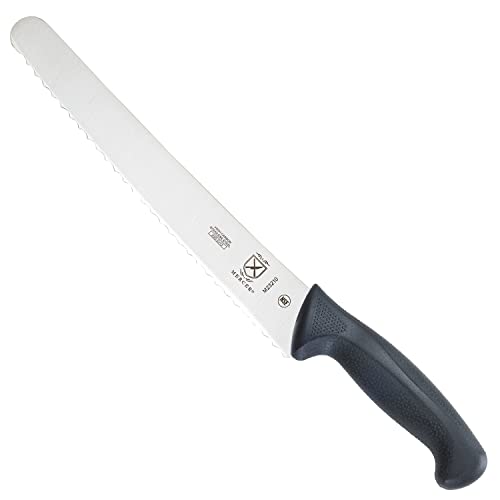
Mercer Culinary Millennia M23210
The Mercer is the knife you will find in professional kitchens, and it brings that same performance home for very little money. Its wide wavy edge glides through crusty sourdough with a gentle sawing motion, leaving few crumbs and a clean face on each slice. The one-piece high-carbon Japanese steel takes a sharp edge and is easy to maintain, while the Santoprene handle with textured finger points stays grippy even with wet hands. The stamped blade is light, so it suits long slicing sessions, though cooks who like a heavy forged knife may find it too light.
Specs
- 10-inch wide wavy edge
- One-piece high-carbon Japanese steel
- Santoprene and polypropylene handle with textured finger points
- Protective finger guard
- NSF certified
- Hand wash only
Best for: Pro-kitchen feel for little money.
Watch out for: The 10-inch blade is long for a small board, so measure your cutting board and storage before ordering.
Shun Classic 9″
The Shun is the premium pick in this guide, and it shows in every detail. Its 9-inch VG-MAX blade, wrapped in 68 layers of Damascus cladding, takes a 16-degree edge that slices crusty loaves and delicate layer cakes with the same clean cut. The D-shaped ebony PakkaWood handle fits either hand and feels warm and secure, while the full composite tang keeps the knife light and balanced. At 7.4 ounces it is easy to control, though the 9-inch blade cannot cross the widest boules in one stroke. Shun backs it with a lifetime warranty and free honing.
Specs
- 9-inch serrated blade
- VG-MAX steel core with 68 layers of Damascus cladding
- 16-degree edge
- D-shaped ebony PakkaWood handle
- 7.4 ounces, 15 inches overall
- Handcrafted in Japan
- Lifetime warranty with free honing
Best for: Premium Japanese steel in a shorter, easy-to-control blade.
Watch out for: The 9-inch blade cannot cross the widest boules in one stroke, and the PakkaWood handle needs hand washing.
WÜSTHOF Classic 9″ Double-Serrated
The double-serrated Classic is the WÜSTHOF for cooks who slice hard-crusted sourdough every day. Its edge carries small scallops inside larger ones, so it bites the crust with less pressure and stays sharp longer than a single-serrated edge, leaving fewer crumbs on the board. The 9-inch forged blade, tempered to 58 HRC, feels solid and planted, and the full bolster guards your fingers while the triple-riveted handle stays secure. It is shorter than the Super Slicer, so very wide boules need two strokes, but for everyday loaves it is the most precise cutter here.
Specs
- 9-inch double-serrated blade
- Forged high-carbon stainless steel, 58 HRC
- Full tang with triple-riveted POM handle
- Full bolster with finger guard
- 0.41 pounds, 4.4-inch handle
- Made in Germany
- Model 1040101123
Best for: Crusty loaves with minimal crumbs.
Watch out for: At 9 inches it is shorter than the Super Slicer, so very wide boules need two strokes.
Which One Fits Your Situation
You bake sourdough every week
Pick the Mercer Millennia or the WÜSTHOF double-serrated Classic. Both edges are built for hard crust: the Mercer’s wide wavy teeth glide through a boule with few crumbs, while the double-serrated WÜSTHOF bites with less pressure and holds its edge longer. The Mercer costs far less, so it is the smart buy if you slice daily; the WÜSTHOF is the buy-forever choice if you want a forged blade.
You want one knife for bread and tomatoes
Pick the Victorinox Fibrox Pro. Its 10.25-inch blade crosses wide loaves in one stroke, and the same serrated edge slices ripe tomatoes without squashing them. The light stamped blade and grippy Fibrox handle make it easy to use every day, and it is the most forgiving knife here if your hands are damp or your board is small.
You want a premium knife as a gift
Pick the Shun Classic. The VG-MAX blade with Damascus cladding, the ebony PakkaWood handle and the handcrafted-in-Japan story make it feel like a gift the moment it comes out of the box. The 9-inch blade suits most loaves and layer cakes, and the lifetime warranty with free honing means the recipient can keep it sharp for years.
You slice crusty loaves for a crowd
Pick the WÜSTHOF Super Slicer. Its 10-inch blade and 1.6-inch width cross the widest boules in one stroke, so you can slice a whole loaf fast without ragged ends. The outward-curved edge saws through tall crusts without rocking the loaf, and the heavy forged blade does the work while your hand stays light.
Common Mistakes
- Pressing down hard while sawing: let the teeth do the work, since pressure crushes the crumb and tears soft bread.
- Slicing on a glass or stone board: hard surfaces dull serrations fast, so use wood or soft plastic instead.
- Putting a good bread knife in the dishwasher: heat and detergent dull the edge and loosen handles, so wash by hand and dry at once.
- Trying to sharpen serrations with a flat stone: serrated teeth need a tapered rod or a professional service, since a flat stone ruins the tooth shape.
- Storing the blade loose in a drawer: the edge knocks against other tools and dulls, so use a block, a sheath or a magnetic strip.
Frequently Asked Questions
What size bread knife is best for home use?
A 9- or 10-inch blade suits most home kitchens. A 10-inch blade crosses wide boules in one stroke, while a 9-inch blade feels easier to control on smaller loaves and cakes. Measure your widest loaf before you buy: the blade should reach across it with a little room to spare, or the slice comes out uneven.
Can a bread knife cut tomatoes and cake?
Yes. A serrated edge grips the skin of a ripe tomato and slices it without squashing the flesh, and the same long blade cuts layer cake in clean, even slices. Keep the blade for soft foods with skins or crusts, and use a straight-edged chef’s knife for meat and vegetables that need a smooth push cut.
How do I sharpen a serrated bread knife?
Serrated teeth cannot be sharpened on a flat stone, which would grind the tooth shape away. Use a tapered ceramic rod that fits between the teeth, working each scallop with a few light strokes, or take the knife to a professional sharpener. Many serrated knives stay usable for years with no sharpening at all if you slice on wood and wash by hand.
Should I wash a bread knife in the dishwasher?
No. Hand wash the blade with warm water and mild soap, then dry it at once. Dishwasher heat and detergent dull the serrated edge, loosen rivets and handles, and can warp wood handles like PakkaWood. A quick hand wash takes less than a minute and keeps the knife sharp and safe for years.
FAQ
What size bread knife is best for home use?
Can a bread knife cut tomatoes and cake?
How do I sharpen a serrated bread knife?
Should I wash a bread knife in the dishwasher?
More from Amazon
Programs that pair well with the guide above. Offers and eligibility are set by Amazon and may change.
Set up recurring deliveries of everyday items on eligible products. Terms and savings are set by Amazon.
Explore Subscribe & SaveCollect the home and kitchen items you want in one registry that guests can shop from.
Create a wedding registryFree shipping on eligible items, Prime Video and more. Eligible new members can start with a free trial.
Start a Prime free trialAudiobooks and podcasts to listen to on the go. Eligible new members can start with a free trial.
Try Audible freeAs an Amazon Associate we earn from qualifying purchases.