Key takeaways
- 1 to 1.5 quarts: Approximately 5 to 6 inches in diameter and ideal for butter, gravy, a single serving of soup, baby food, oatmeal, or warming small portions.
- 2 to 3 quarts: Approximately 6 to 7.5 inches in diameter. This is the best all-purpose range for most homes, handling pasta sauce, rice, custard, vegetables, and two to four servings.
- 4 to 5 quarts: Often 8 to 9 inches wide and useful for larger batches, family-size sauces, beans, and reheating. It needs more storage space and may be awkward on a small burner.
What's inside
- Decide These 3 Things First
- Size: Match Capacity to the Food You Actually Make
- Material: Choose Heat Control, Maintenance, or Ease
- Construction: Inspect the Base Before the Finish
- Comfort and Performance: Weight Is Only Useful If You Can Handle It
- Price Tiers: Know What Your Money Should Buy
- Warranty: Look for Coverage That Matches the Construction
- Delivery and Assembly: Simple Products Still Need Inspection
- Spec Checklist
- Red Flags
- FAQ
A heavy bottom saucepan is one of the most useful pieces of cookware in a kitchen, but “heavy” alone is not a buying specification. A pan can feel substantial yet heat unevenly, have a thin wall that scorches food, or use a base that is poorly bonded and eventually separates. The best choice depends on what you cook, how many people you serve, and which stovetop you use.
- Decide These 3 Things First
- Size: Match Capacity to the Food You Actually Make
- Material: Choose Heat Control, Maintenance, or Ease
- Construction: Inspect the Base Before the Finish
- Comfort and Performance: Weight Is Only Useful If You Can Handle It
- Price Tiers: Know What Your Money Should Buy
- Warranty: Look for Coverage That Matches the Construction
- Delivery and Assembly: Simple Products Still Need Inspection
- Spec Checklist
- Red Flags
- FAQ
Common buying mistakes include choosing a pan that is too large for everyday portions, assuming stainless steel is automatically nonstick, and judging quality by weight without checking the base construction. Shoppers also overlook lid fit, handle clearance, oven limits, and whether the pan actually works with induction. This guide explains how to choose a heavy bottom sauce pan in 2026, with practical measurements and price expectations that make product listings easier to compare.
As an Amazon Associate we earn from qualifying purchases at no extra cost to you. Product prices and availability are accurate as of the date shown and are subject to change.


Decide These 3 Things First
- Your usual batch size: A 1.5- to 2-quart pan suits sauces, oatmeal, reheating, and one or two servings. A 3-quart pan is the most versatile size for families, while 4 to 5 quarts is better for gravy, soup, pasta sauce, and larger batches.
- Your cooktop: Gas and electric stoves work with most metal cookware. Induction requires a magnetic base, usually stainless steel with a ferromagnetic disk or an induction-ready multilayer construction. If you are unsure, check the product specifications rather than relying on appearance.
- Your cleaning and cooking habits: Stainless steel is durable but can need soaking and temperature control. Nonstick is easier for delicate sauces and low-fat cooking but typically has more limits on high heat, metal utensils, and abrasive cleaning.
Size: Match Capacity to the Food You Actually Make
Saucepan capacity is measured to the rim, so usable capacity is lower if you want to prevent bubbling over. As a practical rule, leave about 20 percent of the pan empty when simmering liquids.
- 1 to 1.5 quarts: Approximately 5 to 6 inches in diameter and ideal for butter, gravy, a single serving of soup, baby food, oatmeal, or warming small portions.
- 2 to 3 quarts: Approximately 6 to 7.5 inches in diameter. This is the best all-purpose range for most homes, handling pasta sauce, rice, custard, vegetables, and two to four servings.
- 4 to 5 quarts: Often 8 to 9 inches wide and useful for larger batches, family-size sauces, beans, and reheating. It needs more storage space and may be awkward on a small burner.
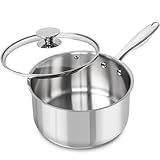
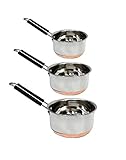
A 3-quart option such as the MICHELANGELO example is a sensible middle-ground size, while the 1.5-quart Cuisinart example is designed for smaller jobs. The 4.5-quart Winco example is better suited to batch cooking. A three-piece set, such as the Royal Sapphire set, can make sense if you regularly use several sizes, but check whether all three pans have the same base quality and whether storage space is available.
Material: Choose Heat Control, Maintenance, or Ease
Tri-ply stainless steel usually combines a stainless-steel cooking surface with an aluminum core and an exterior stainless layer. Aluminum spreads heat quickly, while steel provides durability and compatibility with many cooktops. A fully clad pan heats across the base and sidewalls, which can help with custards and reductions.
Encapsulated-base stainless steel has a thick disk bonded to the bottom. It can provide excellent base stability at a lower price than fully clad cookware, but the sidewalls may remain less responsive. This construction is often a strong value for basic simmering and sauce work.
Nonstick-coated aluminum or stainless steel is convenient for eggs, milk sauces, and sticky foods. Look for a coating described as multilayer or reinforced, but remember that marketing language is not a standardized durability rating. Use silicone, wood, or plastic utensils unless the manufacturer specifically permits metal.
Copper-bottom cookware can respond quickly to temperature changes, although the copper may discolor and requires more care. A copper-colored base is not necessarily solid copper; confirm the construction details before paying a premium.
Construction: Inspect the Base Before the Finish
The base is the most important part of a heavy bottom sauce pan. Look for an advertised base thickness of roughly 3 to 5 millimeters, or a clearly described multi-layer or encapsulated base. Not every manufacturer publishes thickness, so also inspect photographs and specifications for phrases such as “bonded base,” “impact-bonded disk,” “fully clad,” or “aluminum core.”
The bottom should sit flat without rocking. A broad, even base generally distributes heat better than a small central disk, particularly on electric and induction cooktops. The pan should also be thick enough to resist warping when moved between heat and a cooler surface. Avoid intentionally shocking a hot pan with cold water, regardless of its construction.
Check the transition between the base and the sidewall. A visible disk edge is not automatically a problem, but it should be securely bonded with no gaps, lifting, or rough separation. Riveted handles should have smooth, tight rivets, and welded handles should show clean, continuous attachment.
Comfort and Performance: Weight Is Only Useful If You Can Handle It
A practical 2- to 3-quart heavy-bottom saucepan often weighs about 2.5 to 5 pounds without its lid. Larger 4- to 5-quart models can weigh approximately 4 to 7 pounds empty. Add the contents, and a full 3-quart pan may weigh 7 to 10 pounds. If you have limited grip strength, choose a moderately heavy pan with a broad, comfortable handle rather than the heaviest model available.
Look for a handle that is at least 6 to 8 inches long, stays clear of the hottest part of a gas flame, and provides enough room for an oven mitt. A helper handle is valuable on 4-quart and larger pans. The lid knob should be easy to grasp and should not become excessively hot unless it is specifically designed for high-temperature use.
For performance, a thick base should heat steadily rather than simply heat slowly. When making milk, cheese, or egg-based sauces, use low to medium heat and stir frequently. Heavy construction reduces temperature swings, but it cannot prevent scorching if the burner is too powerful or the pan is left unattended.
Price Tiers: Know What Your Money Should Buy
Budget: $20 to $45. Expect small or medium stainless-steel pans, encapsulated bases, basic lids, and occasional nonstick coatings. The Cuisinart 1.5-quart example is listed at $24.95, while the MICHELANGELO 3-quart example is listed at $38.59. At this level, verify induction compatibility, handle attachment, and the coating or base description carefully.
Midrange: $45 to $100. You are more likely to find thicker bonded bases, better-fitted lids, stronger handles, and more consistent finishing. A $50 set, such as the Royal Sapphire example listed at $49.99, may offer several capacities, but compare each pan’s construction with a single higher-quality saucepan before deciding.
Premium: $100 to $250 or more. This tier may include fully clad stainless steel, thicker aluminum or copper cores, refined handles, tighter tolerances, and longer warranties. A premium price is worthwhile if you cook sauces frequently, need precise temperature response, or want cookware for many years. It is not necessary for occasional reheating.
As a reference point, the 4.5-quart Winco example is listed at $39.99, showing that larger capacity does not automatically mean a premium price. Prices can change by retailer, finish, and promotions.
Warranty: Look for Coverage That Matches the Construction
A warranty of one year is common on budget cookware, while limited lifetime warranties are more typical in higher-priced lines. Read the exclusions: coatings may have shorter coverage than the metal body, and damage from overheating, misuse, commercial use, or abrasive cleaners may not qualify.
Save the receipt and product description, particularly if the listing makes specific claims about induction, oven use, or dishwasher safety. A warranty will not compensate for choosing a pan that is too small, so prioritize fit and construction before the length of coverage.
Delivery and Assembly: Simple Products Still Need Inspection
Saucepans require no assembly, but shipping can expose weaknesses. A pan and lid should arrive with enough packaging to prevent dents, bent rims, and scratched nonstick surfaces. Check that the lid sits evenly and that the pan does not rock on a flat counter before washing it.
For online purchases, confirm the delivered package includes the lid, any advertised helper handle, and the correct capacity. A saucepan weighing 5 to 7 pounds may also raise shipping costs. If delivery damage is visible, photograph the box and pan before returning it.
Spec Checklist
| Spec | Budget | Mid | Premium |
|---|---|---|---|
| Typical price | $20–$45 | $45–$100 | $100–$250+ |
| Useful capacities | 1.5–3 qt | 2–4 qt | 2–5 qt |
| Base construction | Thick or encapsulated disk | Bonded base or basic clad | Fully clad, often 3–5 layers |
| Approximate empty weight | 2–4 lb | 3–6 lb | 4–7 lb |
| Induction | Verify explicitly | Common, but confirm | Usually available |
| Lid and handle | Basic lid and riveted handle | Better fit and grip | Balanced handle, helper handle, refined lid |
| Warranty expectation | 1 year or limited coverage | Several years or limited lifetime | Limited lifetime is common |
Red Flags
- The listing says “heavy duty” but gives no material, base, weight, or construction details.
- The pan is labeled induction-compatible without identifying a magnetic stainless base or providing a compatibility symbol.
- The base looks visibly uneven, has gaps around the disk, or is smaller than the main cooking surface.
- The capacity is listed, but the actual diameter and height are missing.
- There is no clear oven-temperature limit for the pan, lid, or handle.
- A nonstick pan promises dishwasher and metal-utensil safety without explaining the coating or care limits.
- The lid rattles, the handle twists, or the pan rocks on a flat surface.
- A very low price is paired with unusually broad claims, such as professional performance, induction use, and unlimited oven safety.
FAQ
What makes a saucepan heavy bottom?
A heavy-bottom saucepan has a thicker, denser base than its sidewalls, usually made with a bonded aluminum, stainless-steel, or copper layer. Look for a 3- to 5-millimeter base or a clearly described encapsulated or multilayer construction.
Is a 3-quart saucepan the best all-purpose size?
For many households, yes. A 3-quart pan is large enough for sauces, grains, vegetables, and several servings without being as bulky as a 4- or 5-quart model. Choose 1.5 to 2 quarts for mostly single servings, or 4 to 5 quarts for batch cooking.
Does a heavier saucepan cook better?
Not necessarily. A well-bonded base matters more than total weight. Excessive weight can make pouring and lifting difficult, while a properly designed 3- to 5-millimeter base can provide stable heating without making the pan impractical.
Can a heavy-bottom saucepan go in the oven?
Only if the manufacturer specifies an oven-safe temperature for the complete pan. Stainless-steel bodies may tolerate high heat, but lids, silicone grips, painted finishes, and nonstick coatings often have lower limits. Treat the lowest-rated component as the maximum temperature.