Key takeaways
- Large cooking capacity: A 14-inch skillet is practical for four to six servings, depending on the food. It gives ingredients room to brown instead of steam.
- Excellent heat retention: Once preheated, the pan holds heat well for searing, frying, roasting, and baking.
- Versatility: It can move from stovetop to oven, provided the handle and any included accessories are oven-safe at the temperature you plan to use.
- Durability: Properly maintained cast iron can last for decades. There are no delicate nonstick coatings to scratch or peel.
- Useful for batch cooking: The extra surface area can save time when cooking burgers, pancakes, vegetables, or chicken for a group.
- Good value over time: A traditional 14- or 15-inch model can cost roughly $40 to $70, which is reasonable for a pan that may remain useful for generations.
- Stable on the stovetop: The weight helps prevent the skillet from shifting while you stir or turn food.
What's inside
The Short Answer
Yes, a 14-inch cast iron skillet is too heavy for many home cooks—but it is manageable if you are comfortable lifting roughly 11 to 14 pounds with one hand and have enough stovetop, oven, and storage space. The deciding condition is whether you can safely lift, rotate, and pour from the fully loaded pan, not whether you can carry the empty skillet from a cabinet to the stove.
A large cast iron skillet can be an excellent tool for cooking several steaks, a family-size hash, cornbread, or a skillet meal for four to six people. It can also become awkward fast. Add two pounds of potatoes, meat, and sauce, and the total load can approach 17 to 20 pounds. That is a substantial amount to control with a short main handle, especially when the pan is hot.
As an Amazon Associate we earn from qualifying purchases at no extra cost to you. Product prices and availability are accurate as of the date shown and are subject to change.


What You Actually Get
A 14-inch cast iron skillet typically measures about 14 inches across the upper rim, but its usable cooking surface is usually closer to 11 1/2 to 12 1/2 inches. Overall length, including the handle, is often 18 to 20 inches. The exact dimensions vary by manufacturer and by whether the measurement includes pour spouts, helper handles, or a curved rim.
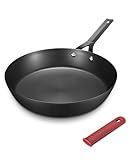
Empty weight commonly falls between 11 and 14 pounds. A thinner “chef collection” design may be closer to the lower end, while a traditional, thick-walled skillet can be heavier. The Lodge Chef Collection 14 Inch Pre-Seasoned Cast Iron Skillet, for example, is designed to reduce some of the bulk associated with older, very thick cast iron pans and is listed around the low-11-pound range. Its reference price is about $59.90.
For comparison, Lodge’s 15-inch Pre-Seasoned Cast Iron Skillet with an easy-grip handle is commonly listed around 12 to 13 pounds and costs about $39.99. It gives you slightly more capacity for less money, but the extra inch does not make it easier to handle. It can also be harder to fit over a standard burner or into a smaller oven.
The benefit of this size is usable surface area. A 14-inch skillet can hold multiple chicken thighs without crowding, brown a large batch of ground meat, or sear several steaks in one round. It is also useful for baking a large cornbread or preparing a meal that would overflow a 10- or 12-inch pan.
The drawback is that cast iron retains heat so well that the pan remains hot long after the burner is turned off. That is helpful for browning, but it increases the importance of having a clear landing spot, a thick oven mitt, and a stable way to move the skillet. A large pan also needs a burner that heats its central cooking zone effectively. On an electric or induction cooktop, the outer edges may remain cooler than the center if the heating element is much smaller than the pan.
Pros
- Large cooking capacity: A 14-inch skillet is practical for four to six servings, depending on the food. It gives ingredients room to brown instead of steam.
- Excellent heat retention: Once preheated, the pan holds heat well for searing, frying, roasting, and baking.
- Versatility: It can move from stovetop to oven, provided the handle and any included accessories are oven-safe at the temperature you plan to use.
- Durability: Properly maintained cast iron can last for decades. There are no delicate nonstick coatings to scratch or peel.
- Useful for batch cooking: The extra surface area can save time when cooking burgers, pancakes, vegetables, or chicken for a group.
- Good value over time: A traditional 14- or 15-inch model can cost roughly $40 to $70, which is reasonable for a pan that may remain useful for generations.
- Stable on the stovetop: The weight helps prevent the skillet from shifting while you stir or turn food.
Cons
- Heavy when empty and very heavy when full: A 12-pound skillet can become a 18-pound cooking vessel after adding food and liquid.
- Difficult to pour: Controlling a large, hot pan with one hand is not easy, even when it has a helper handle.
- Harder to clean: A 14-inch skillet may not fit comfortably in a sink or dishwasher. You may need to clean it on the stovetop or at an angle.
- Storage can be a problem: Its diameter and handle length take up more cabinet or oven space than a standard 10-inch skillet.
- Uneven burner coverage: A small burner may heat the center much more than the edges, especially on glass-top electric and induction ranges.
- Long preheating time: Large cast iron often needs several minutes over medium heat before it is evenly ready for cooking. High heat is not a shortcut and can increase hot spots.
- Not ideal for weak grips or joint pain: Arthritis, wrist injuries, shoulder problems, or limited range of motion can make this size unsafe.
- More demanding maintenance: After washing, the pan should be dried thoroughly and lightly oiled if needed to protect the seasoning.
Who Should Buy It
Buy a 14-inch cast iron skillet if you regularly cook for four or more people and want one pan for large portions. It makes sense for households that prepare family-size breakfasts, oven-finished dinners, deep-dish cornbread, skillet pizzas, or multiple servings of meat at once.
It is also a reasonable choice if you already use cast iron and understand its handling. Experienced users are more likely to have a safe routine: preheating gradually, using both handles when possible, placing a trivet nearby, and keeping a clear path from the stove to the oven or counter.
Choose a lighter 14-inch design if available. The Lodge Chef Collection model at about $59.90 is worth considering when reducing bulk matters more than getting the lowest price. A helper handle is important, but it does not eliminate the need to support the pan with both hands when it is loaded.
Who Should Skip It
Skip a 14-inch skillet if you mainly cook for one or two people. A 10- or 12-inch skillet will usually provide enough room while weighing several pounds less. A 10.25-inch cast iron skillet often weighs about 5 to 6 pounds, while a 12-inch model commonly lands near 7 to 9 pounds.
You should also skip it if your oven has a narrow door, your sink is small, your cabinets cannot hold a pan nearly 20 inches long, or your cooktop has a small heating element. Anyone with wrist, hand, shoulder, or back limitations should test an empty pan in person—or choose a lighter material such as carbon steel, hard-anodized aluminum, or stainless steel.
Cheaper Alternatives
| Option | Cost | Trade-off |
|---|---|---|
| 12-inch traditional cast iron skillet | $25–$45 | Usually 2–5 pounds lighter, but offers less room for large batches. |
| 10-inch cast iron skillet | $20–$35 | Much easier to lift and store; best for one to three servings. |
| 12-inch carbon steel skillet | $45–$90 | Often weighs about 4–6 pounds, but may cost more and can warp if overheated. |
| 12-inch hard-anodized aluminum skillet | $35–$80 | Far lighter and easier to maneuver, but usually has less heat retention than cast iron. |
| Lodge 15-inch cast iron skillet | $39.99 | More cooking area for less money, but it is generally heavier and harder to fit on a standard range. |
FAQ
How much does a 14-inch cast iron skillet weigh?
Most 14-inch cast iron skillets weigh approximately 11 to 14 pounds empty. Lighter chef-style models may be near 11 pounds, while thick traditional designs can approach or exceed 14 pounds. Always check the manufacturer’s listed weight, because “14 inches” describes the rim diameter, not a standardized pan thickness.
Can one person lift a 14-inch cast iron skillet?
Many people can lift the empty pan, but lifting a full one-handed is a different test. For safer handling, use the main handle and the helper handle together, keep the pan close to your body, and avoid carrying it farther than necessary. If you cannot comfortably lift about 15 pounds with both hands, this size is probably not a good fit.
Is a 14-inch skillet too big for a standard stove?
Not necessarily, but it may be larger than the primary heating element. A standard burner often measures roughly 7 to 9 inches, while the skillet’s cooking surface may exceed 12 inches. Use moderate heat, preheat gradually, and rotate the pan when appropriate. On induction cooktops, confirm that the burner can detect and heat a pan of this diameter.
What size cast iron skillet should most people buy?
A 10.25- or 12-inch skillet is the safer default for most households. Choose 10 inches for one or two servings, 12 inches for two to four servings, and 14 inches when you routinely cook large batches. The best size is the largest pan you can safely lift, clean, store, and heat evenly—not simply the one with the most cooking surface.