Key takeaways
- Even heating: The aluminum core distributes heat more effectively than thin stainless steel, reducing the likelihood of scorching in the center of a pan.
- Excellent searing: Stainless steel can reach and hold high heat, making it well suited to browning steak, chicken, mushrooms, and vegetables.
- Durable cooking surface: There is no delicate nonstick coating to peel, blister, or lose effectiveness over time. Normal utensils and careful cleaning are less restrictive.
- Good for pan sauces: Browning creates fond, the flavorful browned bits that can be loosened with wine, stock, or another liquid.
- Versatile: A quality tri-ply pan can typically move from stovetop to oven and, when specified by the maker, under a broiler.
- Induction-friendly options: Many tri-ply collections work on induction, giving them a longer useful life if you change ranges later.
- Long-term value: Although the initial price may be higher, well-made stainless cookware does not need periodic replacement because of a worn coating.
- Low maintenance: It does not require seasoning like cast iron or carbon steel, and routine washing with dish soap is usually sufficient.
What's inside
The Short Answer
Yes, tri-ply stainless steel cookware is worth buying if you want durable, uncoated pans and are willing to learn temperature control. The one condition is that you must preheat the pan properly and use enough cooking fat to reduce sticking; stainless steel is not naturally nonstick.
For many home cooks, tri-ply offers the best balance between performance, longevity, and price. It heats more evenly than thin, single-layer stainless steel, avoids the coating concerns associated with traditional nonstick pans, and can last for decades. However, it is heavier, less forgiving, and usually more expensive than entry-level cookware.
As an Amazon Associate we earn from qualifying purchases at no extra cost to you. Product prices and availability are accurate as of the date shown and are subject to change.


What You Actually Get
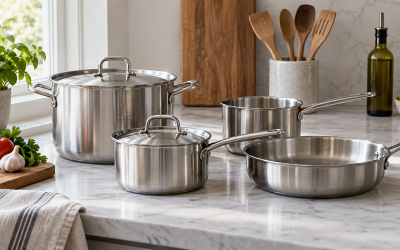
“Tri-ply” means the cookware is built with three bonded layers, usually stainless steel on the cooking surface and exterior, with an aluminum core between them. Stainless steel provides durability, a nonreactive cooking surface, and resistance to rust. Aluminum spreads heat quickly and helps reduce hot spots.
Not every tri-ply set is identical. Some manufacturers use a fully clad design, in which the layered construction extends from the base up the sides. Others use a multi-layer disk only on the bottom. Fully clad cookware generally distributes heat more evenly across the entire cooking surface, which is useful when searing several pieces of food or making sauces that reach the sides of the pan.
A practical tri-ply set typically includes a 1.5- to 2-quart saucepan, a 3- to 4-quart saucepan or sauté pan, an 8- to 10-inch skillet, a 10- to 12-inch skillet, and one or two stockpots ranging from 6 to 8 quarts. Set pieces often weigh between 2 and 7 pounds each, depending on size. That weight is a sign of substantial construction, but it can also make a full set tiring to move and harder to store.
Most modern stainless cookware is compatible with gas, electric, glass-top, and induction ranges, but check the specifications before buying. Induction compatibility requires a magnetic exterior, and not every stainless-steel pan has one. Oven-safe temperatures commonly fall somewhere between 400 and 600 degrees Fahrenheit, although the handles, lids, and manufacturer warranty may impose lower limits.
As a price reference, a large 30-piece CAROTE tri-ply set is listed around $169.99, while a 12-piece Cuisinart stainless steel set is listed around $219.95. Piece counts can be misleading: lids, steamer inserts, and utensils may inflate the number. A smaller set with three excellent pans can be more useful than a large collection filled with duplicates.
Pros
- Even heating: The aluminum core distributes heat more effectively than thin stainless steel, reducing the likelihood of scorching in the center of a pan.
- Excellent searing: Stainless steel can reach and hold high heat, making it well suited to browning steak, chicken, mushrooms, and vegetables.
- Durable cooking surface: There is no delicate nonstick coating to peel, blister, or lose effectiveness over time. Normal utensils and careful cleaning are less restrictive.
- Good for pan sauces: Browning creates fond, the flavorful browned bits that can be loosened with wine, stock, or another liquid.
- Versatile: A quality tri-ply pan can typically move from stovetop to oven and, when specified by the maker, under a broiler.
- Induction-friendly options: Many tri-ply collections work on induction, giving them a longer useful life if you change ranges later.
- Long-term value: Although the initial price may be higher, well-made stainless cookware does not need periodic replacement because of a worn coating.
- Low maintenance: It does not require seasoning like cast iron or carbon steel, and routine washing with dish soap is usually sufficient.
Cons
- Food can stick: Eggs, fish, pancakes, and other delicate foods are challenging until you learn to preheat, add oil, and adjust the burner.
- More weight: A 12-inch tri-ply skillet can weigh roughly 3 to 5 pounds before food is added. A filled stockpot may be awkward to lift safely.
- Learning curve: Stainless steel responds differently from nonstick. Excessive heat can cause sticking, discoloration, and difficult cleanup.
- Heat is not perfectly uniform: Tri-ply improves performance, but it cannot eliminate every hot spot. The burner should be reasonably matched to the pan’s base.
- Exterior discoloration: Rainbow-colored heat tint, white mineral marks, and browned residue are common. They are usually cosmetic and can often be removed with a stainless-steel cleaner.
- Sets may include unnecessary pieces: A large set can cost more while giving you multiple small saucepans or utensils you rarely use.
- Handles and lids vary: A pan can have excellent construction but an uncomfortable handle, a loose lid, or a handle that becomes hot during cooking.
- Dishwasher limitations: Some sets are labeled dishwasher-safe, but repeated cycles can dull the finish and may increase spotting or discoloration.
Who Should Buy It
Tri-ply stainless steel is a strong choice for cooks who prepare meals from basic ingredients and want one set to cover most techniques. It is especially useful if you regularly sear meat, sauté vegetables, reduce sauces, boil pasta, make soups, or transfer pans to the oven.
It also makes sense for households replacing mismatched cookware. Instead of buying a cheap pan every few years, you can choose a practical 8- or 10-piece collection with a skillet, saucepan, sauté pan, stockpot, and matching lids. If you cook on induction, confirm compatibility before purchasing; it should be a buying requirement rather than an assumption.
Tri-ply is also a good fit for people who prefer to avoid conventional fluoropolymer nonstick coatings. Stainless steel is not “non-toxic” in the sense that no cookware material can affect cooking conditions, but it is a stable, uncoated surface when used as intended. People with a known nickel sensitivity should check the alloy and consult a medical professional before choosing stainless steel.
Who Should Skip It
Skip tri-ply if your main priority is effortless release. If you cook eggs every morning, rarely use oil, or want food to slide out with minimal technique, a quality nonstick skillet may be a better companion. You do not need to choose one material for every task; many kitchens work best with stainless steel for searing and a separate nonstick pan for delicate foods.
It may also be a poor match if you have limited hand strength, reduced mobility, or little cabinet space. A 30-piece set sounds comprehensive, but its pots and lids can consume a large amount of storage. Buyers who cook for one or two people may get better value from a 10-inch skillet, 2-quart saucepan, and 3- to 4-quart sauté pan than from a full collection.
Cheaper Alternatives
| Option | Cost | Trade-off |
|---|---|---|
| Basic single-layer stainless skillet | $25–$60 | Lower price and lighter weight, but more uneven heating and a greater chance of hot spots. |
| Tri-ply starter set | $100–$180 | Covers the essentials, but may use thinner walls, less comfortable handles, or fewer oven-safe components. |
| Tri-ply open-stock pieces | $35–$140 per pan | You can buy only what you need, but the per-piece price may be higher than a carefully chosen set. |
| Hard-anodized nonstick set | $80–$220 | Generally easier for delicate foods, but the coating eventually wears and requires gentler utensils and heat. |
| Cast-iron skillet plus stainless saucepan | $50–$140 total | Excellent searing and low cost, but cast iron is very heavy and less convenient for acidic foods or quick cleanup. |
For the best value, compare usable cookware rather than the number printed on the box. A $170 set with multiple lids and utensils may be less practical than three open-stock pans costing $120 to $200 altogether. Look for fully clad construction, riveted handles, flat bottoms, clear oven-temperature limits, and a warranty that explains what is covered.
FAQ
Is tri-ply better than regular stainless steel?
Usually, yes. The aluminum core in tri-ply cookware spreads heat more effectively than a thin single layer. The improvement is most noticeable when searing, simmering sauces, or cooking foods that are sensitive to hot spots. A well-made single-layer pan can still perform adequately, but it generally requires more careful burner adjustment.
Does tri-ply stainless steel cookware rust?
It should resist rust under normal kitchen use, but it is not completely immune to damage. Leaving food, salt water, or moisture on the surface for long periods can cause staining or corrosion. Avoid chlorine bleach and abrasive steel wool, dry pans after washing, and follow the manufacturer’s cleaning instructions.
How do you keep food from sticking to stainless steel?
Start with a clean, dry pan. Preheat it over medium heat for a few minutes, add oil, and wait until the oil shimmers before adding food. Pat meat or fish dry, avoid moving it immediately, and let a browned crust develop before turning it. If oil smokes heavily, the pan is too hot; lower the heat and allow it to cool briefly.
Should I buy a full tri-ply set or individual pans?
Buy a set only if you will use most of its core pieces. For many cooks, the most useful combination is an 8- or 10-inch skillet, a 2-quart saucepan, a 3- or 4-quart sauté pan, and a 6- to 8-quart stockpot. Individual pans cost more per piece but prevent clutter and let you prioritize the sizes that match your recipes and household.