Key takeaways
- Let the plates cool first. Wiping a hot nonstick surface with a wet cloth can cause thermal shock and may warp the plate or lid.
- Remove loose flour after every batch. Burnt flour becomes abrasive and can shorten the coating’s useful life.
- Use a barely damp cloth, not running water. Most countertop electric presses are not immersion-safe.
- Avoid cooking oil directly on the plates unless the manual permits it. Excess oil can polymerize into a sticky film around the hinge and rim.
- Do not force the hinge. A dough ball that is too large can stress the hinge, squeeze filling into the mechanism and create uneven pressure.
- Expect the coating to wear first. Scratches, persistent sticking and uneven release usually appear before the heating element fails. Replacement plates are uncommon, so careful utensils and moderate heat extend ownership.
The best electric chapati maker for most occasional home cooks is a heated 10–12-inch press with adjustable thickness, while an automated machine such as Rotimatic is the better choice for frequent, hands-off cooking. The important distinction is that many products sold as “roti makers” only press dough; they do not cook the chapati.
Quick picks by situation
| Best for | Recommended type or model | Typical specification | What it actually does |
|---|---|---|---|
| Lowest-cost occasional use | Basic heated tortilla/chapati press | 700–1,000 W; 8–10-inch plates; about $30–$70 | Presses and partially cooks; often needs flipping and a pan finish |
| Larger flatbreads | Brentwood TS-126S | About 1,000 W; 12-inch cooking surface; 120 V | Heats and presses; manual shaping and turning remain necessary |
| Compact, repeatable pressing | CucinaPro electric tortilla maker, such as the 1447 series | About 1,000 W; roughly 10-inch plates | Heats and presses tortillas or roti-style dough, but does not automate the recipe |
| Frequent hands-off production | Rotimatic | Approximately 10-inch flatbreads; countertop automated appliance; commonly $1,000–$2,000 depending on version and offers | Mixes, portions, shapes and cooks programmed flatbreads |
Specifications can vary between regional versions and production revisions, so check the rating plate before buying. In particular, confirm the voltage, usable plate diameter and whether the listed wattage refers to total appliance power or only one heating element.

SUYIFAN 16-Inch Electric Saj Maker, 1600W Flatbread & Tortilla Griddle
Included for 'Best Electric Chapati Makers for Fast Flatbreads' because the listing specifies 1600W Flatbread & Tortilla Griddle, details this guide uses to compare options.
View on Amazon
Electric Tortilla Press Maker Chapati Machine Flour Burrito Roti Press (8 IN)
Included for 'Best Electric Chapati Makers for Fast Flatbreads' as a relevant option in this category; details come from the product listing.
View on Amazon
Fully Roti Maker, Automatic Chapati Maker,Roti & ChapatiMaker, With 3 Temperature Settings, ElectricMachine forChapati/Paratha/Tortilla/Thin Pancakes/Crepes
Included for 'Best Electric Chapati Makers for Fast Flatbreads' because the listing specifies Automatic Chapati Maker and Roti & ChapatiMaker, details this guide uses to compare options.
View on Amazon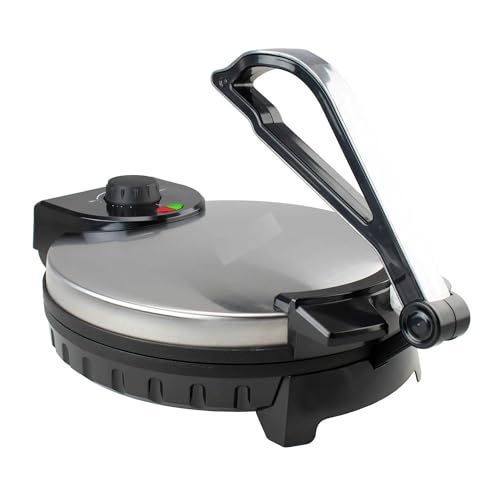
12-Inch Stainless Steel Nonstick Electric Tortilla Maker – 1200W Roti, Chapati & Flatbread Press with Adjustable Heat
Included for 'Best Electric Chapati Makers for Fast Flatbreads' because the listing specifies 1200W Roti and Chapati & Flatbread Press with Adjustable Heat, details this guide uses to compare options.
View on AmazonWhat makes the best electric chapati maker?
Heating power and temperature recovery
Wattage matters most when cooking several chapatis consecutively. A 700-watt press can work for small portions, but its plates usually recover more slowly after a cold dough ball is added. A 900–1,200-watt appliance is a more useful range for family batches, provided the thermostat is well controlled.
Look for a preheat indicator or a clearly defined ready light. A typical heated press takes about 3–7 minutes to reach working temperature. Recovery between chapatis may take 30–90 seconds. High wattage alone does not guarantee good results: an overly hot plate can brown the outside before steam has inflated the bread.
Plate diameter and usable area
Plate size should match the dough balls you normally make. An 8-inch press is compact but leaves little margin for expansion. A 10-inch plate suits everyday chapatis and tortillas, while a 12-inch plate is more comfortable for large rotis and lets you press a slightly irregular dough ball without creating a thin edge.
Do not confuse the external lid diameter with the usable cooking diameter. Hinges, raised rims and non-heated areas can reduce the effective surface by an inch or more. If cabinet space is limited, measure the appliance both closed and with the lid fully open.
Thickness control
Adjustable pressure or a mechanical height stop is more valuable than an extremely powerful hinge. A fixed-gap model may produce thin tortillas well but crush a soft chapati into a dense disc. For chapatis, choose a press that allows at least a small range of thickness adjustment, or use a dough ball size and parchment spacing that the manufacturer recommends.
Remember that pressing does not replace dough development. Dough that is too dry cracks at the edge; dough that is too wet sticks and may squeeze out from the sides. The appliance can make thickness more consistent, but it cannot correct poor hydration.
Head-to-head: heated press versus automated machine
Brentwood TS-126S: best for large, inexpensive batches
The Brentwood TS-126S is appealing when the priority is a broad 12-inch surface and straightforward electric heating. Its roughly 1,000-watt output is suitable for pressing large dough portions, and the larger plate gives beginners more room to work.
Its limitation is the same as most heated presses: it is not a complete chapati-making system. You still portion and roll or flatten the dough, monitor browning, and usually turn the chapati. The hinge and nonstick coating also need gentle treatment. Use silicone or wooden tools rather than a metal spatula, and avoid cutting directly on the plate.
CucinaPro electric tortilla maker: best for compact repeatability
A CucinaPro electric tortilla maker in the 1447 range is a sensible middle ground for cooks who want consistent pressing without the bulk or price of an automated roti appliance. Its approximately 10-inch plates are large enough for standard chapatis, and the heated design can finish the bread faster than a cold manual press.
It works best when the dough balls are uniform. Weighing each portion is more effective than repeatedly tightening the lid to compensate for different sizes. Expect to flip or reposition some breads, especially if the upper and lower plates do not brown at exactly the same rate.
Rotimatic: best for convenience, not value
Rotimatic occupies a different category. It is designed to mix ingredients, portion dough, shape flatbreads and cook them according to selected settings. That makes it the closest option to a genuinely automatic chapati maker, particularly for households that prepare flatbreads several times a week.
The trade-offs are substantial: a much higher purchase price, more counter space, more parts to clean and greater dependence on correct ingredient loading and machine calibration. It is excessive for someone who makes a dozen chapatis once a month. It becomes easier to justify when convenience and repeatability matter more than the lowest cost per flatbread.
Decision matrix
| Your situation | Choose | Why |
|---|---|---|
| Under $70 and fewer than 20 chapatis per month | Basic 8–10-inch heated press | Low entry cost; manual work is acceptable at this frequency |
| Two to four people, weekly use | 900–1,200-watt, 10–12-inch press | Better recovery time and enough surface area for a batch |
| Small kitchen or limited storage | 10-inch press under about 6 kg | Easier to store, lift and clean than an automated machine |
| Little shaping experience | Adjustable heated press | Controls diameter and thickness more consistently than a manual tawa alone |
| Daily use and minimal hands-on cooking | Automated machine such as Rotimatic | Reduces portioning, pressing and cooking steps, at a much higher cost |
Cost per use: when does automation make sense?
Suppose a $50 heated press lasts three years and is used twice a week. That is about 312 sessions, or approximately $0.16 in appliance cost per session before electricity and ingredients. A $1,500 automated machine used five times a week for three years would cost about $1.92 per session before ingredients, maintenance and any subscription or service costs.
This is not a quality score. It shows why a press is the economical choice for occasional cooking, while automation only earns its price through frequent use and saved preparation time.
Cleaning, nonstick durability and common mistakes
- Let the plates cool first. Wiping a hot nonstick surface with a wet cloth can cause thermal shock and may warp the plate or lid.
- Remove loose flour after every batch. Burnt flour becomes abrasive and can shorten the coating’s useful life.
- Use a barely damp cloth, not running water. Most countertop electric presses are not immersion-safe.
- Avoid cooking oil directly on the plates unless the manual permits it. Excess oil can polymerize into a sticky film around the hinge and rim.
- Do not force the hinge. A dough ball that is too large can stress the hinge, squeeze filling into the mechanism and create uneven pressure.
- Expect the coating to wear first. Scratches, persistent sticking and uneven release usually appear before the heating element fails. Replacement plates are uncommon, so careful utensils and moderate heat extend ownership.
How to get more even chapatis from a press
- Preheat for the full indicator cycle rather than adding dough immediately after switching on.
- Divide the dough by weight; 25–35 grams suits many 8–10-inch chapatis, while larger breads may need 40–60 grams.
- Rest the covered dough balls for 10–20 minutes so the surface relaxes and does not spring back.
- Lightly dust only when necessary. Excess flour burns on the plates and produces bitter black specks.
- Press briefly, check the edge, then cook or turn according to the appliance instructions. Leaving the lid clamped shut can trap steam and make the bread tough.
- Stack finished chapatis in a clean cloth for a few minutes. This softens the surface through retained steam.
For most buyers, the best electric chapati maker is therefore a 10–12-inch heated press with at least 900 watts, a durable nonstick surface and some thickness control. Choose the Brentwood TS-126S when large diameter matters, a CucinaPro model when compact repeatability matters, and Rotimatic only when full automation justifies the price, cleaning and counter space.