Key takeaways
- For a café or compact bakery: The Hobart N50 is a 5-quart countertop mixer suited to small, frequent batches and limited floor space. Its small bowl also means less headroom for scaling recipes.
- For an intermittent-use kitchen: A Globe SP10 is a 10-quart countertop option. It offers more working capacity than a 5-quart machine without taking up the footprint of a floor mixer.
- For everyday production: A Hobart HL200 is a 20-quart floor mixer designed for a broad range of bakery and food-service tasks. A Globe SP20 is another 20-quart class option to compare, particularly for service access, available attachments, and local support.
- For larger batches: A Hobart HL600 is a 60-quart floor mixer for kitchens with the space, electrical capacity, and production volume to justify a larger machine. It is a poor fit if most jobs are small: a large bowl may mix small quantities less effectively.
Best Commercial Planetary Mixers
The best commercial planetary mixer for most small bakeries and busy kitchens is a 20-quart, 1-horsepower floor model with a metal gear train, a bowl guard, and readily available replacement parts; choose a 10-quart countertop model for occasional small batches or a 60-quart machine when large dough batches are a routine production need. Before buying, check the manufacturer’s capacity guidance for your specific recipe: bowl volume alone does not tell you how much stiff dough the mixer can safely handle.
Shortlist by kitchen and workload
- For a café or compact bakery: The Hobart N50 is a 5-quart countertop mixer suited to small, frequent batches and limited floor space. Its small bowl also means less headroom for scaling recipes.
- For an intermittent-use kitchen: A Globe SP10 is a 10-quart countertop option. It offers more working capacity than a 5-quart machine without taking up the footprint of a floor mixer.
- For everyday production: A Hobart HL200 is a 20-quart floor mixer designed for a broad range of bakery and food-service tasks. A Globe SP20 is another 20-quart class option to compare, particularly for service access, available attachments, and local support.
- For larger batches: A Hobart HL600 is a 60-quart floor mixer for kitchens with the space, electrical capacity, and production volume to justify a larger machine. It is a poor fit if most jobs are small: a large bowl may mix small quantities less effectively.
These are established commercial product lines, but exact configurations, motor ratings, guards, and available attachments can differ by generation and market. Confirm the specification sheet for the exact model being quoted.
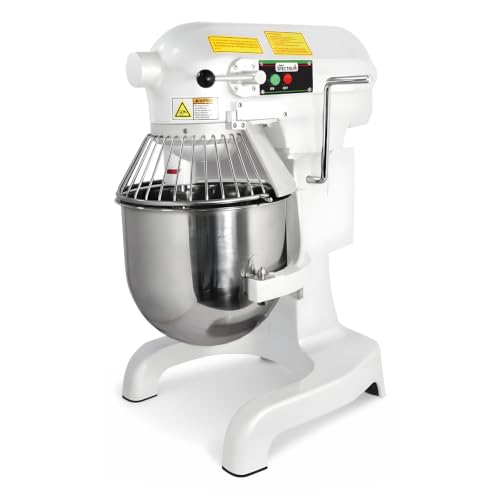
Winco 10 L White Commercial-Grade Planetary Mixer
Included for 'Best Commercial Planetary Mixers' as a relevant option in this category; details come from the product listing.
View on Amazon
Waring Luna Planetary Stand Mixer with 7-Quart Capacity
Included for 'Best Commercial Planetary Mixers' as a relevant option in this category; details come from the product listing.
View on Amazon
Globe Food Equipment SP08 8-Quart 3-Speed Countertop Planetary Mixer, Stainless Steel, 115 V, NSF
Included for 'Best Commercial Planetary Mixers' because the listing specifies Stainless Steel and 115 V, details this guide uses to compare options.
View on Amazon
eurodib Commercial Planetary Mixer, 42 Qt, 220V – LNS M40A220ETL
Included for 'Best Commercial Planetary Mixers' because the listing specifies 42 Qt and 220V, details this guide uses to compare options.
View on AmazonCompare capacity, power, and operating demands
Capacity figures below are bowl volumes, not promises that every recipe can fill the bowl. Motor power is shown where commonly specified; listings can report different ratings or electrical configurations, so use the manufacturer’s documentation for the exact unit. Weight is approximate and varies by configuration.
| Mixer | Bowl capacity | Motor power | Approx. machine weight | Best fit |
|---|---|---|---|---|
| Hobart N50 | 5 qt | About 1/6 hp | About 100 lb | Small batches and limited counter space |
| Globe SP10 | 10 qt | About 1/2 hp | About 150 lb | Moderate batches in a countertop footprint |
| Hobart HL200 | 20 qt | About 1/2 hp | About 250 lb | Regular bakery or food-service production |
| Globe SP20 | 20 qt | About 1 hp | About 250 lb | Daily work where 20 qt is the right batch scale |
| Hobart HL600 | 60 qt | About 2 hp | About 700 lb | High-volume production and large batches |
These are approximate reference figures, not a substitute for a model’s data plate or current specification sheet. Horsepower is not a direct measure of dough capacity: gearing, duty rating, speed selection, recipe hydration, and the mixer’s stated batch limits all matter. For heavy dough, compare the rated flour or dough capacity and duty guidance—not just bowl size or motor power.
Choose by batch size, space, and frequency
| Your situation | Likely fit | What to verify |
|---|---|---|
| Small kitchen; occasional frosting, fillings, or light dough | 5–10 qt countertop mixer | Counter support, minimum batch size, and whether the bowl can be removed easily |
| Café or bakery mixing several times a day | 20 qt floor mixer | Daily duty guidance, bowl-lift operation, guard design, and service access |
| Large batches are routine; space and power are available | 60 qt floor mixer | Maximum batch limits, delivery route, installation requirements, and bowl handling |
| Production varies widely between tiny and large batches | Two appropriately sized mixers may beat one oversized unit | Whether the smaller mixer is used enough to justify its cost and upkeep |
A useful sizing check is to write down the smallest and largest batches you actually make. If a 20-quart bowl is frequently used for just one or two cups of ingredients, the attachment may not reach the mixture reliably. If your largest dough batch approaches the maker’s stated limit, leave a margin rather than treating that limit as a daily target.
What matters beyond the headline specifications
Gears and long-term durability
A planetary mixer’s attachment orbits the bowl while the bowl stays in place. During stiff dough work, that action places substantial load on the drive system. Commercial machines use different transmissions, and the word “gear” alone does not establish durability. Ask whether the unit is rated for the recipes and duty cycle you plan to run, whether the gearbox is serviceable, and whether authorized technicians and parts are available nearby. Repeatedly forcing dense dough beyond the specified batch limit can shorten component life even on a substantial machine.
Attachments and speed range
Common tools include a flat beater for batters and mixing, a wire whip for aerated mixtures, and a dough hook for kneading. Confirm that all three are included and that spare bowls, beaters, and hooks are sold for the exact model. Some commercial mixers also accept powered attachments such as grinders or slicers, but a compatible hub and attachment are not automatic. Check the manufacturer’s compatibility list and whether the added accessory suits your production workflow.
Safety and bowl handling
Look for a bowl guard or safety cage, a bowl-lift interlock, and controls that prevent operation in an unsafe position. Guard style and features vary by model and generation. A bowl lift can be easier than manually raising a heavy bowl into position, but removing a full bowl is still a handling task. In a busy kitchen, consider the operator’s reach, the lift mechanism, and the path from mixer to bench—not only the listed bowl capacity.
Cleaning and wear items
Removable stainless-steel bowls and attachments are generally easier to clean than fixed components, but the mixer body and hub must be cleaned according to the manual rather than sprayed or immersed. Batter can collect around the guard, bowl-lift supports, and attachment hub. Wipe those areas promptly, dry removable parts thoroughly, and check the manual before using a dishwasher. Beaters, hooks, bowl guards, seals, and drive components can require replacement over time; their availability and cost are part of ownership, not an afterthought.
Budget for the complete installation
As a broad market guide, small commercial countertop mixers can run from the high hundreds into several thousand dollars; 20-quart floor models commonly cost several thousand to over $10,000; and large 60-quart machines can reach well into five figures. Configuration, new versus used condition, freight, warranty, and local service affect the final price. Used equipment can be good value, but inspect the bowl and tools, test every speed and safety interlock, listen for abnormal gearbox noise, and confirm parts support before committing.
Also account for the machine’s weight, doorway clearance, floor or counter capacity, and electrical requirements. A mixer that cannot be delivered, installed, or serviced conveniently is not a bargain. For a new purchase, obtain the exact voltage, phase, plug or hardwiring details, and installation instructions in writing.
Bottom line
For frequent small batches, a 5- or 10-quart countertop model keeps the footprint and batch scale manageable. For a typical working bakery or food-service kitchen, a 20-quart floor mixer is often the most balanced choice. Move to 60 quarts only when large batches are genuinely routine and the space, power, and handling setup support it. The best commercial planetary mixer is the one whose approved batch range covers your recipes, whose safety features suit your staff, and whose parts and service you can obtain when the machine needs attention.