Key takeaways
- Aluminized steel: A steel core with an aluminum-rich surface heats evenly and resists warping better than very thin sheet metal. It is a strong choice for frequent baking.
- Uncoated aluminum: Heats quickly and often browns well, but it can discolor and may react with strongly acidic residues. Avoid abrasive scrubbing.
- Carbon steel: Durable and conductive, but it may rust if left wet. Dry it immediately and follow any seasoning instructions.
- Nonstick-coated metal: Releases dough easily and reduces oiling. The coating is the part most likely to wear first, especially with metal tools, scouring pads, or temperatures above the stated limit.
- Ceramic: Retains heat and supports covered baking, but it is heavy, breakable, and slower to change temperature.
he best baguette pans for most home bakers are perforated metal pans with two or three long wells: choose a two-loaf pan for easier oven fit and more even browning, or a three-loaf pan when you regularly bake several baguettes at once.
Best baguette pans by baking situation
| Situation | Best choice | Useful specification | Why it fits |
|---|---|---|---|
| Small oven or first baguette pan | Two-well perforated metal pan | About 15–16 inches long; 2 loaves | Easier to position and less likely to touch the oven walls |
| Weekly family baking | Three-well perforated metal pan | About 15–17 inches long; 3 loaves | Produces 50% more loaves per batch without a second bake |
| Maximum crust protection | Covered ceramic baguette baker | Usually 2 loaves; roughly 14–16 inches long | Enclosed space retains moisture during the early bake |
| Lowest purchase cost | Thin steel or aluminized-steel pan | Approximately 0.8–1.5 lb | Affordable and responsive, though it may warp or discolor sooner |
| Frequent use and easy release | Heavy aluminized steel with food-safe coating | Approximately 1.5–2.5 lb; 3 wells | More rigid, distributes heat consistently, and needs less greasing |
What shape should a baguette pan have?
A baguette pan is not simply a flat baking sheet with grooves. Its curved channels support dough as it expands, helping a narrow loaf keep its cylindrical profile instead of spreading into a flat oval. The most useful shapes are rounded, semi-cylindrical wells with enough separation that adjacent loaves do not merge during proofing.
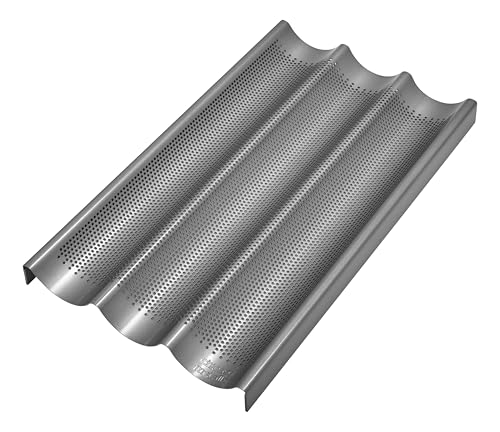
Chicago Metallic Commercial II Non-Stick Perforated Baguette Pan. Creates a crisp, golden-brown crust, 16 L x 9 W x 1.5 H
Included for 'Best Baguette Pans for Baking at Home' because the listing specifies golden-brown crust and 16 L x 9 W x 1.5 H, details this guide uses to compare options.
View on Amazon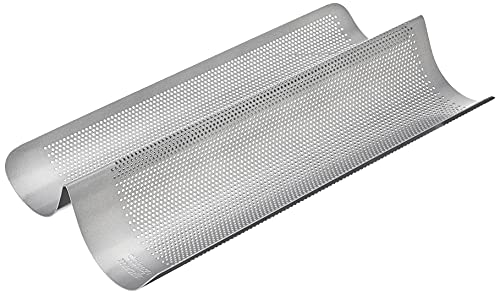
Chicago Metallic Commercial II Non-Stick Perforated French Bread Pan, Perfect for creating a crisp, golden-brown crust,
Included for 'Best Baguette Pans for Baking at Home' because the listing specifies Perfect for creating a crisp and golden-brown crust, details this guide uses to compare options.
View on Amazon
USA Pan Bakeware Aluminum Perforated Nonstick French Baguette Bread Pan, 3-Loaf
Included for 'Best Baguette Pans for Baking at Home' because the listing specifies 3-Loaf, details this guide uses to compare options.
View on AmazonTwo-well pans
Two-well pans are the safer choice for most home kitchens. They leave more room around each loaf, are easier to load with proofed dough, and tend to give more consistent side browning because the loaves are not packed closely together. They are also more manageable when the pan must be covered with a large roasting lid or transferred to a cooling rack.
Look for wells around 2.5 to 3 inches wide and 1 to 1.5 inches deep. A shallow channel supports the loaf while exposing more surface area to hot air; a very deep channel can shade the lower sides and make the crust paler there.
Three-well pans
Three-loaf pans are valuable when you bake baguettes for a household, dinner party, or weekly meal preparation. Their principal compromise is width. A three-well pan commonly measures about 15 to 17 inches long and 9 to 13 inches wide, so check the oven rack and door opening rather than assuming it will fit.
The central loaf can brown differently from the outer loaves if the wells are closely spaced. A pan with perforations across the curved base and open space between channels usually performs better than a solid, tightly joined design because hot air can reach more of the dough.
Perforated metal versus solid metal and ceramic
Perforated metal: the best all-purpose design
Small holes allow oven heat and air to contact more of the dough’s underside. That improves bottom browning and helps moisture escape instead of leaving the base soft. Perforated aluminized steel is particularly practical because it combines good heat transfer with enough rigidity for repeated use. USA Pan’s French baguette pans are a familiar example of the coated, perforated metal category.
Perforations do not create steam by themselves. Steam still comes from the dough and the baking setup. They simply reduce the insulating effect of a solid pan. Because the holes can allow sticky dough or cheese toppings to drip through, use a sheet pan on the rack below when necessary rather than lining the baguette pan with paper, which can block airflow.
Solid metal: tidy, but less ventilated
Solid metal pans are easier to wipe clean and cannot shed crumbs through holes. They can also produce a more distinct, darker bottom when made from a conductive material. However, the solid base shields the underside from circulating heat. If your loaves repeatedly emerge pale underneath, a perforated design or a preheated baking surface may be more effective.
Ceramic covered bakers: crust control over speed
A covered ceramic baguette baker creates a smaller humid chamber around the dough. That can delay crust setting and help scoring open before the exterior hardens. The trade-off is slower heat response, greater weight, and less flexibility: many ceramic models are designed for two loaves and may have manufacturer-specific temperature limits.
Ceramic is also less forgiving of thermal shock. Do not move a hot ceramic baker onto a cold, wet surface or pour cold water onto it. A ceramic baguette baker is a good fit when you value a covered bake and have storage space; it is not automatically the best choice for maximum underside browning.
Oven fit: measure before choosing capacity
Measure three things: the usable rack width, the front-to-back depth, and the oven-door opening. Record the smallest measurement. Then allow at least 1 inch of clearance from the oven walls and door so hot air can circulate and the pan can be handled safely.
For example, if the usable rack width is 18 inches, a 17-inch pan leaves only 0.5 inch on each side. That may technically fit, but it gives little room for oven mitts and can limit airflow. A 15-inch two-well pan leaves 1.5 inches per side and is usually the more comfortable choice. Also measure diagonally if your oven has a narrow door: a wide three-well pan may fit inside but be difficult to angle through the opening.
How materials affect browning and durability
- Aluminized steel: A steel core with an aluminum-rich surface heats evenly and resists warping better than very thin sheet metal. It is a strong choice for frequent baking.
- Uncoated aluminum: Heats quickly and often browns well, but it can discolor and may react with strongly acidic residues. Avoid abrasive scrubbing.
- Carbon steel: Durable and conductive, but it may rust if left wet. Dry it immediately and follow any seasoning instructions.
- Nonstick-coated metal: Releases dough easily and reduces oiling. The coating is the part most likely to wear first, especially with metal tools, scouring pads, or temperatures above the stated limit.
- Ceramic: Retains heat and supports covered baking, but it is heavy, breakable, and slower to change temperature.
Dark finishes generally brown faster than bright aluminum. If your oven already produces dark crusts, a lighter or heavier pan can make the result easier to control. Do not judge a pan by color alone: thickness, ventilation, and the distance between the dough and the oven’s heating elements matter as much.
Cleaning requirements that affect ownership
Before the first bake, wash a new pan according to its instructions and dry it completely. For coated metal, use warm water, mild dish soap, and a soft sponge. Soak stuck dough briefly rather than scraping it with a knife. A narrow, soft brush helps clean perforations without enlarging them.
Many coated baguette pans are marketed as dishwasher-safe, but repeated dishwasher cycles can dull finishes and accelerate corrosion around holes or exposed edges. Hand-washing usually preserves the release surface longer. Uncoated steel must be dried immediately; a thin film of neutral cooking oil can help prevent rust during storage.
Avoid placing a perforated pan directly on an oven stone if the holes can catch or damage its surface. Do not use parchment as a permanent liner when your goal is underside airflow. For especially wet dough, dust the wells lightly with flour or fine semolina only if the manufacturer permits it.
Common mistakes with baguette pans
- Overfilling the wells: Dough that rises above the channel can spread sideways and touch the neighboring loaf. Use a dough weight appropriate to the pan’s well size rather than filling it by eye.
- Ignoring proofing expansion: Leave space between shaped loaves before the final rise. A pan cannot restore separation after the dough has joined.
- Using excessive grease: Oil pooling in perforations can smoke and darken the crust. Apply only a thin film when needed.
- Putting a cold pan into an aggressive preheat: This is especially risky with ceramic. Follow the maker’s preheating instructions.
- Confusing a baguette pan with a baking stone: The pan supports shape and affects airflow; it does not necessarily supply the strong conductive heat of a thick stone or steel.
Bottom line
Choose a two-well perforated aluminized-steel pan if you want the most forgiving combination of oven fit, support, ventilation, and browning. Choose a three-well version when batch capacity matters and your oven has at least 1 to 2 inches of spare width. Select a covered ceramic baker when moisture retention and a protected crust are more important than fast heat response. Whichever design you buy, prioritize measured oven clearance, sturdy wells, accessible cleaning, and a surface that will tolerate your baking frequency—not just the number of loaves printed on the packaging.