Our Top Picks
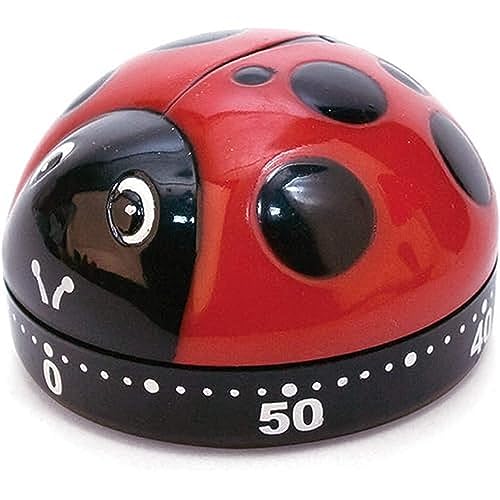 Kikkerland Ladybug Kitchen Timer5.7 x 5.7 x 4.4 cm2.25 x 2.25 x 1.75 inches0.13 poundsCheck on Amazon


Digital timers are capable, but they share two failure modes: a dead battery at the worst moment and a screen that needs dry, clean fingers to operate. A mechanical wind-up timer removes both. Twist the dial, walk away, and listen for the bell. Every timer below is fully mechanical, counts down up to sixty minutes, and needs no battery, no charging cable, and no instruction manual. They differ in how they alert you, where they sit, and how they are built.
As an Amazon Associate, we earn from qualifying purchases.
Quick answer
The Taylor Long Ring Timer is the default pick: a simple twist dial, bold markings, and a ring that carries across the house. The Secura visual timer suits cooks who prefer watching a disc shrink to listening for a bell. The Accoglie is the compact stainless option with a magnetic back for the fridge, while the CASOWAT and Kikkerland picks add novelty shapes to the same wind-up idea.
Taylor Mechanical Long Ring Timer (5831N)

The Taylor long ring timer is the design most people picture when they think of a wind-up kitchen timer, and it has stayed in production for years because the formula works. You turn the dial to your minutes, up to sixty, and the spring-driven mechanism ticks back down to zero, where it sounds a long ring that is easy to hear from another room. There is nothing to program and nothing to charge.
The dial carries bold black graphics against a light face, so settings are readable at a glance and in poor light, and the markings are spaced for the short intervals cooking actually uses: five minutes for pasta, ten for eggs, twenty for a tray of vegetables. The body is compact enough to live beside the stove without crowding it, and the whole control is one knurled twist, which works fine with wet or floury hands.
The honest limits are the class limits. One countdown at a time, a sixty-minute ceiling, and no count-up mode. The ring is a single sustained bell rather than an adjustable alarm, so there is no volume control and no silent option. Within those limits, this is the most straightforward mechanical timer of the five, and the one to buy first.
Secura 60-Minute Visual Countdown Timer, 7.5-Inch Oversize (T764)
The Secura takes the opposite approach to getting your attention. Instead of a numbered dial, its oversize seven-and-a-half-inch face carries a colored disc that shrinks as the minutes pass, so the time remaining reads as a picture rather than a number. A glance from across the kitchen tells you whether the roast has most of its time left or only a sliver.
That visual format suits cooks who work with their eyes on the food, households where a ringing bell would wake a sleeping child, and anyone who finds numbers easy to misread at distance. The mechanism is still a mechanical wind-up with a sixty-minute range, set by turning the dial, and the back is magnetic, so the timer can live on the fridge door or the side of a range hood at eye level instead of taking counter space.
Size is the trade-off. At seven and a half inches across, this is by far the largest timer here, and it needs a clear patch of fridge or counter to earn its keep. It also shows one countdown only, and the disc format gives a sense of proportion rather than an exact minute count. For visual thinkers, that trade is worth it.
Accoglie Mechanical Kitchen Timer
The Accoglie is the modern stainless take on the wind-up timer. Its body is stainless steel, the back is magnetic, and a foldable stand gives a second placement option on the counter. At roughly two and a third inches square, it is small enough for an apron pocket or a crowded drawer, and the listing rates its mechanical alarm at eighty-five decibels, loud enough to hear over a vent hood and a running faucet.
Setting follows the standard mechanical routine: wind the dial clockwise toward fifty-five, then turn back to the minutes you want, which fully tensions the spring so the bell rings properly at zero. The range is the usual sixty minutes, the face markings are clear, and the smooth rotation makes short settings easy to land accurately.
Two cautions apply. The compact face means the minute marks sit close together, so precision at the one-minute level is limited, and like every timer here it watches a single dish. The stainless shell wipes clean and shrugs off splashes better than painted plastic, though the mechanism itself should never be submerged. For a small, loud, fridge-mounted timer, this is the strongest of the newer designs.
CASOWAT Blue Dragon Kitchen Timer
The CASOWAT wraps the same mechanical idea in a blue dragon shape, which makes it the giftable pick of the five and a timer children will actually volunteer to watch. Under the novelty body it is a conventional wind-up countdown: no batteries, a sixty-minute ceiling, and a loud mechanical alarm at zero.
The body is stainless steel rather than thin plastic, which gives the figure some weight and keeps it planted on the counter, and the back carries a magnet for the fridge door. At about one hundred sixty-nine grams it is light enough to move around the kitchen but heavy enough not to skitter when the dial is twisted. The dial markings follow the dragon design, so the numbers are styled rather than stark, and reading an exact minute takes a second longer than on the Taylor.
Buy it for the right reason: it is a real mechanical timer whose shape makes timing feel less like a chore, useful for cooking with kids or for a kitchen that leans playful. Cooks who set timers by feel and want the plainest possible dial should take the Taylor instead. Availability on this listing can be patchy, so check that it is in stock before settling on it.
Kikkerland Ladybug Kitchen Timer (KT21-A)
Kikkerland’s ladybug is the other novelty classic here, a red spotted dome that twists to set. It is a sixty-minute mechanical countdown timer, model KT21-A, and it has been sold in gift and kitchen shops for years. The body measures about five point seven by five point seven by four point four centimeters, small enough to sit on a windowsill or a shelf edge.
Operation is the familiar one: grip the body, twist to your minutes, and wait for the bell at zero. There is no magnet and no stand, so it lives on flat surfaces only, and the curved dome is not the easiest shape to turn with greasy hands. The markings are simple, and like the CASOWAT, the design puts charm ahead of dial precision.
Its role in a kitchen is a second timer rather than the main one: the egg timer by the stove, the tea timer by the kettle, the one a child is in charge of. As a first and only timer, the Taylor or the Accoglie is the more practical spend. As a small, cheerful backup that needs no battery, the ladybug earns its spot.
How to choose
Start with the alert. A ringing bell, like the Taylor and Accoglie, reaches you in another room; a visual disc, like the Secura, only works if you are looking toward it, which suits quiet households and cooks who stay in the kitchen. Next, placement: magnetic backs belong on the fridge at eye level, while countertop models need a flat, dry spot near the stove. Check the setting routine too. Most wind-up timers must be wound toward the top of the dial first, then turned back to the target, or the bell will not ring; make sure everyone in the house knows that habit.
Build matters more than decoration. Stainless shells wipe clean and resist stains, while painted novelty bodies chip if they are knocked off the counter. Dial clarity is the last filter: bold, widely spaced minute marks are faster to set accurately than styled numbers, and that difference shows up every time you set five minutes with wet hands. Finally, accept the class limits before buying. Sixty minutes is the ceiling, one dish is the limit, and accuracy is to the nearest minute rather than the second. If your cooking regularly breaks any of those, a mechanical timer should be a backup, not your only timer.
Who should skip
Skip mechanical timers if your cooking leans on long, slow processes. Bread doughs, braises, smokers, and stockpots run for hours, far past the sixty-minute ceiling, and a timer that stops at one hour will leave you re-winding it all afternoon. Skip them if you routinely run three or four dishes at once and need separate countdowns with distinct alarms; a multi-channel digital timer or a phone handles that job better. Also skip them if you need count-up stopwatch timing for staged cooking steps, since wind-up timers only count down, and if you want a silent vibrating alert in a pocket. Everyone else, especially cooks who time one dish at a time in the five-to-sixty-minute range, is exactly who these are built for.
Frequently Asked Questions
Why does a wind-up timer sometimes fail to ring?
The spring was not fully wound. Most mechanical timers need to be turned toward the top of the dial first, to fifty-five or sixty minutes, and then turned back to the time you actually want. That first wind tensions the spring that powers both the ticking and the bell. Setting a short time directly, without the full wind, leaves too little energy stored, so the dial may reach zero quietly.
Are mechanical timers accurate enough for baking?
Yes, for the timing baking actually needs. A wind-up timer is accurate to roughly the nearest minute, and cakes, cookies, and roasts are forgiving at that scale. Where it falls short is precision work measured in seconds, such as timing a thirty-second blanch or a pour-over bloom, and very short settings under two minutes, where the closely spaced marks are hard to land exactly. Use a digital timer for those jobs.
Can one mechanical timer watch two dishes?
No. A wind-up timer runs a single countdown, and resetting it for a second dish erases the first. The practical fixes are buying two inexpensive mechanical timers, which many cooks do, or pairing one mechanical timer with a phone or a multi-channel digital unit for the extra dishes. If three or four countdowns at once is your normal cooking pattern, start with a multi-channel digital timer instead.
How do you clean and store a mechanical timer?
Wipe the body with a damp cloth and dry it; never submerge a mechanical timer or put it in a dishwasher, because water inside the spring housing causes rust and kills the movement. Keep it away from sustained steam where possible, and store it unwound in a drawer or on the fridge. Dropped timers can bend the bell or shaft, so a magnetic mount at eye level doubles as safe storage.
Final verdict
Mechanical timers trade features for certainty: no battery will ever die in one, and the twist-and-ring routine never changes. The Taylor Long Ring is the safest single buy, the Secura is the pick for visual cooks and quiet kitchens, and the Accoglie adds a magnet and a loud alarm in a compact stainless body. The CASOWAT dragon and Kikkerland ladybug cover the novelty end honestly, as real timers in playful shells. Match the alert style to how you cook, and any of the five will serve for years.
Product and ASIN Reference
| Product | ASIN |
|---|---|
| Taylor Mechanical Long Ring Timer (5831N) | B0007NIIOK |
| Secura 60-Minute Visual Countdown Timer, 7.5-Inch Oversize (T764) | B08HQ8DHKN |
| Accoglie Mechanical Kitchen Timer | B0FHGY37FJ |
| CASOWAT Blue Dragon Kitchen Timer | B0G2YMYWWS |
| Kikkerland Ladybug Kitchen Timer (KT21-A) | B004A7XQNM |
FAQ
Why does a wind-up timer sometimes fail to ring?
Are mechanical timers accurate enough for baking?
Can one mechanical timer watch two dishes?
How do you clean and store a mechanical timer?
More from Amazon
Programs that pair well with the guide above. Offers and eligibility are set by Amazon and may change.
Set up recurring deliveries of everyday items on eligible products. Terms and savings are set by Amazon.
Explore Subscribe & SaveCollect the home and kitchen items you want in one registry that guests can shop from.
Create a wedding registryFree shipping on eligible items, Prime Video and more. Eligible new members can start with a free trial.
Start a Prime free trialAudiobooks and podcasts to listen to on the go. Eligible new members can start with a free trial.
Try Audible freeAs an Amazon Associate we earn from qualifying purchases.