Key takeaways
- Best Double Boilers for Chocolate and Sauces The best double boiler for chocolate and sauces is a heavy-gauge stainless-steel saucepan with a snugly fitted upper bowl, a generous water gap, and a handle or rim that gives you controlled pouring.…
Best Double Boilers for Chocolate and Sauces
The best double boiler for chocolate and sauces is a heavy-gauge stainless-steel saucepan with a snugly fitted upper bowl, a generous water gap, and a handle or rim that gives you controlled pouring. For most home cooks, a 1.5- to 2-quart insert is the most useful size: large enough for ganache, hollandaise, custards, and a batch of chocolate coating without taking over the stovetop.
Quick comparison: which double boiler fits your cooking?
| Double-boiler type | Typical bowl capacity | Water gap | Typical metal thickness | Induction compatibility | Best for |
|---|---|---|---|---|---|
| Small saucepan with glass or stainless bowl | 1 to 1.5 qt | 1 to 2 in | 0.8 to 1.2 mm | Only the lower pan needs to be induction-ready | Occasional chocolate and small sauce batches |
| Dedicated 1.5-qt stainless double boiler | 1.25 to 1.5 qt | 1.5 to 2.5 in | 1.0 to 1.5 mm | Usually, if the base is magnetic | Hollandaise, custard, and everyday home use |
| Dedicated 2-qt stainless double boiler | 1.75 to 2 qt | 2 to 3 in | 1.2 to 1.8 mm | Often, but check the base specification | Ganache, larger chocolate batches, frequent cooking |
| Commercial 3- to 4-qt double boiler | 2.5 to 4 qt | 2 to 4 in | 1.0 to 1.5 mm | Model-dependent | Large batches and high-volume preparation |
Capacities in this table refer to the upper bowl’s nominal volume, not the amount you should fill. For whisking sauces safely, leave at least 20 percent of the bowl empty. A 2-quart insert therefore works best with roughly 1.5 quarts of ingredients, while a 1.5-quart insert is more comfortable with 1 to 1.2 quarts.

Farberware Classic Series Double Boiler and Saucepan with Lid, 2 Qt
Included for 'Best Double Boilers for Chocolate and Sauces' because the listing specifies 2 Qt, details this guide uses to compare options.
View on Amazon
Marsheepy1.1QT Double Boiler Melting Pot with 2QT 304 Stainless Steel Pot
Included for 'Best Double Boilers for Chocolate and Sauces' as a relevant option in this category; details come from the product listing.
View on Amazon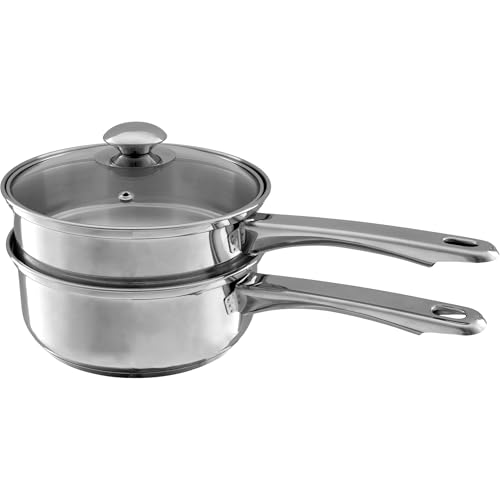
Classic Cuisine 6 Cup Double Boiler Pot Set, 7.75” x 3”
Included for 'Best Double Boilers for Chocolate and Sauces' because the listing specifies 7.75” x 3”, details this guide uses to compare options.
View on AmazonWhat separates a good double boiler from an awkward one?
Bowl capacity and working shape
Capacity matters less than the diameter and height of the upper bowl. Chocolate melts more evenly in a broad bowl because the pieces spread into a shallow layer. A narrow, deep insert can trap unmelted pieces above the steam and makes stirring harder.
For two to four servings of hollandaise, lemon curd, or pastry cream, a 1- to 1.5-quart bowl is usually sufficient. Choose 2 quarts if you regularly make a large ganache, dip fruit in chocolate, or prepare several cups of custard. A 3-quart commercial unit is useful for production cooking but is unnecessarily bulky for a single batch of sauce.
Water-gap design
The upper bowl should sit above the water rather than touch it. A water gap of about 1.5 to 3 inches gives you indirect heat and reduces the chance of scorching. The water should simmer gently, not boil aggressively. If the bowl contacts the water, the setup becomes closer to direct boiling, which can overheat chocolate and scramble egg-based sauces.
Look for a lower pan that supports the upper bowl securely at the rim. A bowl that wobbles, drops too far into the pan, or leaves only a few millimeters between water and ingredients is difficult to control. A dedicated double boiler generally fits better than a random mixing bowl balanced over a saucepan.
Stainless-steel thickness and heat behavior
Stainless steel is durable, nonreactive, and easy to clean, but it is not an especially fast heat conductor. Thicker walls and a heavier base slow temperature changes, which is helpful when emulsifying butter or tempering chocolate. The trade-off is extra weight and slower response when you need to reduce heat quickly.
For frequent use, aim for stainless steel around 1.2 mm or thicker in the upper insert, with a substantial base on the lower pan. Very thin metal can develop hot spots and may feel unstable when whisking. A fully clad lower saucepan is helpful but not essential, because the water distributes heat more gently than direct contact with a burner.
Induction compatibility
On an induction cooktop, the lower pan must have a magnetic base. The upper insert does not usually need to be magnetic because it is heated by steam and warm water rather than by direct induction. Check whether the lower pan is explicitly labeled induction-compatible; stainless steel alone does not guarantee that it will work.
Induction can bring the water to a simmer quickly, so use a low setting after the water heats. A power level that is appropriate for boiling pasta may create too much steam for chocolate or hollandaise. If the pan cycles aggressively, a thick-based model provides a more stable buffer.
Pouring and handling control
For sauces, a rolled rim or pouring spout is more valuable than decorative features. A long, stay-cool handle helps you hold the bowl while whisking, while a helper handle is useful on a 2-quart insert. If the upper bowl has no handle, make sure its rim remains cool enough to grip with a dry towel and that lifting it does not bring your hand close to rising steam.
A pouring lip should be shaped into the bowl rather than stamped as a sharp corner. Sharp edges catch sauce and make cleaning harder. For chocolate, a smooth interior is preferable because scraped seams can collect cocoa solids and sugar.
Best choice by cooking situation
| Your situation | Recommended specification | Why |
|---|---|---|
| Budget-conscious, occasional use | 1- to 1.5-qt stainless insert, 1-inch minimum water gap | Handles small sauces without paying for a large specialty pan |
| New cook learning emulsions | 1.5-qt dedicated set with stable rim support and pouring lip | Reduces wobbling and makes gradual heating easier to manage |
| Small kitchen or limited storage | Insert that nests inside an existing 2-qt saucepan | One vessel performs multiple jobs and takes less cabinet space |
| Frequent chocolate work | 2-qt heavy-gauge stainless unit with broad upper bowl | Provides even spreading, better capacity, and greater thermal stability |
| Induction cooktop | Magnetic, thick-base lower pan with adjustable low-power control | Prevents rapid cycling and ensures the water heats at all |
| Large or commercial batches | 3- to 4-qt commercial stainless double boiler | More workspace, but only worthwhile if the added size is used regularly |
How to use a double boiler for chocolate and sauces
- Check the fit. Place the upper bowl on the lower pan before adding water. It should sit securely, and the bottom should remain above the water.
- Add modest water. Start with enough water to leave a 1.5- to 3-inch air gap. Too much water creates excessive steam and can splash into chocolate.
- Heat to a gentle simmer. Once small bubbles appear, lower the burner. A rolling boil is unnecessary.
- Add ingredients to a dry upper bowl. Even a small amount of water can make melted chocolate seize. Keep the bowl, spatula, and whisk dry.
- Stir continuously when eggs or emulsions are involved. Move the whisk across the base and around the edges, where heat is most concentrated.
- Remove the bowl before the mixture looks completely finished. Residual heat continues cooking the sauce. For chocolate, remove it when a few small pieces remain and stir until smooth.
For a simple sizing check, suppose a recipe uses 500 grams of chocolate. If chopped chocolate occupies approximately 0.65 liters by volume, a 1.5-quart bowl, holding about 1.4 liters, has ample capacity. However, a shallow 2-quart bowl will be easier to stir and dip from than a tall 1.5-quart bowl, even though both technically fit the recipe.
Durability, cleaning, and common ownership problems
The first parts to become troublesome are usually the lid or rim fit, the handle attachment, and any nonstick coating—not the stainless-steel body. A plain stainless insert tolerates whisking, soaking, and occasional dishwasher cycles better than a coated one. If the upper bowl has a nonstick interior, use silicone or wooden utensils and follow the maker’s cleaning instructions.
Dry the rim and underside after washing. Water trapped between nested pans can leave mineral deposits and, over time, discoloration. For cloudy stainless steel, a mild citric-acid or stainless-steel cleaner is preferable to abrasive scouring powder. Never immerse a handle assembly with a loose joint until you have checked how it is attached.
Common mistakes include filling the lower pan too high, turning the burner up to speed melting, and lifting the upper bowl with a wet towel. Steam burns can occur even when the water is only simmering. Keep the handle turned away from the edge of the cooktop, and use a dry, heat-resistant grip.
Final verdict
Choose a 1.5-quart stainless double boiler for sauces and occasional chocolate, or step up to a 2-quart heavy-gauge model if chocolate work is frequent or batches are larger. Prioritize a real water gap, secure rim support, a broad upper bowl, a pouring lip, and a magnetic lower base for induction. Those details have more effect on melting control and sauce stability than extra accessories or a polished finish.