Key takeaways
- Core steel is the spec that matters. VG-10 (~61 HRC) is the standard; VG-MAX and SG2/R2 (~62–64 HRC) hold an edge longer but chip more easily; AUS-10V (~60 HRC) is slightly tougher and cheaper.
- Layer count is marketing. Whether a knife is 33, 45, 67, or 101 layers changes appearance, not sharpness. The cladding’s real jobs are stain resistance and a small amount of lateral toughness.
- Edge angle beats hardness numbers. Japanese Damascus sets are typically ground to 12–16° per side, which feels sharper but demands cutting-board discipline — no bones, no frozen food, no twisting cuts.
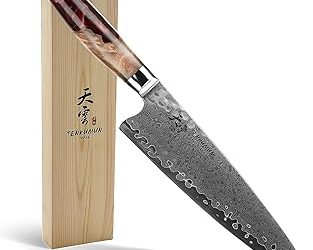
The best Damascus steel knife sets in 2026 are defined by what’s underneath the wavy pattern: a hard, thin core steel (VG-10, VG-MAX, SG2, or AUS-10V) at 60–62 HRC, clad in softer stainless layers that protect against chipping and corrosion — not by how dramatic the pattern looks, which is mostly cosmetic etching.
What “Damascus” Actually Means on a Modern Kitchen Knife
Almost every Damascus kitchen knife sold today is not pattern-welded in the historical sense. The construction is a laminate: a single hard core steel does the cutting, and 30–70 alternating layers of softer stainless are forge-welded on each side as cladding. The visible pattern comes from grinding and acid-etching those layers. That means two sets with identical “67-layer” marketing can perform completely differently depending on the core.
The practical rules:
- Core steel is the spec that matters. VG-10 (~61 HRC) is the standard; VG-MAX and SG2/R2 (~62–64 HRC) hold an edge longer but chip more easily; AUS-10V (~60 HRC) is slightly tougher and cheaper.
- Layer count is marketing. Whether a knife is 33, 45, 67, or 101 layers changes appearance, not sharpness. The cladding’s real jobs are stain resistance and a small amount of lateral toughness.
- Edge angle beats hardness numbers. Japanese Damascus sets are typically ground to 12–16° per side, which feels sharper but demands cutting-board discipline — no bones, no frozen food, no twisting cuts.
How the Leading Sets Compare on Paper
| Set | Core Steel | Layers | Hardness (HRC) | Edge Angle | Chef’s Knife Weight | Typical Price Range |
|---|---|---|---|---|---|---|
| Shun Classic 7-pc block set | VG-MAX | 34 per side | ~61 | 16°/side | ~210 g | $650–800 |
| Miyabi Kaizen II 7-pc | FC61 (fine carbide) | 49 per side | ~61 | 9.5–12°/side | ~195 g | $550–700 |
| Dalstrong Shogun Series X 5-pc | AUS-10V | 66 layers total | 62+ | 8–12°/side | ~225 g | $350–450 |
| Yoshihiro VG-10 Damascus (individual/3-pc) | VG-10 | 16 per side | 60–61 | Double bevel, ~15° | ~165–185 g | $150–200/knife |
| Zwilling Kanren 7-pc | FC61 | 48 per side | ~61 | 9.5–12°/side | ~200 g | $600–750 |
| Generic “67-layer VG-10” import sets | Often unspecified or 9Cr18MoV | 67 claimed | Varies (56–60) | Varies | 180–240 g | $80–200 |
Two things jump out. First, most premium Japanese Damascus sets cluster at 60–62 HRC — the differences in edge life between VG-10, VG-MAX, and FC61 are smaller than the differences in sharpening quality out of the box. Second, the budget tier often substitutes 9Cr18MoV (a softer Chinese stainless around 56–59 HRC) for true VG-10; it still takes a decent edge but needs honing roughly twice as often.
Best Picks by Situation
Best overall for most home cooks: Shun Classic
The VG-MAX core adds vanadium and tungsten over standard VG-10 for modestly better edge retention, and the D-shaped pakkawood handle suits right-handed cooks (lefties should look at the symmetrical Premier handles or other brands). The 7-piece block typically covers an 8″ chef’s, 9″ bread, 6″ utility, 3.5″ paring, shears, honing steel, and block — the four knives you’ll actually use plus honest storage.
Best edge geometry: Miyabi Kaizen II
Miyabi’s Honbazuke finishing gives a 9.5–12° per-side edge, the sharpest factory grind in this category. Thin behind the edge, it glides through vegetables, but that thinness means it chips more readily if your cutting habits are rough. Pick this if precision cutting is the point.
Best value under $500: Dalstrong Shogun X
AUS-10V at a stated 62+ HRC, G10 handles that tolerate humidity and dish-sink splashes better than wood, and a heavier, more Western-feeling balance. Fit and finish don’t match Shun or Miyabi, and the aggressive etched pattern polarizes buyers, but performance per dollar is strong.
Best for buying one knife at a time: Yoshihiro VG-10 Damascus gyuto
A wa-handled (octagonal magnolia) gyuto around 210mm runs $150–200, lighter than any Western-handled equivalent. Building a set piece by piece — chef’s knife first, petty second, bread knife third — is cheaper than a block set and gets you a better knife than any sub-$500 bundle.
Skip if you’re rough on knives
If your household puts knives in the dishwasher, cuts on glass or granite boards, or hacks through squash stems, no Damascus set will survive well. Softer German steel (Wüsthof, Zwilling Pro, ~56–58 HRC) rolls rather than chips and tolerates abuse. This is the honest counterpoint to buying hard steel.
Decision Matrix
| Your situation | Best fit | Why |
|---|---|---|
| First serious knife set, budget ~$600 | Shun Classic or Miyabi Kaizen II | Proven cores, real warranty support, block storage included |
| Budget under $400 | Dalstrong Shogun X 5-pc, or one Yoshihiro gyuto + a cheap paring knife | One great blade beats five mediocre ones |
| Cooks daily, sharpens on stones already | SG2/R2 options (e.g., Miyabi Artisan line) | Harder steel rewards sharpening skill with longer edge life |
| Never sharpened a knife, wants low effort | AUS-10V or VG-10 at 60–61 HRC | Easier to restore on a pull-through or 1000-grit stone than 64 HRC SG2 |
| Left-handed | Symmetrical handles + double-bevel blades (Miyabi, Dalstrong, Yoshihiro wa) | Avoid D-shaped handles designed for right hands |
| Humid kitchen / no climate control | G10 or pakkawood handles, stainless cladding | Natural magnolia wa-handles can swell; store dry |
Handle Ergonomics: The Spec Nobody Reads
Handle shape changes how a knife behaves more than any blade stat. Wa-handles (octagonal or D-shaped Japanese wood) shift balance toward the blade — ideal for push-cutting vegetables. Western full-tang handles (pakkawood, G10) balance at the bolster and suit rock-chopping. Rough benchmarks: an 8″ Damascus gyuto should weigh 160–220g; heavier than 240g and thin-core steel is wasted weight. If you have smaller hands, check for a handle circumference under ~80mm — oversized oval handles cause grip fatigue faster than any weight issue.
Ownership Realities: Maintenance and What Wears First
- Never the dishwasher. Heat and detergent degrade handles and bang the edge against racks. This is the single most common way these sets die early.
- Boards matter. End-grain wood or soft plastic only. Glass, bamboo (harder than expected), and ceramic boards will chip a 61 HRC edge within weeks.
- Hone weekly, sharpen rarely. A ceramic honing rod weekly maintains the edge; actual sharpening on a 1000/6000 stone should be needed only every 6–12 months for home use. Electric sharpeners remove steel aggressively and will wear down the thin core prematurely.
- What wears first: the etching. The Damascus pattern fades with sharpening and polishing over years — cosmetic only. Handle scales loosening is the second most common issue, usually fixable with a drop of epoxy.
- Watch the core exposure. On some budget knives, heavy sharpening past the cladding leaves less than 1mm of core at the edge — a sign to stop aggressive grinding.
A Quick Cost-Per-Use Reality Check
A $700 Shun Classic set used daily for 15 years, with $40/year in stones and occasional professional sharpening, costs roughly $0.17 per cooking day. A $150 generic set that dulls quickly, gets replaced twice in the same span, and adds sharpening service costs lands near $0.12/day — the gap is real but far smaller than the sticker difference suggests. Buy premium because it cuts better and holds geometry, not because it saves money.
FAQ
Is real pattern-welded Damascus worth paying more for?
For kitchen use, no. Hand-forged pattern-welded blades (e.g., from artisan smiths) are collector items; laminated factory Damascus performs identically or better at a fraction of the price.
How many knives does a set actually need?
Four: an 8″ chef’s or gyuto, a 4–5″ petty/paring, a bread knife, and optionally a 6–7″ santoku or utility. Sets padded with steak knives, kitchen shears, and a sharpening steel of dubious quality often cost more for knives you’ll never draw.
VG-10 vs. SG2 — does the upgrade matter?
SG2 (~63–64 HRC) holds an edge roughly 30–50% longer but is more brittle and harder to sharpen. If you sharpen on whetstones and want maximum edge life, it’s worth it. Otherwise VG-10-family steels are the sweet spot.