Key takeaways
- For one or two people: A 4–5-quart set saves cabinet space and heats a smaller quantity of water efficiently. It is less forgiving if you want to prepare couscous for guests or steam vegetables alongside it.
- For regular family meals: A 6–8-quart stainless-steel set is the balanced choice. It has room for a generous batch without the storage demands and weight of a large banquet-size pot.
- For large gatherings: Choose a 10–12-quart set if your burner can support its base and you have room to store it. A wide, stable base is especially important when the pot is full of water.
- For an induction cooktop: The lower pot must have a magnetic, induction-compatible base. Stainless steel is not automatically induction-compatible, so check the manufacturer’s specification or use a magnet on the bottom. The upper basket does not need to be magnetic.
- For a gas or electric coil stove: Most stainless-steel and aluminum sets are suitable, but the burner should not extend far beyond the pot’s base. Excess flame can discolor the sides and heat handles.
- For a smooth glass-ceramic cooktop: Favor a flat, stable base and lift rather than slide the pot to help avoid scratches. A very large set may be awkward on a small cooking zone.
The best couscoussier for traditional couscous is a two-piece pot with a snug-fitting steamer basket, enough room for the grain to expand, and perforations that release steam evenly without letting couscous fall through. For most homes, a 6–8-quart stainless-steel model is the practical choice; larger households or frequent entertaining call for 10–12 quarts, while a smaller 4–5-quart set suits compact kitchens and modest batches.
A couscoussier’s name matters less than how its parts work together. The lower pot must hold a steady simmer, the upper basket needs holes fine enough for your grain, and the basket should sit securely without leaving a large gap around the rim. Check those details before choosing by capacity or price.
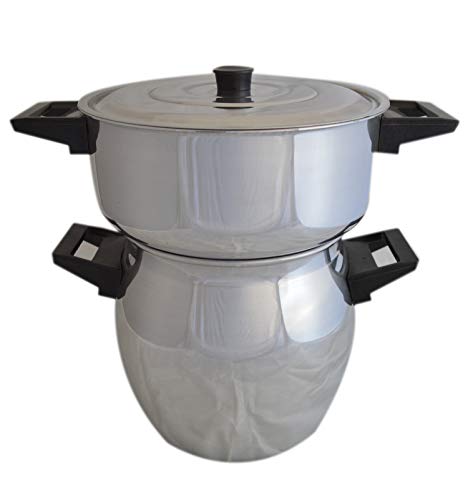
Couscoussier 6 Liter Moroccan Steamer Pot Imported from Morocco Couscous Cooker Pot
Included for 'Best Couscoussiers for Traditional Couscous' as a relevant option in this category; details come from the product listing.
View on Amazon
Baumalu 342646 Couscous Maker 11 L 26 cm Stainless Steel Silver
Included for 'Best Couscoussiers for Traditional Couscous' as a relevant option in this category; details come from the product listing.
View on AmazonCompare capacities and construction
Capacities below are useful shopping ranges, not standardized measurements. Brands may quote the lower pot’s volume, the steamer’s volume, or both, so confirm what a product’s stated capacity refers to. Basket dimensions and the manufacturer’s intended serving range are more useful than a single quart number.
| Approximate lower-pot capacity | Typical batch size | Best suited to | Common construction | Approximate empty weight |
|---|---|---|---|---|
| 4–5 qt | About 1–1.5 lb dry couscous | One or two people, limited storage | Stainless steel or aluminum | 3–5 lb |
| 6–8 qt | About 2–3 lb dry couscous | Most households and small gatherings | Stainless steel, sometimes with a bonded base | 5–8 lb |
| 10–12 qt | About 3–5 lb dry couscous | Large families, entertaining, batch cooking | Stainless steel or aluminum | 7–12 lb |
Batch estimates assume the grain is steamed loosely rather than packed down; actual capacity varies with basket shape and the amount of headroom. Traditional couscous expands during steaming, so leaving space to lift, separate, and return the grains is more important than filling the basket to its rim. When comparing two sets, look for basket depth and usable width—not just the lower pot’s headline capacity.
Choose by household and cooking setup
- For one or two people: A 4–5-quart set saves cabinet space and heats a smaller quantity of water efficiently. It is less forgiving if you want to prepare couscous for guests or steam vegetables alongside it.
- For regular family meals: A 6–8-quart stainless-steel set is the balanced choice. It has room for a generous batch without the storage demands and weight of a large banquet-size pot.
- For large gatherings: Choose a 10–12-quart set if your burner can support its base and you have room to store it. A wide, stable base is especially important when the pot is full of water.
- For an induction cooktop: The lower pot must have a magnetic, induction-compatible base. Stainless steel is not automatically induction-compatible, so check the manufacturer’s specification or use a magnet on the bottom. The upper basket does not need to be magnetic.
- For a gas or electric coil stove: Most stainless-steel and aluminum sets are suitable, but the burner should not extend far beyond the pot’s base. Excess flame can discolor the sides and heat handles.
- For a smooth glass-ceramic cooktop: Favor a flat, stable base and lift rather than slide the pot to help avoid scratches. A very large set may be awkward on a small cooking zone.
What separates a good steamer basket from a frustrating one?
Perforation size and distribution
Holes should pass steam readily while retaining the couscous used in your cooking. There is no universal hole-size standard, and retailers do not always publish perforation dimensions. If a listing or manufacturer provides them, compare the openings with your dry grain; if not, request a clear close-up or check the return policy. Very large or widely spaced holes can let smaller grains drop into the pot. Sparse holes may slow the movement of steam, especially when the basket is filled deeply.
Look for perforations spread across the basket floor rather than concentrated in a small center area. Avoid a design with a handful of large openings if you plan to steam fine-grain couscous directly. Some cooks use a thin, clean cloth or a fine insert as a barrier, but this adds another item to wash and can obstruct steam if it is packed too tightly.
Fit between the pot and basket
The basket should sit level, remain stable when lifted, and overlap the lower pot enough to limit steam escaping around the sides. A little looseness is normal; a conspicuous gap wastes heat and can make steaming uneven. A basket that wedges tightly into the pot can be difficult to remove when hot, so a secure rim or collar is preferable to a friction fit.
Before buying, compare the lower pot’s opening diameter with the basket’s seating diameter. A set sold as one unit should be designed to fit, but replacement baskets and mix-and-match pieces are not reliably interchangeable. Similar stated diameters can conceal differences in rim shape, taper, and seating depth.
Materials, upkeep, and ownership costs
Stainless steel resists rust and is relatively easy to maintain. A bonded or encapsulated base can distribute heat more evenly than a thin single-layer base, particularly on electric and induction cooktops. The trade-off is weight, and food can scorch in the lower pot if water boils away.
Aluminum is lighter and often less expensive, and it heats quickly. It may dent more readily, and some finishes can discolor or react with strongly acidic ingredients. Check whether the manufacturer specifies dishwasher use; handwashing is a safer default when the finish or handles are uncertain.
With either material, the parts that tend to cause trouble are usually the ones users can check before purchase: loose handles, a warped base, a poorly seated basket, or an overfilled basket that catches on the rim. After cooking, cool the pot before washing, clear grain from the perforations, and dry the set thoroughly before storing it. Avoid forcing food out of holes with a sharp metal tool, which can scratch the surface or deform thin perforations.
A useful value check is to divide the set’s purchase price by the number of times you expect to use it each year over five years. For example, a $100 set used twice monthly works out to about $0.83 per use over five years: $100 ÷ (24 uses × 5 years). This is only a planning estimate, but it shows why a well-fitting, easy-to-store set can be a better buy than a larger model that rarely leaves the cupboard.
Buying decision at a glance
| Your situation | What to prioritize | Best fit |
|---|---|---|
| New to steaming couscous | Secure basket fit, straightforward cleaning, moderate capacity | 6–8 qt stainless-steel set |
| Small kitchen or occasional use | Compact footprint, low storage weight | 4–5 qt set; choose stainless or aluminum based on cooktop |
| Frequent family cooking | Durable handles, even-heating base, room to fluff grain | 6–8 qt set with a substantial base |
| Large groups or batch cooking | Deep basket, wide stable base, burner fit | 10–12 qt set, provided storage and cooktop allow |
| Induction cooking | Verified magnetic lower-pot base | Induction-compatible stainless-steel set |
How to check the setup before the first batch
- Assemble the pot and basket empty. Confirm the basket sits level and does not wobble or leave a large side gap.
- Check the basket’s working depth. Leave enough room for the grains to expand and for you to lift and separate them during cooking.
- Test with water before steaming. Add water to the lower pot without letting it touch the basket bottom. Bring it to a simmer and check that steam rises through the basket rather than escaping mainly around the rim.
- Keep the simmer steady. A rolling boil can send water droplets into the couscous and evaporate the pot dry faster. Recheck the water level during long steaming sessions.
- Clean and dry after use. Remove trapped grains from the holes and dry the pot and basket completely to reduce residue and water marks.
For most cooks, the best couscoussier for traditional couscous is a mid-size stainless-steel set with a flat, cooktop-compatible base and a basket that fits securely. Choose smaller when storage and occasional cooking matter most; go larger only if you regularly make big batches and can match the pot’s footprint to your burner. The basket’s holes and the pot-to-basket fit deserve at least as much attention as the capacity printed on the box.