Key takeaways
- Preheat the oven fully instead of relying on the dish to warm with it.
- Dry meat and vegetables before oiling; surface moisture causes steaming.
- Keep vegetables in one layer, with a little space between pieces.
- Use the largest baker that fits the portion without making the food look sparse.
- For chicken skin or cheese toppings, uncover the dish near the end of cooking.
- Expect ceramic to add a few minutes to some recipes compared with a thin metal pan, and check internal doneness rather than relying only on the printed time.
The best ceramic baker for oven roasting for most family meals is a 4- to 4.5-quart rectangular stoneware dish with thick walls, broad handles, and a usable interior of about 13 by 9 inches; among established options, the Emile Henry Large Rectangular Baker is the strongest all-purpose pick, while a smaller 3-quart dish suits couples and a covered baker is better for moist roasts and make-ahead cooking.
Quick picks by cooking situation
| Situation | Best format | Recommended capacity | Why it fits |
|---|---|---|---|
| Family of four to six | Large rectangular stoneware baker | 4 to 4.5 qt | Room for a chicken, vegetables, or a full casserole without crowding |
| Two people or limited oven space | Medium rectangular baker | 2.5 to 3 qt | Easier storage and faster heating for smaller portions |
| Covered braises and moist roasts | Covered ceramic baker | 3.5 to 4.5 qt | Retains steam and reduces the need for foil |
| Frequent high-heat roasting | Thick stoneware with generous handles | 4 qt or larger | Better heat retention and safer lifting when full |
What matters more than the advertised capacity
Manufacturers usually quote the dish’s total volume, measured nearly to the rim. A 4-quart baker may hold 16 cups in theory, but roasting works better when food occupies roughly two-thirds to three-quarters of that space. That leaves room for hot juices, bubbling sauces, and air circulation.

MALACASA Casserole Dishes for Oven with Roasting Racks, Ceramic Baking Dishes Set of 3, Baking Pan Casserole Dish Set, Rectangular Lasagna Pan Deep with Handles for Baking, Khaki White (14.5''/13''/10.5''), Series TARA
Included for 'Best Ceramic Baker for Oven Roasting: Durable Picks for Family Meals' because the listing specifies Ceramic Baking Dishes Set of 3 and Baking Pan Casserole Dish Set, details this guide uses to compare options.
View on Amazon
LOVECASA 4.5 Quart Ceramic Casserole Dish with Lid – Oven, Microwave & Dishwasher Safe Bakeware for Family Meals, Lasagna, Roasting, Rectangular Stoneware 9x13 Baking Pan, Gradient Red
Included for 'Best Ceramic Baker for Oven Roasting: Durable Picks for Family Meals' because the listing specifies Oven and Microwave & Dishwasher Safe Bakeware for Family Meals, details this guide uses to compare options.
View on Amazon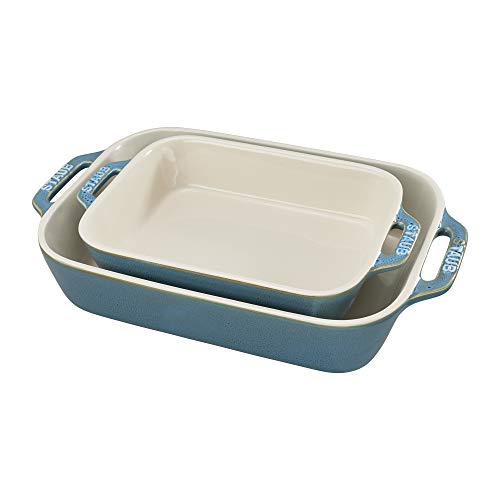
Staub 2-Pc Ceramic Baking Dish Set, Oven Safe Up To 570°F, Turquoise
Included for 'Best Ceramic Baker for Oven Roasting: Durable Picks for Family Meals' because the listing specifies Oven Safe Up To 570°F and Turquoise, details this guide uses to compare options.
View on Amazon
LE TAUCI Ceramic Casserole Dishes for Oven with 304 Racks, Set of 3, White
Included for 'Best Ceramic Baker for Oven Roasting: Durable Picks for Family Meals' because the listing specifies Set of 3 and White, details this guide uses to compare options.
View on AmazonFor a family roast, compare the usable floor area rather than quarts alone. An interior measuring approximately 13 by 9 inches gives 117 square inches of cooking surface. A narrower dish with the same capacity may be deeper, which is useful for lasagna but less effective for browning potatoes or spreading vegetables into a single layer.
Wall thickness also affects cooking. Thick ceramic heats more slowly than thin metal but holds heat longer and moderates temperature changes. This is helpful for casseroles, gratins, and chicken pieces. The trade-off is slower preheating and a heavier dish, particularly when filled with food and liquid.
Head-to-head: the leading ceramic baker formats
Emile Henry Large Rectangular Baker
This French stoneware baker is the best all-around choice when even cooking, attractive serving, and long-term durability matter more than the lowest price. Its large rectangular format is designed for family casseroles, roasted vegetables, baked pasta, and poultry pieces. The thick ceramic walls retain heat well, while the glazed surface releases baked-on food more readily than unglazed clay.
Its handles are integrated into the body rather than attached separately, so there are fewer joints to loosen or trap residue. The handles are broad enough for oven mitts, although the dish becomes substantially heavier when filled. Emile Henry’s ceramic cookware is made for oven use and is commonly rated for high temperatures; follow the current care instructions because thermal limits can vary by product line.
Choose it when you cook large meals at least a few times each month and want a baker that can move from oven to table. Its main disadvantages are weight, storage space, and a typical premium-market price of roughly $70 to $120 depending on size and finish.
Le Creuset Heritage Rectangular Dish
The Le Creuset Heritage range is a good alternative for cooks who prioritize sturdy handles and coordinated serving ware. Its glazed stoneware interior is suitable for roasting and baking, and the rectangular profile provides a useful balance between casserole depth and surface area.
Compared with a shallow metal roasting pan, it generally gives less aggressive browning because ceramic warms more gradually. That is not a defect: it helps prevent delicate sauces from scorching, but it means you should avoid overcrowding and give vegetables space. The wide side handles are particularly useful for older cooks or anyone who prefers a more secure grip.
These dishes occupy a similar premium price range, commonly about $60 to $110. Select one if handle comfort, brand support, and table presentation are more important than maximizing the lowest possible weight.
Staub ceramic rectangular baker
Staub’s ceramic baking dishes are aimed at cooks who want substantial stoneware with a refined finish. Depending on the model and market, sizes range from compact individual bakers to larger family formats. The deeper versions work well for gratins, baked rice, and saucy chicken dishes, while a broad shallow model is preferable for browning.
Check the exact dimensions before purchasing: “rectangular baker” does not always mean a large roasting footprint. A dish that is technically 3 quarts may have only enough surface area for two to four servings. Staub ceramic pieces are usually positioned in the premium range, often approximately $50 to $100.
Covered ceramic baker
A covered ceramic baker is the practical choice for pot roasts, stuffed cabbage, baked beans, and meals that need gentle, moist heat. The lid reduces evaporation and protects food during reheating. However, the cover reduces available oven height and adds weight, so measure the distance between your oven rack and the upper heating element.
For crisp skin or browned cheese, remove the lid for the final 15 to 25 minutes. Ceramic still will not brown as quickly as aluminum, but a dry surface, moderate oil, and sufficient spacing make a noticeable difference.
Comparison of useful specifications
| Baker type | Typical exterior size | Usable capacity | Typical wall thickness | Best use |
|---|---|---|---|---|
| Compact ceramic baker | 10–12 by 7–8 in | 2–2.5 qt | 6–9 mm | Two servings, side dishes, small gratins |
| Medium rectangular baker | 12–14 by 8–9 in | 2.5–3.5 qt | 7–10 mm | Small families and everyday casseroles |
| Large family baker | 14–16 by 9–11 in | 4–4.5 qt | 8–12 mm | Four to six servings and larger roasts |
| Covered ceramic baker | 13–16 by 8–11 in | 3.5–4.5 qt | 8–12 mm | Braises, moist roasts, make-ahead meals |
These are useful buying ranges rather than universal specifications. Exact measurements vary, and exterior dimensions include handles and rim thickness. Always check the manufacturer’s interior dimensions if oven fit or browning area is critical.
Thermal shock: the durability issue owners notice first
Ceramic is durable in normal oven use but vulnerable to sudden temperature changes. Do not transfer a refrigerator-cold baker directly into a fully heated oven unless the manufacturer specifically permits it. Do not place a hot dish on a wet countertop, directly on stone, or under cold running water. Use a dry trivet and let the baker cool gradually.
Thermal-shock resistance is influenced by the clay body, firing process, glaze, and design—not simply by thickness. A very thick dish can retain heat beautifully yet still crack if exposed to abrupt temperature changes. Small glaze marks may be cosmetic, but a crack through the body is a reason to stop using the dish, especially for liquid-heavy recipes.
How to get better browning from ceramic
- Preheat the oven fully instead of relying on the dish to warm with it.
- Dry meat and vegetables before oiling; surface moisture causes steaming.
- Keep vegetables in one layer, with a little space between pieces.
- Use the largest baker that fits the portion without making the food look sparse.
- For chicken skin or cheese toppings, uncover the dish near the end of cooking.
- Expect ceramic to add a few minutes to some recipes compared with a thin metal pan, and check internal doneness rather than relying only on the printed time.
One useful sizing calculation is to estimate 1 cup of finished food per adult for a main casserole, plus about 25 percent extra for expansion, sauce, and serving flexibility. Six adult portions therefore need approximately 7.5 cups of practical space—about 1.9 quarts—before accounting for the floor area needed to brown ingredients. In practice, a 3- to 4-quart baker is more comfortable than a dish filled to its rim.
Cleanup and long-term ownership
Glazed ceramic is usually simple to clean once it has cooled. Soak stuck food in warm water, then use a nonabrasive sponge or soft nylon brush. Baking soda paste can help with browned residue. Avoid plunging a hot dish into water, and check whether the specific baker is dishwasher-safe before using a heated or aggressive cycle.
The first parts to show wear are often the glaze around the rim, the underside from rack contact, and the handles’ edges where they meet the body. Metal utensils can leave gray marks or scratches, especially on decorative finishes. Silicone, wood, or nylon tools preserve the glaze better. Do not use a ceramic baker on a stovetop unless it is explicitly designed for that purpose; most oven stoneware is not a direct-heat pan.
At $80 and 40 uses per year for five years, a $80 baker costs about $0.40 per use before considering energy and food. That calculation favors a durable dish only if its size matches your routine. A premium large baker that stays in a cupboard because it is too heavy is poorer value than a less expensive medium model used weekly.
Final buying recommendation
Choose the Emile Henry Large Rectangular Baker if you want the best balance of usable capacity, heat retention, integrated handles, and family-meal versatility. Choose a Le Creuset Heritage Rectangular Dish when handle security and coordinated table presentation lead your priorities. Choose a Staub ceramic baker when you prefer a substantial premium dish but can confirm that its interior floor area suits your portions. For couples, smaller households, or limited storage, skip the oversized family model and buy a 2.5- to 3-quart baker that will be used often.