Our Top Picks
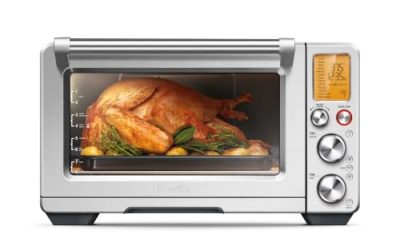
 Panasonic HomeChef 7-in-1 Compact Oven with Convection BakeCompact15.9 x 15.9 x 14.8 inches27 poundsCheck on Amazon
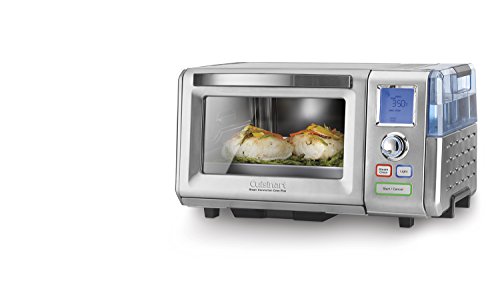
 Cuisinart CSO-300 Combo Steam/Convection OvenNO SIZE18 x 15.5 x 10.75 inches22 poundsCheck on Amazon

Bread baking in a home oven fails most often on steam. A loaf needs a burst of humidity in the first minutes so the crust stays soft enough to expand, then dry heat to brown and crisp. A steam assisted countertop oven adds that humidity on demand, and a removable water tank makes the whole routine practical: you fill it at the sink, slide it in, and empty it after baking without moving the oven. The real decision is how the oven controls steam and heat together, because a tank you cannot reach or a steam burst you cannot time will not help a loaf.
This guide is for home bakers who bake bread weekly, for cooks moving from a Dutch oven method to a steam oven, and for anyone whose built-in oven cannot hold steam. The five ovens below were chosen from their Amazon titles and listed specifications, comparing tank design, steam control, capacity, and browning power, so you can match an oven to the bread you actually bake.
Quick Picks
As an Amazon Associate we earn from qualifying purchases.
| Product | Best for | Key spec from title |
|---|---|---|
| Anova Precision Oven | Precise steam and temperature control | 1.2 cu ft, 1800 watts, food probe |
| Cuisinart CSO-300N1 | Steam and convection in one box | 1800 watts, 0.6 cu ft, 9 functions |
| Panasonic HomeChef NU-SC180B | Small kitchen, many functions | 1200 watts, 0.7 cu ft, 7-in-1 |
| Tovala Smart Oven Pro | Hands-off baking with an app | 6-in-1 with steam, smartphone control |
| Cuisinart CSO-300 | A simpler steam and convection oven | 1800 watts, 0.6 cu ft, steam |
How to Choose
Removable Water Tank Design
The tank is the part you touch every bake, so its design matters more than the brochure suggests. A tank that slides out from the front or side fills at the sink in seconds, while a tank buried behind a panel means pulling the oven forward each time. Check the tank capacity too: a small tank may run dry during a long bake, and refilling mid-bake lets steam escape. A tank you can remove with one hand and see the water level through is the practical choice. Empty the tank after each session, since standing water leaves mineral deposits that clog the steam system over time.
Steam Control and Humidity Range
Not every steam oven gives you the same control. Some ovens offer a fixed steam burst, which works for a basic loaf but not for a bake that needs high humidity early and dry heat later. An oven with adjustable humidity, or at least separate steam and convection stages, lets you match the bake: heavy steam for oven spring, then dry heat for a crisp crust. A food probe helps here as well, since it tells you the crumb temperature without opening the door and losing steam. Look for a temperature range that reaches at least 450 degrees Fahrenheit, since bread needs that heat for a deep brown crust.
Capacity and Loaf Size
Capacity decides what you can bake, not just how much. A 0.6 cubic foot oven fits a single loaf pan or a small baking tray, which suits a baker who makes one loaf at a time. A 1.2 cubic foot oven takes a larger tray or a turkey-sized roast, which suits a baker who bakes two loaves side by side or uses the oven for roasting too. Measure the interior height as well as the width, since a tall loaf needs clearance to rise. If the oven also serves as your second oven for roasting, the larger size earns its counter space.
Browning and Convection Power
Steam alone makes bread pale. The oven needs strong convection and enough wattage to drive off surface moisture after the steam stage, so the crust turns golden and crisp. A 1200 watt oven can do this for a single loaf, while an 1800 watt oven holds temperature better when the door opens or a cold tray goes in. Look for a convection fan that runs during the bake, not only during air frying, and for a broil element that can finish the top. A glass door helps you watch the crust color without opening the oven and losing heat.
The 5 Best Options
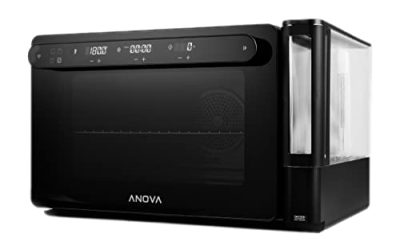
Anova Precision Oven
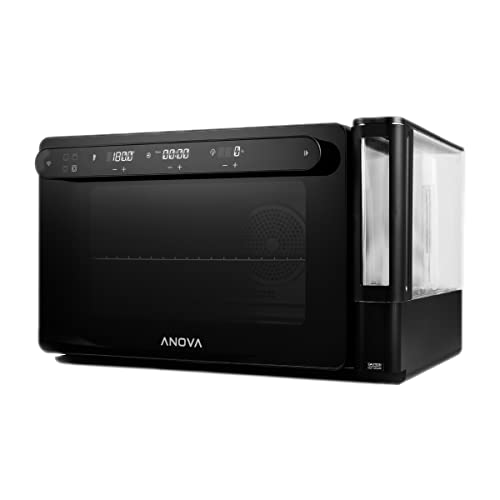
The Anova Precision Oven gives a bread baker the most control over steam in this group. Its 1.2 cubic foot interior holds a full baking tray, and the water tank feeds steam at humidity levels from zero to 100 percent, so you can set a wet stage for oven spring and a dry stage for browning. The temperature range runs from 77 to 482 degrees Fahrenheit, and a food probe reports the crumb temperature without opening the door. App control lets you program a bake in stages, which suits a baker who repeats the same loaf every week and wants the same result each time.
- Specs:
- 1.2 cu ft capacity, 1800 watts
- Humidity control from 0 to 100 percent
- Temperature range 77 to 482 degrees Fahrenheit
- Removable water tank, food probe
- App control, convection, steam, bake, broil, roast, dehydrate
- Fits an 11 to 12 lb turkey
- Best for: a baker who wants exact steam and temperature control for every loaf
- Watch out for: the 59 lb weight makes it a permanent countertop fixture, not a portable one
Cuisinart CSO-300N1
The Cuisinart CSO-300N1 pairs steam with convection in a compact 0.6 cubic foot box. Nine functions cover steam, convection bake, broil, and more, and the removable water reservoir slides out for filling at the sink. A steam clean mode helps with maintenance after baking, since flour dust and steam residue build up inside any steam oven. The LCD display keeps the settings visible, and the 1800 watt element holds temperature well for a single loaf. This is the oven for a baker who wants steam and convection together without giving up a large stretch of counter.
- Specs:
- 1800 watts, 0.6 cu ft capacity
- 9 functions including steam and convection bake
- Removable water reservoir
- Steam clean mode, LCD display
- Best for: a compact countertop that needs steam and convection in one oven
- Watch out for: the 0.6 cu ft interior fits one loaf at a time, not a double batch
Panasonic HomeChef NU-SC180B
The Panasonic HomeChef NU-SC180B is the versatile pick for a small kitchen. Seven functions cover convection bake, air frying, steam, slow cooking, and fermenting, and the ferment mode is a genuine bonus for bread: dough proofs in a warm, humid chamber instead of on a cold counter. The 0.7 cubic foot interior is a step up from the smallest steam ovens, and the 1200 watt element is enough for a single loaf. An Easy Clean interior wipes down quickly after a bake, which matters when flour and steam leave a film on the walls.
- Specs:
- 1200 watts, 0.7 cu ft capacity
- 7-in-1: convection bake, airfryer, steam, slow cook, ferment
- Easy Clean interior
- Model NU-SC180B
- Best for: a baker who also wants a proofing chamber and an air fryer in one box
- Watch out for: 1200 watts recovers temperature more slowly than 1800 watt ovens when the door opens
Tovala Smart Oven Pro
The Tovala Smart Oven Pro is built for the baker who wants the oven to handle the timing. Six functions cover steam, toast, air fry, bake, broil, and reheat, and smartphone control lets you start and monitor a bake from another room. Scan-to-cook reads a code and sets the time and temperature for you, which suits a baker who follows recipes on a phone. Steam works alongside the other modes, so a loaf gets humidity at the start and dry heat at the end without manual changes. The compact size fits a counter that already holds a coffee maker and a toaster.
- Specs:
- 6-in-1: steam, toast, air fry, bake, broil, reheat
- Smartphone control, scan-to-cook
- Steam and convection modes
- Best for: a baker who wants app control and automated timing
- Watch out for: the compact interior suits one loaf, not a large baking tray
Cuisinart CSO-300
The Cuisinart CSO-300 is the earlier generation of the CSO-300N1, and it covers the same core job: steam plus convection in a 0.6 cubic foot oven. The 1800 watt element and removable water reservoir match the newer model, and the steam mode gives a loaf the humidity it needs for oven spring before the convection stage browns the crust. As an older listing it is often the simpler buy, with fewer modes and a more direct control panel. Choose it when you want steam and convection for bread and do not need the newer model’s extra functions.
- Specs:
- 1800 watts, 0.6 cu ft capacity
- Steam and convection modes
- Removable water reservoir
- Best for: a straightforward steam and convection oven for one loaf at a time
- Watch out for: it is the older generation, so check that the listing matches the features you need
Which One Fits Your Situation
You Bake the Same Loaf Every Week
Choose the Anova Precision Oven. Programmable stages and a food probe let you repeat the same bake with the same steam and temperature every time, and the large interior takes a full baking tray. Once you dial in a recipe, the oven reproduces it, which is the point of a weekly bake. The weight and size are the trade-off, so give it a permanent spot on the counter.
Your Kitchen Is Small
Pick the Panasonic HomeChef or the Tovala Smart Oven Pro. Both fit a tight counter, and the Panasonic adds a ferment mode that doubles as a proofing box, which saves a separate step. The Tovala adds app control for a baker who works from a phone. Either one handles a single loaf well, and both leave room on the counter for the rest of your kitchen.
You Want Steam and Convection Without a Big Footprint
The Cuisinart CSO-300N1 or the CSO-300 is the right call. Both pack steam and convection into a 0.6 cubic foot box with a removable water reservoir, and the 1800 watt element holds temperature for a single loaf. Pick the CSO-300N1 for the extra functions and steam clean mode, or the CSO-300 for a simpler panel and the same core steam performance.
You Bake Two Loaves at Once
Only the Anova has the interior space for a double batch here. Its 1.2 cubic foot cavity takes a larger tray or two loaf pans side by side, and the steam system covers the whole cavity. The smaller ovens in this group bake one loaf at a time, so a double batch means two rounds and twice the time. If your household eats a loaf every two days, the larger oven pays for itself in saved sessions.
Common Mistakes
- Filling the water tank with tap water in a hard water area and letting mineral scale clog the steam system.
- Leaving water in the tank between bakes, which breeds deposits and odors inside the oven.
- Opening the door during the steam stage to check the loaf, which lets the humidity escape and flattens the oven spring.
- Baking at too low a temperature, so the crust stays pale even after the steam stage ends.
- Choosing an oven too small for the loaf pan, then discovering the dough rises into the heating element.
Frequently Asked Questions
Does a steam oven really improve bread?
Yes, steam keeps the crust soft during the first minutes of baking, which lets the loaf expand fully before the crust sets. That expansion is called oven spring, and it gives bread a lighter crumb and a taller shape. After the steam stage, dry heat browns the crust. A steam oven automates what bakers used to do with a tray of water in a conventional oven.
How often should I empty the water tank?
Empty it after every baking session. Standing water leaves mineral deposits that clog the steam system, and it can develop an odor over time. Refill with fresh water before each bake, and use filtered water if your tap water is hard, since that slows scale buildup inside the tank and the steam lines.
Can I proof dough in a steam oven?
Some steam ovens have a ferment mode, like the Panasonic HomeChef, which holds dough at a warm temperature with humidity. That combination proofs dough faster and more evenly than a cold kitchen counter. If your oven has no ferment mode, a low temperature steam setting can work, but watch the dough closely so it does not overproof.
What size steam oven do I need for bread baking?
A 0.6 cubic foot oven fits one loaf pan and suits a baker who makes one loaf. A 0.7 cubic foot oven adds room for a larger pan. A 1.2 cubic foot oven takes two loaf pans or a full tray, which suits a household that bakes in batches. Match the interior to your usual loaf size, and measure the height so a tall loaf can rise.
FAQ
Does a steam oven really improve bread?
How often should I empty the water tank?
Can I proof dough in a steam oven?
What size steam oven do I need for bread baking?
More from Amazon
Programs that pair well with the guide above. Offers and eligibility are set by Amazon and may change.
Set up recurring deliveries of everyday items on eligible products. Terms and savings are set by Amazon.
Explore Subscribe & SaveCollect the home and kitchen items you want in one registry that guests can shop from.
Create a wedding registryFree shipping on eligible items, Prime Video and more. Eligible new members can start with a free trial.
Start a Prime free trialAudiobooks and podcasts to listen to on the go. Eligible new members can start with a free trial.
Try Audible freeAs an Amazon Associate we earn from qualifying purchases.