Key takeaways
- 800R to 1000R: best for immersive gaming, especially on 34-inch or larger ultrawides; less natural for shared viewing and some precision office tasks.
- 1500R: a versatile middle ground for gaming, work, and media.
- 1800R to 1900R: a gentler curve that suits productivity and users who frequently show content to someone beside them.
The best curved monitors for work and gaming depend less on having the largest screen and more on matching the curve, resolution, refresh rate, and desk depth to how you actually sit and use your workspace.
Best curved monitors by situation
| Best for | Recommended type or model | Key specifications | Why it fits |
|---|---|---|---|
| Mixed office work and gaming | Dell UltraSharp U3425WE | 34 inches, 3440 × 1440, 120Hz, 1900R, IPS Black | Comfortable width, sharp text, USB-C docking, and a moderate curve |
| Competitive PC gaming | Samsung Odyssey G6 32-inch | 32 inches, 2560 × 1440, up to 240Hz, 1000R | Fast motion and a strong curve without requiring an exceptionally wide desk |
| Immersive single-player gaming | LG UltraGear 45GR95QE-B | 45 inches, 3440 × 1440, 240Hz, 800R, OLED | Very wide field of view, excellent contrast, and an enveloping gaming position |
| Productivity with multiple windows | Samsung ViewFinity S65UA | 34 inches, 3440 × 1440, 100Hz, 1000R, USB-C | Useful ultrawide workspace and a relatively accessible office-oriented feature set |
| Large-format gaming and simulation | Samsung Odyssey OLED G9 | 49 inches, 5120 × 1440, up to 240Hz, 1800R, OLED | Replaces two 27-inch displays while retaining a continuous center area |
These are starting points rather than universal winners. A 49-inch display can be spectacular for a racing simulator and awkward for spreadsheets if your desk is only 24 inches deep. Similarly, a 240Hz gaming monitor adds little value if your computer normally renders at 80 frames per second.

Samsung 32" Odyssey (G55C) Series QHD 1000R Curved Gaming Monitor,
Included for 'Best Curved Monitors for Work and Gaming' as a relevant option in this category; details come from the product listing.
View on Amazon
Sceptre Curved 24-inch Gaming Monitor 1080p R1500 98% sRGB HDMI x2 VGA Build-in Speakers, VESA Wall Mount Machine Black (C248W-1920RN Series)
Included for 'Best Curved Monitors for Work and Gaming' because the listing specifies VESA Wall Mount Machine Black (C248W-1920RN Series), details this guide uses to compare options.
View on Amazon
SANSUI 32 Inch Curved 240Hz Gaming Monitor High Refresh Rate, FHD 1080P
Included for 'Best Curved Monitors for Work and Gaming' because the listing specifies FHD 1080P, details this guide uses to compare options.
View on Amazon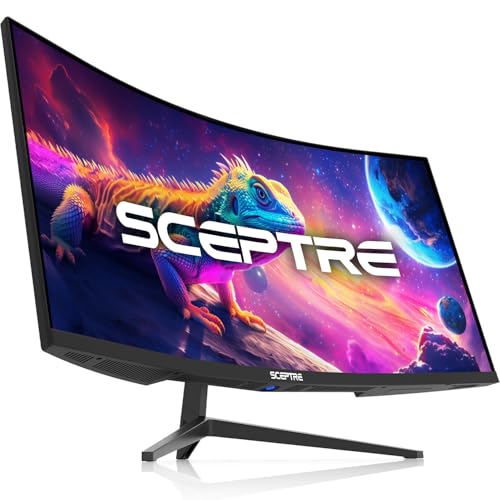
Sceptre 34-Inch Curved Ultrawide WQHD Monitor, 3440 x 1440, R1500, Up to 180Hz/165Hz, DisplayPort x2, 100% sRGB, 1ms, Built-in Speakers, Black (C345B-QUT168 Series)
Included for 'Best Curved Monitors for Work and Gaming' because the listing specifies 3440 x 1440 and R1500, details this guide uses to compare options.
View on AmazonChoose the screen size before the refresh rate
27 to 32 inches: the easiest fit
A curved 27-inch monitor is usually a sensible choice for a compact desk, but curves are more noticeable and useful on larger panels. At 32 inches, a 16:9 display gives you more vertical room for documents while remaining easy to position. A 32-inch 1440p monitor typically needs around 70 to 90 centimeters of viewing distance for comfortable full-screen use.
For gaming, 1440p at 165Hz or 240Hz is a strong balance. It is substantially easier for a midrange graphics card to drive than 4K, while looking sharper than 1080p at this size. A 1000R curve is immersive, but it may feel excessive if you spend most of the day reading straight lines or working in detailed design software.
34 to 38 inches: the productivity sweet spot
Ultrawide monitors in the 34-inch class commonly use a 21:9 aspect ratio and 3440 × 1440 resolution. They provide enough horizontal space for two large windows without the bezel between two monitors. A 38-inch 3840 × 1600 model offers more vertical pixels, but it is also more expensive and needs a wider desk.
For office work, a 1500R to 1900R curve is generally easier to live with than an extremely tight curve. It reduces the distance to the edges without making text and spreadsheets appear dramatically bent. USB-C power delivery, a built-in KVM switch, and height adjustment can matter more to daily convenience than an extra 20Hz of refresh rate.
45 to 49 inches: buy for immersion or replacement of two monitors
A 49-inch 32:9 display is effectively two 27-inch 16:9 monitors placed side by side. The continuous panel is excellent for timeline editing, simulation games, and wide spreadsheets, but the center of the screen is still the natural viewing position. You may turn your head frequently to read content at either edge.
Large 45-inch OLED ultrawides are even more immersive, often using an 800R curve. They work best when you sit centrally and have a desk at least 80 centimeters deep. Before buying, measure the monitor stand as well as the panel: the stand can consume considerable front-to-back space.
Curvature: what 1000R, 1500R, and 1800R mean
The “R” figure describes the radius of the curve in millimeters. A 1000R monitor follows a tighter circle than a 1800R monitor. Lower numbers bring the edges closer to your eyes, while higher numbers look flatter.
- 800R to 1000R: best for immersive gaming, especially on 34-inch or larger ultrawides; less natural for shared viewing and some precision office tasks.
- 1500R: a versatile middle ground for gaming, work, and media.
- 1800R to 1900R: a gentler curve that suits productivity and users who frequently show content to someone beside them.
Curvature does not enlarge the usable resolution. It changes viewing geometry. If you sit too close, a tight curve can feel visually aggressive; if you sit too far away, the benefit largely disappears.
Resolution and refresh rate: match them to your computer
Resolution determines workspace and image detail, while refresh rate determines how often the screen can update. A 3440 × 1440 monitor contains about 34% more pixels than a 2560 × 1440 monitor, so it needs more graphics performance at the same game settings. A 5120 × 1440 ultrawide has almost twice the pixels of 2560 × 1440.
| Use | Practical target | What to prioritize |
|---|---|---|
| Documents, coding, and general office work | 3440 × 1440 at 100–120Hz | Text clarity, USB-C, height adjustment, and low-glare coating |
| Fast competitive games | 2560 × 1440 at 165–240Hz | Response consistency, adaptive sync, and a graphics card capable of high frame rates |
| Story-driven games and creative work | 3440 × 1440 or 3840 × 1600 at 144–240Hz | Contrast, HDR behavior, color coverage, and immersion |
| 49-inch ultrawide gaming | 5120 × 1440 at 120–240Hz | DisplayPort bandwidth, GPU performance, and desk width |
Do not select a 240Hz monitor solely because the number is higher. If your game produces 90 to 120 frames per second, a 120Hz or 144Hz display may deliver most of the practical benefit at a lower cost. Adaptive-sync support is valuable because it helps the display follow variable frame rates and reduces tearing.
Desk depth and ergonomic fit
Measure from the rear edge of the desk to the front edge, then account for the stand. A useful rule is to leave roughly 10 to 15 centimeters behind the monitor for cables and another 60 to 90 centimeters between your eyes and the screen, depending on size and curve.
For example, suppose a 34-inch monitor and stand extend 25 centimeters from the rear of the desk. On a 70-centimeter-deep desk, the front edge of the screen may sit around 45 centimeters away before you add your keyboard. That is close for some people, especially with an 800R or 1000R display. A monitor arm can reclaim desk space, but confirm that the arm supports the monitor’s weight and VESA pattern.
- Keep the top of the screen roughly at eye level or slightly below.
- Place the center of the display directly in front of your chair.
- Use the height adjustment before tilting the panel upward.
- For a 49-inch monitor, sit centrally rather than aligning one side with your chair.
- Check that the stand does not block your keyboard, speakers, or desk drawer.
Panel type and ownership realities
IPS panels generally provide consistent viewing angles and clear text, making them dependable for office work. VA panels often deliver stronger native contrast, although dark transitions can vary by model. OLED panels provide exceptional per-pixel contrast and fast response, but they require more thoughtful ownership.
OLED users should enable the monitor’s panel-care features, use screen timeout, and avoid leaving a static taskbar, spreadsheet, or browser window displayed for many hours every day. These measures reduce risk but cannot guarantee that image retention will never occur. An IPS or VA monitor is the less complicated choice for a workstation that displays static content continuously.
Curved screens also need careful cleaning. Turn the monitor off, use a clean microfiber cloth, and lightly dampen the cloth with water if necessary. Do not spray liquid directly onto the panel or press hard near the edges. Dust tends to collect along the lower bezel and stand hinge, while glossy OLED surfaces show fingerprints more readily.
A practical buying decision
- Small desk, mixed use: choose a 27- or 32-inch 1440p model with a moderate 1500R–1800R curve.
- One monitor for work and games: choose a 34-inch 3440 × 1440 display at 100Hz or higher, preferably with USB-C.
- Competitive gaming: choose 27 or 32 inches, 1440p, and 165–240Hz rather than paying for a huge ultrawide.
- Immersive games and movies: choose a 34- or 45-inch ultrawide with a tighter curve and strong contrast.
- Replacing two monitors: choose a 49-inch 32:9 model, but verify desk width, graphics output, and window-management software.
- Long daily static workloads: favor IPS or VA unless OLED’s contrast and motion performance justify the extra care.
Final recommendation
For most people seeking one of the best curved monitors for both work and gaming, a 34-inch 3440 × 1440 model running at 100–165Hz is the safest all-round choice. Choose a gentler 1500R–1900R curve for productivity, a tighter 800R–1000R curve for immersion, and a 49-inch display only when your desk and workflow genuinely benefit from two wide screens in one panel.