Key takeaways
- Hold the bowl rather than twisting the stem when loosening stuck residue.
- Do not pour boiling water into a cold coupe or ice-cold water into a warm one.
- Inspect the rim before serving; a tiny chip can become a sharp edge.
- Store glasses upright if dust is a concern, but avoid stacking unless the manufacturer specifically designs them to stack.
- Dry stems by supporting the bowl and base separately rather than twisting the glass with a towel inside it.
The best coupe cocktail glasses for most home bars are 7–8 oz (207–237 ml) glasses with a 4–5 inch (10–13 cm) stem, a moderately wide rim, a reinforced foot, and dishwasher-safe construction; choose a smaller 5–6 oz coupe for Champagne-based drinks and a 9–10 oz bowl when you want generous Manhattans or garnish-heavy cocktails.
Best coupe cocktail glasses by drinking situation
| Situation | Best specification | Why it works | Typical market range |
|---|---|---|---|
| Everyday Manhattans and sours | 7–8 oz bowl, 4–5 inch stem, 2.5–3 inch rim | Balances cocktail volume, aroma, and stability | $5–$12 per glass |
| Champagne-based cocktails | 5–6 oz bowl, narrow-to-medium rim, thin or medium glass | Leaves room for sparkling wine without making the drink look undersized | $7–$18 per glass |
| Large stirred cocktails or generous garnishes | 9–10 oz bowl, broad rim, sturdy stem | Accommodates ice dilution, large citrus twists, or foam | $8–$25 per glass |
| Small cabinets or frequent entertaining | Stackable or compact 6–7 oz design, dishwasher-safe glass | Uses less storage space and simplifies cleanup | $4–$10 per glass |
| Formal table setting | 7–8 oz crystal or lead-free crystalline glass, thin rim | Provides a lighter lip feel and more refined appearance | $12–$35 per glass |
What separates a good coupe from a frustrating one?
Bowl capacity: measure usable volume, not the brim
A coupe’s stated capacity is normally its maximum volume, filled almost to the edge. A properly served cocktail occupies less space. A useful rule is to fill a coupe to roughly 70–80% of its stated capacity so the drink can be carried without spilling.

True Coupe Glass, Martini Glasses for Cocktail Party, Perfect for Espresso Martini, Manhattan, Champagne, Elegant 7 oz Glassware for Home Bars, Wedding Gifts, Margarita Glasses Set of 4
Included for 'Best Coupe Cocktail Glasses for Stylish Drinks' because the listing specifies Martini Glasses for Cocktail Party and Perfect for Espresso Martini, details this guide uses to compare options.
View on Amazon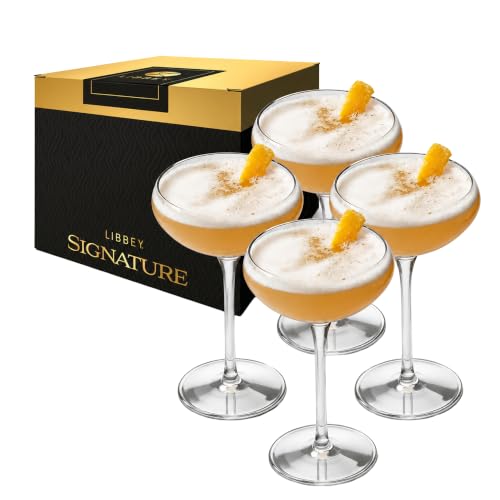
Libbey Signature Kentfield Coupe Cocktail Glasses Set of 4, Classic Tall Stemmed Glass Cup, Champagne Coupe Glasses Gift Set for Weddings, Birthdays
Included for 'Best Coupe Cocktail Glasses for Stylish Drinks' because the listing specifies Classic Tall Stemmed Glass Cup and Champagne Coupe Glasses Gift Set for Weddings, details this guide uses to compare options.
View on Amazon
GIHOP Nick and Nora Cocktail Glasses, Small Coupe Martini Glasses Set of 4
Included for 'Best Coupe Cocktail Glasses for Stylish Drinks' because the listing specifies Small Coupe Martini Glasses Set of 4, details this guide uses to compare options.
View on Amazon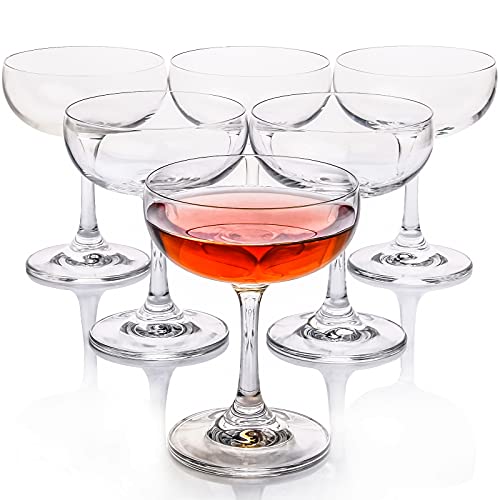
FAWLES Crystal Coupe Glasses, Set of 6, 7 Ounce(220ml), Elegant Short Stem Design, Clear Cocktail Glasses Sets Perfect for Drinking Champagne, Sweet Wine, etc.
Included for 'Best Coupe Cocktail Glasses for Stylish Drinks' because the listing specifies Set of 6 and 7 Ounce(220ml), details this guide uses to compare options.
View on AmazonFor example, a 7 oz coupe has a practical serving capacity of about 5–5.5 oz. That suits a Manhattan made with 2 oz of whiskey, 1 oz of vermouth, bitters, and dilution from stirring. A 5 oz glass has only about 3.5–4 oz of comfortable working capacity, making it better for a shorter Champagne cocktail or a modest aperitif.
Large 9–10 oz coupes are not automatically better. They can make a standard 3.5–4 oz cocktail look sparse, and a broad surface lets the drink warm more quickly. Choose extra capacity only if you regularly serve larger portions or cocktails with foam, fruit, or an oversized garnish.
Stem height and stability
A taller stem keeps warm hands farther from the bowl and gives the glass a classic silhouette. A stem around 4–5 inches is a practical middle ground. Stems above 5 inches look elegant but create more leverage if the glass is bumped, particularly when paired with a wide bowl.
Stability depends on the entire base, not stem length alone. Look for a foot approximately 2.5–3.25 inches across, with enough weight to counterbalance the bowl. A narrow, lightweight foot is more likely to tip when a guest places a cocktail pick or citrus twist into the drink.
For crowded dinner tables, a slightly shorter stem and heavier foot are usually preferable to a delicate, tall design. For a dedicated home bar, a longer stem can be worthwhile because it improves hand placement and presentation.
Rim shape and drinking comfort
The rim has a noticeable effect on both aroma and perceived quality. A thin, smoothly finished rim directs the drink cleanly to the lips and makes delicate cocktails feel less heavy. A rolled or reinforced rim is more resistant to chips and is a sensible choice for frequent dishwasher use, although it may feel less refined.
A wide rim, around 3 inches or more, releases aroma effectively and leaves room for a large garnish. It also increases evaporation and spill risk. A medium rim of approximately 2.5–2.75 inches is more versatile for Manhattans, Cosmopolitans, Daiquiris, and sparkling-wine cocktails.
A sharply flared bowl can be attractive but is less forgiving when walking with a full drink. If you often serve guests who are new to stemware, choose a gently curved bowl with a moderate opening.
Glass thickness and material
Thin glass provides a lighter lip feel and usually looks more polished, but the rim and stem demand careful handling. Medium-thickness soda-lime glass is the practical choice for most households: affordable, reasonably clear, and more tolerant of knocks.
Lead-free crystalline glass, used by brands such as Schott Zwiesel, Riedel, and Spiegelau in selected ranges, can offer high clarity with a lighter feel. It is not indestructible, however; the stem and rim remain the parts most likely to fail.
Traditional soda-lime options from brands such as Libbey and Bormioli Rocco are often the better value for parties or everyday use. Cocktail Kingdom’s professional-style glassware is another option when a classic bar profile matters more than compact storage. Check the exact range before buying, because dishwasher guidance and dimensions vary by collection.
Head-to-head: the main coupe styles
Classic 7–8 oz coupe
This is the strongest all-rounder. It gives a Manhattan enough visual presence without requiring an oversized pour, and it handles shaken sours, Daiquiris, and most vermouth-forward drinks comfortably. Choose one with a medium-width rim and a foot at least 2.75 inches wide.
Small 5–6 oz coupe
The small coupe is ideal for Champagne-based drinks such as a French 75, where sparkling wine needs room to rise without overflowing. Its reduced bowl also helps preserve a neat ratio between the base spirit, citrus, sugar, and bubbles. It is less suitable for cocktails served over a large amount of dilution or a substantial garnish.
Large 9–10 oz coupe
A large coupe works for dessert cocktails, foamy drinks, and generous serves, but it demands more storage and careful pouring. It can also expose more liquid to room-temperature air. Unless your recipes regularly exceed 5 oz before serving, the additional capacity is mostly decorative.
Nick & Nora-style glass
A Nick & Nora glass has a smaller, more enclosed bowl and is often easier to hold and carry than a broad coupe. It is a strong choice for neat stirred drinks and compact bar cabinets. It does not provide the same open aroma or visual space for large garnishes, so it is a complement to—not always a replacement for—a coupe.
Dishwasher safety and long-term ownership
“Dishwasher safe” means the glass can generally tolerate a household dishwasher, not that every cycle is equally gentle. Put coupes on the upper rack when the manufacturer permits it, keep them separated from metal utensils, and use a lower-temperature or glassware cycle. Never force a bowl into a rack position where the stem is under pressure.
Hand washing is still the lowest-risk method for very thin rims, etched designs, gold decoration, and tall delicate stems. Rinse cocktails containing sugar, dairy, or egg soon after use; dried residue encourages scrubbing, and scrubbing is more likely to damage a rim than normal washing.
- Hold the bowl rather than twisting the stem when loosening stuck residue.
- Do not pour boiling water into a cold coupe or ice-cold water into a warm one.
- Inspect the rim before serving; a tiny chip can become a sharp edge.
- Store glasses upright if dust is a concern, but avoid stacking unless the manufacturer specifically designs them to stack.
- Dry stems by supporting the bowl and base separately rather than twisting the glass with a towel inside it.
How many glasses should you buy?
For occasional use, four matching coupes are usually enough. If you serve cocktails to six or more people, six glasses reduce the need to wash during the gathering. A simple cost-per-use calculation explains why a durable mid-range set can be sensible: four $8 glasses cost $32. Used once a month for three years, the set provides 144 uses, or about $0.22 per glass-use before breakage. The same set used weekly for three years costs about $0.05 per use.
If storage is limited, prioritize four 7–8 oz coupes over buying separate small and large versions. If Champagne cocktails are your main interest, choose six 5–6 oz glasses instead; matching capacity improves portion control and makes a set look intentional.
Final buying recommendation
For the broadest cocktail range, select 7–8 oz coupes with a medium rim, a 4–5 inch stem, a stable foot, and medium-thickness dishwasher-safe glass. Choose 5–6 oz glasses for Champagne-led drinks and smaller servings, or 9–10 oz coupes only when your recipes need extra room. Prioritize a smooth rim and a well-balanced base over an especially thin bowl: those are the features you notice every time you drink, while the first chip or tip-over is what determines whether the glasses remain enjoyable to own.