Key takeaways
- Use a line and knot system rated above the lure-and-sonar load, and inspect the connection before every session.
- Never cast directly into shallow rocks if the unit can land on a hard bottom.
- Rinse the housing with fresh water after saltwater use, especially around charging contacts and threaded attachment points.
- Dry the unit before charging; do not seal a wet sonar in a bag.
- Check for hairline cracks, loose eyelets and water inside the housing before trusting it on a long cast.
- Keep the sonar away from the boat propeller and avoid wrapping the tow line around anchors or trolling-motor hardware.
The best castable fish finders for most anglers are the Deeper CHIRP+ 2 for maximum casting range, depth and mapping, while the Garmin STRIKER Cast GPS is the simpler choice for casual shore fishing and small boats. The right purchase depends less on the headline “fish finder” label than on five practical limits: how far you can cast, how deep you fish, whether you need GPS maps, how reliable the app is, how long the battery lasts, and how well the sonar unit survives repeated impacts.
Best castable fish finders at a glance
| Model | Best use | Maximum casting range | Maximum depth | Battery claim | Notable features |
|---|---|---|---|---|---|
| Deeper CHIRP+ 2 | Serious shore anglers and small boats | Approximately 394 ft / 120 m | Approximately 330 ft / 100 m | Up to about 15 hours | CHIRP sonar, GPS bathymetric mapping, three beam frequencies |
| Deeper PRO+ 2 | Mapping waters on a moderate budget | Approximately 394 ft / 120 m | Approximately 330 ft / 100 m | Up to about 9 hours | GPS mapping, dual-beam sonar, Wi-Fi connection |
| Garmin STRIKER Cast GPS | Easy shore fishing and basic boat use | Approximately 200 ft / 60 m | Approximately 150 ft / 45 m | Up to about 10 hours | GPS-enabled Quickdraw contour mapping, simple app interface |
| Garmin STRIKER Cast | Budget-conscious anglers fishing familiar water | Approximately 200 ft / 60 m | Approximately 150 ft / 45 m | Up to about 10 hours | Basic sonar without the GPS mapping version |
These are manufacturer-published or commonly specified maximum figures, not guaranteed fishing performance. Casting distance depends on tackle, wind, line diameter and the weight of the sonar. Depth readings can also vary with water clarity, bottom composition, boat movement and the selected sonar frequency.

Garmin Striker Cast, Castable Sonar with GPS, Pair with Mobile Device and Cast from Anywhere, Reel in to Locate and Display Fish on Smartphone or Tablet (010-02246-02)
Included for 'Best Castable Fish Finders for Shore and Boat Use' because the listing specifies Castable Sonar with GPS and Pair with Mobile Device and Cast from Anywhere, details this guide uses to compare options.
View on Amazon
Deeper Start Fish Finder - Portable and Depth Finder for Recreational Fishing from Dock, Shore, Bank or Kayak | Castable Deeper Smart Sonar with Free User Friendly App
Included for 'Best Castable Fish Finders for Shore and Boat Use' because the listing specifies Portable and Depth Finder for Recreational Fishing from Dock and Shore, details this guide uses to compare options.
View on Amazon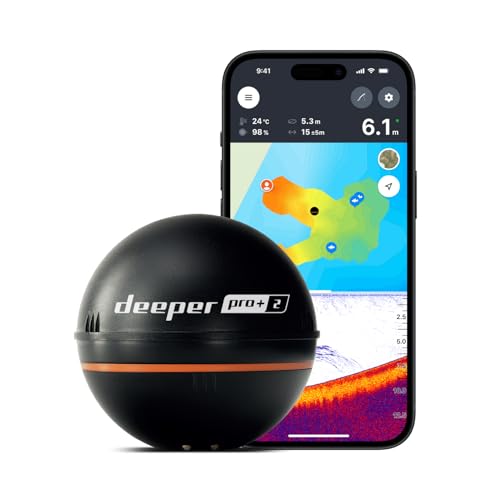
Deeper PRO+ 2 Sonar Fish Finder - Portable Fish Finder and Depth Finder For Kayaks, Boats and Ice Fishing with GPS Enabled | Castable Deeper Fish Finder with FREE User Friendly App
Included for 'Best Castable Fish Finders for Shore and Boat Use' because the listing specifies Portable Fish Finder and Depth Finder For Kayaks and Boats and Ice Fishing with GPS Enabled, details this guide uses to compare options.
View on AmazonOur picks by fishing situation
Best overall: Deeper CHIRP+ 2
The CHIRP+ 2 is the strongest all-round choice when you want one castable unit for banks, piers, kayaks and small boats. Its CHIRP system sends a broader range of frequencies than a basic single-frequency sonar, helping it separate targets and display bottom detail more clearly. The three beam settings are useful in different situations: a narrow beam concentrates on deeper water, a wider beam covers more area, and the middle setting offers a practical compromise.
Its GPS mapping is particularly valuable from shore. You can cast a grid across a lake or reservoir, record depth points and build a contour map instead of relying only on the sonar screen at that moment. That makes the unit more useful on future trips. The trade-offs are a higher price, a somewhat more involved app and greater dependence on keeping the phone connection stable during long casts.
Best for mapping on a lower budget: Deeper PRO+ 2
The PRO+ 2 is a good fit for anglers who care about casting range and bathymetric maps but do not need the CHIRP+ 2’s more refined target separation. Its GPS is built into the sonar unit, so mapping can work while the device is being cast from shore. It is also suitable for a small boat when you want portable depth information without permanently installing a display and transducer.
Choose it when the main goal is locating drop-offs, channels and depth changes. Choose the CHIRP+ 2 instead if you regularly fish deeper water, need better separation around structure or want more control over the sonar presentation.
Best simple option: Garmin STRIKER Cast GPS
The STRIKER Cast GPS is easier to recommend to beginners who want a quick answer to “how deep is it here?” rather than a full mapping project. The Garmin app is relatively direct, and the GPS version can create Quickdraw contours as you move around a waterway. It is well suited to ponds, canals, sheltered reservoirs and small boats where a roughly 200-foot casting radius is enough.
Its smaller depth and range envelope is the important limitation. If you fish large reservoirs from a steep bank, a casting range of 200 feet may leave promising water out of reach. The non-GPS STRIKER Cast saves money if you only need sonar readings and do not intend to build maps.
Head-to-head: what matters more than the maximum range?
Casting range
Maximum wireless range is not the same as useful fishing range. A shore angler may cast 100 yards with heavy tackle, but a small sonar floating behind thin line can become difficult to control in wind. A practical setup often keeps the sonar within roughly 50 to 100 yards, leaving a margin for line angle, waves and phone connectivity.
Match the unit to your bank position. A compact pond rarely requires the Deeper’s full range. A broad reservoir, surf zone or large gravel pit makes additional range much more valuable.
Sonar depth and image quality
Advertised maximum depth is a detection limit, not a promise of a detailed fish arch at that depth. Wider beams cover more water but can make it harder to pinpoint a target. Narrower or higher-frequency beams generally provide more detail in shallower water, while lower-frequency settings are more useful for depth and coverage.
For most freshwater shore fishing, 150 feet of rated depth is already ample. The deeper-rated Deeper models make more sense for reservoirs, deep quarries, offshore edges and anglers who want extra operating margin.
GPS and mapping
GPS mapping is the feature that most clearly separates a toy-like depth checker from a useful long-term fishing tool. Mapping lets you compare a bank, cove or channel over several trips. It can reveal a submerged point that is invisible from the surface and help you repeat a productive cast.
Remember that a castable unit maps the places you actually sample. A few isolated casts do not create an accurate lake map. For useful contours, work in parallel lines and space your casts consistently. Mapping will also be less precise when wind pushes the sonar sideways between readings.
App usability and connection
Castable units typically connect to a phone through Wi-Fi rather than your home’s internet. That means the phone may temporarily lose its normal cellular or Wi-Fi data connection. Download app updates, maps and account information before leaving home, and disable battery-saving restrictions that may suspend the app.
A bright phone screen can be difficult to see in direct sunlight. A waterproof phone pouch, a high-visibility screen setting and a neck lanyard are practical accessories. On a small boat, mount the phone where spray cannot reach it while keeping the sonar line clear of the propeller.
Battery life
Battery figures are usually best-case estimates. Cold weather, frequent casting, high screen brightness and constant mapping reduce runtime. As a useful planning calculation, a four-hour session using a device rated for 10 hours consumes about 40 percent of its nominal capacity before accounting for cold or aging. Two consecutive sessions therefore justify carrying a power bank and charging cable.
Do not store the sonar fully discharged. Recharge it after use, then keep it in a cool, dry place. If the battery is sealed, eventual battery wear can mean replacing the entire unit rather than fitting a new cell.
Decision matrix for choosing the best castable fish finder
| Your situation | Best match | Why |
|---|---|---|
| First fish finder, small pond, occasional use | Garmin STRIKER Cast | Sufficient depth and a simple sonar workflow at the lower end of the market |
| Beginner who wants maps without a complicated setup | Garmin STRIKER Cast GPS | Accessible app and GPS contour mapping |
| Frequent bank angler covering large water | Deeper PRO+ 2 | Long range, deep rating and built-in GPS mapping |
| Experienced angler targeting deep or structured water | Deeper CHIRP+ 2 | CHIRP processing, multiple beams and the greatest overall capability |
| Small-boat owner with little storage | Garmin STRIKER Cast GPS or Deeper PRO+ 2 | Portable alternatives to a fixed console display and transducer |
Durability: what wears first
The transducer housing is exposed to more abuse than a permanently mounted unit. The common failure points are impact damage from rocks, stress at the tow eye, cracked thread fittings, water entering through damaged seals and corrosion on the charging contacts. A castable sonar can survive ordinary casting, but it should not be deliberately bounced off concrete, dragged across gravel or retrieved by whipping the rod.
- Use a line and knot system rated above the lure-and-sonar load, and inspect the connection before every session.
- Never cast directly into shallow rocks if the unit can land on a hard bottom.
- Rinse the housing with fresh water after saltwater use, especially around charging contacts and threaded attachment points.
- Dry the unit before charging; do not seal a wet sonar in a bag.
- Check for hairline cracks, loose eyelets and water inside the housing before trusting it on a long cast.
- Keep the sonar away from the boat propeller and avoid wrapping the tow line around anchors or trolling-motor hardware.
How to set one up for more reliable readings
- Charge both devices. The sonar and phone need separate power reserves; a full sonar battery does not help if the app phone shuts down.
- Pair in open air before casting. Confirm the app shows a depth reading while the unit is beside you.
- Start with a medium or wide beam. This gives a better picture of bottom shape while you locate a feature. Switch narrower for more precise work.
- Cast in a repeatable pattern. Record depth at several distances and angles rather than repeatedly casting to one spot.
- Interpret the bottom first. A sharp depth change, hard return or vegetation edge is usually more useful than chasing every isolated fish icon.
- Rinse, dry and recharge after fishing. This prevents salt and grit from becoming long-term problems.
Final buying advice
Buy the Garmin STRIKER Cast if you want an uncomplicated, compact sonar for moderate distances. Select the GPS version when creating maps matters. Choose the Deeper PRO+ 2 when range and mapping are central to your fishing, and step up to the Deeper CHIRP+ 2 when you want the best combination of depth, beam control, target detail and future usefulness.
Before purchasing, measure your real casting distance, estimate the deepest water you fish and decide whether you will actually build maps. Those three answers usually identify the best castable fish finder more accurately than the largest number printed on the box.